
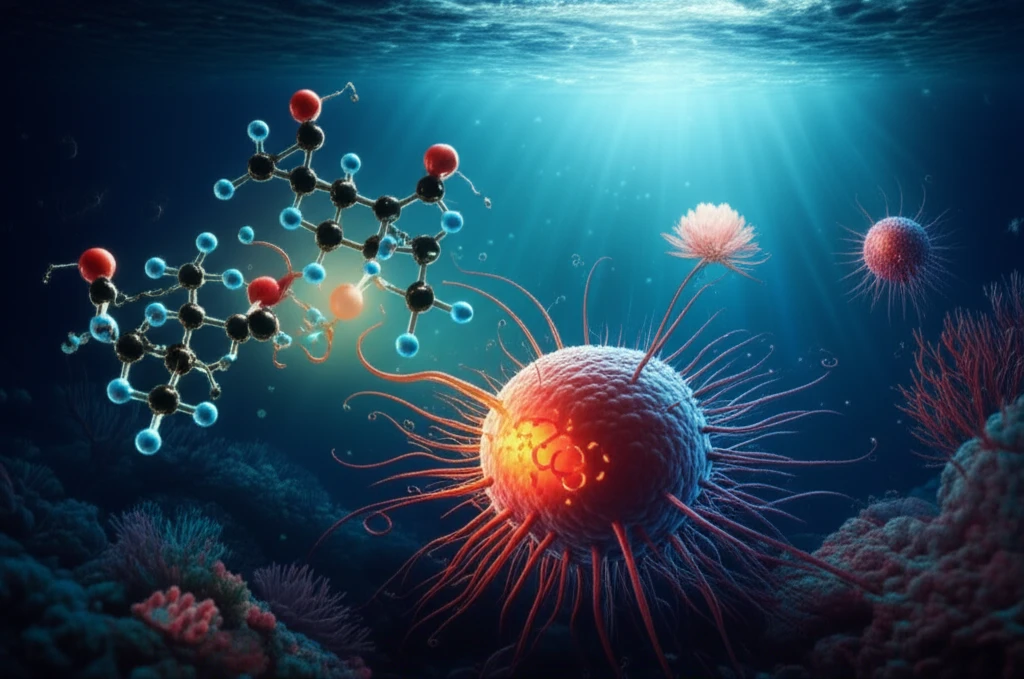
Microscopic view of Lasonolide A molecule interacting with a cancer cell.

Lasonolide A: Can This Sea Sponge Compound Revolutionize Cancer Treatment?

"Scientists achieve a breakthrough in synthesizing Lasonolide A, a potent anticancer compound found in marine sponges, paving the way for new treatment possibilities."


The ocean, a vast and largely unexplored realm, holds countless secrets and potential solutions for some of humanity's most pressing challenges. Among these is the quest for new and effective cancer treatments. Marine natural products, compounds derived from marine organisms, have long been a source of inspiration for drug discovery. One such compound is Lasonolide A, a complex molecule found in certain species of sea sponges.

Lasonolide A has garnered significant attention in the scientific community due to its promising anticancer activities. It exhibits a unique mechanism of action, potentially overcoming resistance to existing cancer drugs. However, its limited availability from natural sources has hindered extensive research and clinical development. Synthesizing this complex molecule in the laboratory has been a formidable challenge.

Recently, a team of researchers achieved a significant breakthrough in the synthesis of Lasonolide A. This achievement not only provides a more sustainable source of the compound for further studies but also opens doors for the development of new and improved cancer therapies. Let's explore the intricacies of this groundbreaking synthesis and its potential impact on the future of cancer treatment.

What Makes Lasonolide A a Promising Anticancer Agent?

Microscopic view of Lasonolide A molecule interacting with a cancer cell.

Lasonolide A stands out due to its unique mechanism of action (MOA), which differs from many conventional cancer drugs. This is crucial because cancer cells often develop resistance to existing treatments. Lasonolide A shows promise in treating multi-drug resistance cancer cell lines, making it a valuable candidate for further investigation.

The complex chemical structure of Lasonolide A has intrigued organic chemists for years. While several syntheses have been reported, a practical and efficient method for producing this compound in sufficient quantities for drug development has remained elusive.

  • Unique Mechanism of Action: Potential to overcome drug resistance in cancer cells.
  • Activity Against Pancreatic Cancer: Shows promise in treating a particularly aggressive form of cancer.
  • Complex Structure: Presents a significant challenge for chemical synthesis.
The newly developed synthesis addresses these challenges by providing a more efficient and scalable route to Lasonolide A. This breakthrough could enable researchers to explore its full potential and develop it into a viable cancer therapy.

The Future of Lasonolide A and Marine-Based Pharmaceuticals

The successful synthesis of Lasonolide A represents a major step forward in the field of marine-based pharmaceuticals. By overcoming the challenges of limited natural availability, scientists can now fully explore the therapeutic potential of this compound and its derivatives. This breakthrough could pave the way for new and more effective cancer treatments, offering hope to patients battling this devastating disease. Furthermore, it highlights the importance of continued research into the vast and untapped resources of the ocean, which may hold the key to solving some of humanity's most pressing health challenges.

About this Article -

This article was crafted using a human-AI hybrid and collaborative approach. AI assisted our team with initial drafting, research insights, identifying key questions, and image generation. Our human editors guided topic selection, defined the angle, structured the content, ensured factual accuracy and relevance, refined the tone, and conducted thorough editing to deliver helpful, high-quality information.See our About page for more information.

Everything You Need To Know

1

What makes Lasonolide A a promising candidate for cancer treatment?

Lasonolide A is promising because of its unique mechanism of action (MOA), which differs from many conventional cancer drugs. This is significant because cancer cells often develop resistance to existing treatments. Lasonolide A has shown promise in treating multi-drug resistant cancer cell lines. It also shows activity against pancreatic cancer, a particularly aggressive form of cancer, further highlighting its potential as a valuable candidate for cancer therapy investigation.

2

Why has it been so difficult to study and develop Lasonolide A as a cancer treatment?

The difficulty in studying and developing Lasonolide A stems from its limited availability from natural sources. Lasonolide A is a complex molecule found in certain species of sea sponges, and obtaining sufficient quantities for research and clinical trials has been a major obstacle. Synthesizing this complex molecule in the laboratory has been a formidable challenge, requiring innovative chemistry to overcome its structural intricacies. This is also due to its complex chemical structure which has intrigued organic chemists for years. While several syntheses have been reported, a practical and efficient method for producing this compound in sufficient quantities for drug development has remained elusive, hindering the exploration of its full therapeutic potential.

3

How does the recent breakthrough in synthesizing Lasonolide A impact cancer research and treatment development?

The recent breakthrough in synthesizing Lasonolide A has a significant impact on cancer research and treatment development. This achievement provides a more sustainable source of the compound for further studies, overcoming the limitations of relying on natural sources. With increased availability, researchers can now fully explore its therapeutic potential, investigate its mechanism of action in more detail, and develop it into a viable cancer therapy. This breakthrough opens doors for the development of new and improved cancer treatments, offering hope to patients battling this devastating disease.

4

What are marine natural products, and why are they important in drug discovery, particularly in the context of Lasonolide A?

Marine natural products are compounds derived from marine organisms, such as sea sponges, algae, and bacteria. These compounds are important in drug discovery because they often possess unique chemical structures and biological activities that are not found in terrestrial organisms. In the context of Lasonolide A, it exemplifies the potential of marine natural products as a source of inspiration for cancer treatments. It showcases a unique mechanism of action and promising anticancer activities that could lead to the development of new and more effective therapies.

5

What implications does the successful synthesis of Lasonolide A have for the future of marine-based pharmaceuticals and the exploration of the ocean's resources?

The successful synthesis of Lasonolide A represents a major step forward in the field of marine-based pharmaceuticals. By overcoming the challenges of limited natural availability, scientists can now fully explore the therapeutic potential of this compound and its derivatives. This breakthrough could pave the way for new and more effective cancer treatments, offering hope to patients battling this devastating disease. Furthermore, it highlights the importance of continued research into the vast and untapped resources of the ocean, which may hold the key to solving some of humanity's most pressing health challenges. It also reinforces the idea that the ocean's biodiversity can lead to innovative solutions in medicine, promoting further investigation and conservation efforts.

Newsletter Subscribe

Subscribe to get the latest articles and insights directly in your inbox.