
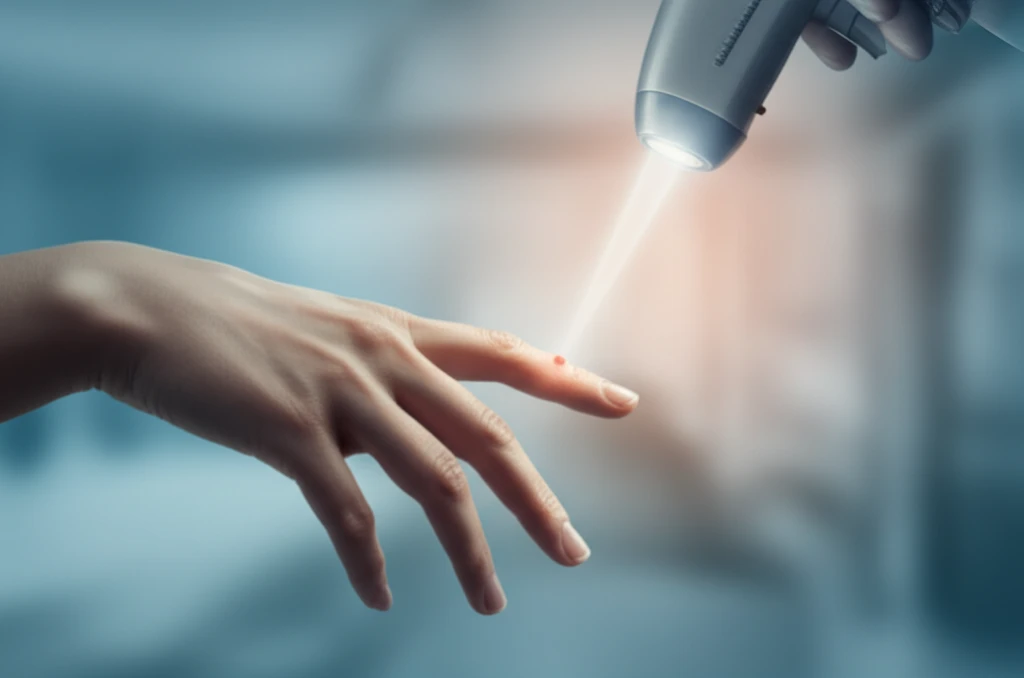
Nd-YAG laser treatment for pyogenic granuloma

Laser Away Pesky Skin Growths: Could Nd-YAG Be Your Answer?

"Discover how Nd-YAG laser treatment offers a safe and effective alternative for removing pyogenic granulomas on fingers and toes, especially when surgery isn't ideal."


Pyogenic granulomas (PGs) are common, non-cancerous skin growths that appear as small, raised bumps, often red or dark in color. While they can occur anywhere on the body, they're frequently found on the head, neck, hands, and feet. These lesions are typically characterized by rapid growth and a tendency to bleed easily, even with minor trauma.

When it comes to treating PGs, several options exist, ranging from surgical excision to cryotherapy and topical medications. Surgical removal is often considered the most effective, offering the lowest recurrence rates and allowing for a definitive diagnosis through biopsy. However, surgery can be challenging when lesions are located on the fingers and toes, particularly if they're close to the nails.

That's where laser treatment comes in. This article explores the use of the neodymium-yttrium aluminum garnet (Nd-YAG) laser as a safe and effective alternative for treating PGs on the fingers and toes. We'll delve into a recent study that investigated the clinical efficacy and safety of this approach, offering insights into how it works and what results you can expect.

Nd-YAG Laser: A Gentle but Effective Solution for PGs?

Nd-YAG laser treatment for pyogenic granuloma

The study evaluated twenty-one patients with PGs located on their fingers and toes. Each patient received multispot Nd-YAG laser treatments, with the laser targeting the lesions using a monopulse setting (pulse width 10.5–13.5 ms; energy 100–125 J/cm²). Treatments were spaced 3–4 weeks apart, allowing the skin to heal between sessions.

Here's what the study found:

  • High Success Rate: All lesions disappeared after just one or two laser treatments.
  • Minimal Scarring: There was no noticeable scar formation in any of the patients.
  • No Functional Impact: The treatment didn't affect the function of the fingers and toes.
  • No Nail Damage: There was no damage to nail growth.
  • Low Recurrence: No PGs returned during the 12-month follow-up period.
These results suggest that the Nd-YAG laser is a safe and effective option for treating PGs located on the fingers and toes, offering a non-invasive alternative to surgery with minimal side effects and a low risk of recurrence. In many cases, surgery on PGs located close to the nail can cause immense discomfort; however, this laser approach circumvents these issues.

The Future of PG Treatment: Is Laser Therapy Right for You?

The study's findings support the use of Nd-YAG laser as a promising treatment option for pyogenic granulomas, particularly in sensitive areas like the fingers and toes. Its non-invasive nature, minimal scarring, and low recurrence rates make it an attractive alternative to surgical excision.

Of course, it's essential to consult with a qualified dermatologist or medical professional to determine the best course of treatment for your specific situation. They can assess your lesion, discuss the potential benefits and risks of each option, and help you make an informed decision.

With ongoing advancements in laser technology, non-surgical treatments for skin conditions like pyogenic granulomas are becoming increasingly effective and accessible. The Nd-YAG laser represents a significant step forward, offering a gentle yet powerful solution for removing these pesky skin growths and restoring your skin's health and appearance.

About this Article -

This article was crafted using a human-AI hybrid and collaborative approach. AI assisted our team with initial drafting, research insights, identifying key questions, and image generation. Our human editors guided topic selection, defined the angle, structured the content, ensured factual accuracy and relevance, refined the tone, and conducted thorough editing to deliver helpful, high-quality information.See our About page for more information.

This article is based on research published under:

DOI-LINK: 10.1007/s10103-018-2577-7, Alternate LINK

Title: Efficacy Of Nd-Yag Laser For Treatment Of Pyogenic Granuloma On The Fingers And Toes

Subject: Dermatology

Journal: Lasers in Medical Science

Publisher: Springer Science and Business Media LLC

Authors: J. Dong, S. G. Peng, X. Y. Zhang, C. G. Tong, F. Liu, M. Cao, Y. H. Li, Y. L. He

Published: 2018-07-11

Everything You Need To Know

1

What exactly are pyogenic granulomas, and where do they typically appear on the body?

Pyogenic granulomas are non-cancerous skin growths that manifest as small, raised bumps, often exhibiting a red or dark coloration. They are characterized by their rapid growth and tendency to bleed easily, even from minor trauma. While they can appear anywhere on the body, they are frequently found on the head, neck, hands, and feet.

2

How does the Nd-YAG laser treatment work to remove pyogenic granulomas, and what parameters are used?

The Nd-YAG laser treatment is a minimally invasive method for removing pyogenic granulomas, particularly on fingers and toes. It works by targeting the lesions with a specific laser wavelength, effectively destroying the growth while minimizing damage to the surrounding tissue. The study used a monopulse setting with pulse width of 10.5–13.5 ms and energy of 100–125 J/cm².

3

What were the results of the Nd-YAG laser treatment study in terms of success rate, scarring, and recurrence?

The study showed the Nd-YAG laser treatment had a high success rate, with all lesions disappearing after one or two treatments. There was minimal to no scarring, no impact on the function of fingers and toes, and no damage to nail growth. Furthermore, there were no recurrences of pyogenic granulomas during the 12-month follow-up period.

4

Besides Nd-YAG laser treatment, what other options exist for removing pyogenic granulomas, and when might surgery be a better choice?

While the study focused on the effectiveness of Nd-YAG laser treatment for pyogenic granulomas, other treatment options exist. These include surgical excision, cryotherapy, and topical medications. Surgical removal is often preferred for its low recurrence rates and ability to provide a definitive diagnosis through biopsy, but may not be ideal for lesions located in sensitive areas like fingers and toes.

5

Beyond pyogenic granulomas, what are the potential future applications and implications of using Nd-YAG laser technology in treating other skin conditions?

The use of the Nd-YAG laser has implications for treating other skin conditions, especially those in sensitive areas where surgery might be problematic. While the study focused on pyogenic granulomas, the precision and minimal invasiveness of the Nd-YAG laser could potentially be applied to other benign skin lesions, vascular abnormalities, or cosmetic procedures. Further research would be needed to fully explore these applications.

Newsletter Subscribe

Subscribe to get the latest articles and insights directly in your inbox.