
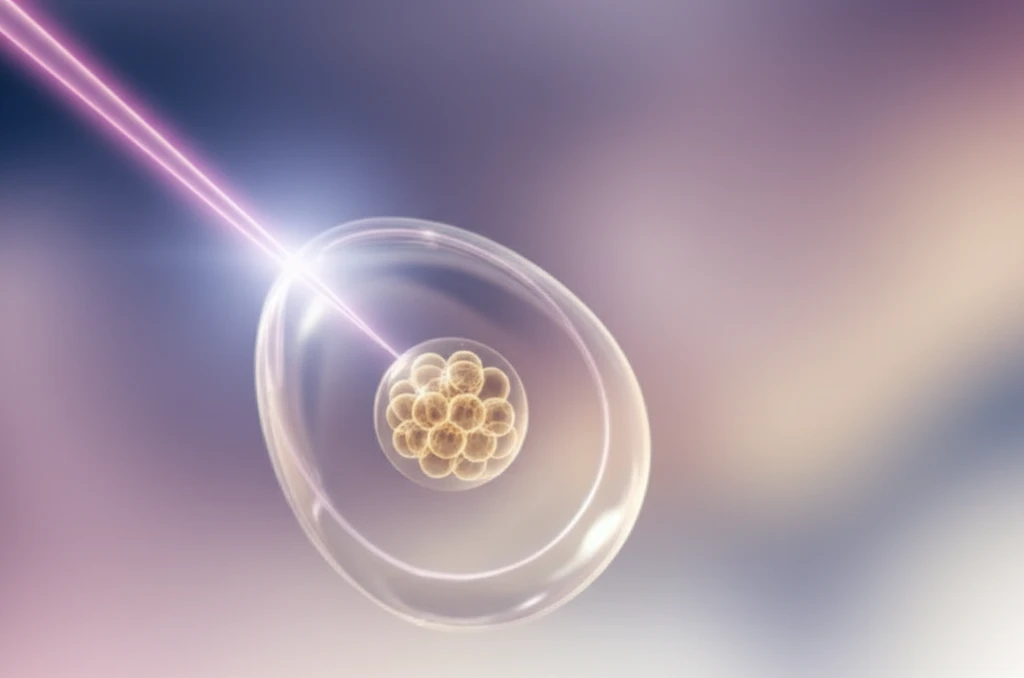
Laser Assisted Hatching Opening Zona Pellucida

Laser-Assisted Hatching: Does the Location Matter for IVF Success?

"Unlocking the Secrets of Embryo Implantation: A Detailed Look at Laser Zona Opening and Its Impact on IVF Outcomes."


In vitro fertilization (IVF) success hinges on several critical factors, one of the most important being the embryo's ability to 'hatch' from its protective outer layer, the zona pellucida (ZP). This natural hatching process is vital for the embryo to implant into the uterine wall and continue developing. Think of it like a seed sprouting—it needs to break free from its shell to grow.

The natural hatching process involves the embryo's cells proliferating, increasing internal pressure to thin the ZP, and secreting enzymes to degrade it. When this process is naturally impaired, assisted hatching (AH) techniques, such as laser zona opening, come into play. Laser zona opening involves using a precise laser to create a small opening in the ZP, making it easier for the embryo to hatch. It's designed to give the embryo a helping hand, particularly in cases where the ZP is thicker or harder than usual.

The question is, does the location of this laser-created opening matter? Some experts believe where you create the opening on the zona pellucida significantly impacts the embryo's ability to hatch and implant successfully. This article dives into the details of a fascinating study that investigates whether the site of laser zona opening affects the complete hatching and cell numbers of mouse blastocysts.

ICM vs. TE: Does the Laser Site Really Influence Hatching?

Laser Assisted Hatching Opening Zona Pellucida

Researchers in Thailand conducted a detailed study using mouse blastocysts to explore this very question. They randomly divided the blastocysts into three groups to see if the location of the laser opening made a difference:

ICM Group: The laser created an opening in the zona pellucida near the inner cell mass (ICM), which will eventually develop into the fetus.

  • TE Group: The opening was made opposite the ICM, targeting the trophectoderm (TE), which forms the placenta.
  • Control Group: This group received no laser treatment; the embryos were left to hatch naturally.
The goal was to determine if opening the zona pellucida near the ICM versus the TE affected the rate of complete hatching and the cell numbers of the hatched blastocysts. The researchers meticulously tracked and compared the hatching rates and cell counts across all three groups.

Implications and Future Directions

This research offers valuable insights into optimizing assisted hatching techniques. While the study indicates the specific site of laser zona opening doesn't significantly impact hatching rates or cell numbers in mouse blastocysts, further research is essential to confirm these findings in human embryos. More studies are needed to explore the effects on embryo transfer, implantation, and ultimately, pregnancy rates.

About this Article -

This article was crafted using a human-AI hybrid and collaborative approach. AI assisted our team with initial drafting, research insights, identifying key questions, and image generation. Our human editors guided topic selection, defined the angle, structured the content, ensured factual accuracy and relevance, refined the tone, and conducted thorough editing to deliver helpful, high-quality information.See our About page for more information.

This article is based on research published under:

DOI-LINK: 10.5653/cerm.2016.43.3.152, Alternate LINK

Title: The Effect Of The Site Of Laser Zona Opening On The Complete Hatching Of Mouse Blastocysts And Their Cell Numbers

Subject: Reproductive Medicine

Journal: Clinical and Experimental Reproductive Medicine

Publisher: The Korean Society for Reproductive Medicine

Authors: Usanee Sanmee, Waraporn Piromlertamorn, Teraporn Vutyavanich

Published: 2016-01-01

Everything You Need To Know

1

What is Laser-Assisted Hatching and why is it used in IVF?

Laser-Assisted Hatching (AH) is a technique used in In Vitro Fertilization (IVF) to help embryos hatch from their zona pellucida (ZP), which is the protective outer layer. This is crucial because the embryo must hatch to implant successfully in the uterine wall. AH uses a precise laser to create a small opening in the ZP, aiding the embryo, especially if the ZP is thick or hardened. Without successful hatching, implantation and pregnancy are unlikely. AH assists the natural hatching process by providing an easier route for the embryo to emerge.

2

What are the ICM and TE and how do they relate to embryo development?

The Inner Cell Mass (ICM) and the Trophectoderm (TE) are both critical parts of a blastocyst, which is a stage of early embryo development. The ICM is the group of cells that will eventually develop into the fetus. The TE, on the other hand, forms the placenta, which is essential for providing nutrients and oxygen to the developing fetus and removing waste. In the context of Laser-Assisted Hatching, researchers investigated whether opening the zona pellucida near the ICM versus the TE had different outcomes on the hatching process and cell development within the embryo.

3

Does the location of the laser opening on the zona pellucida really matter for IVF success?

According to the study discussed, the specific location of the laser zona opening, either near the Inner Cell Mass (ICM) or the Trophectoderm (TE), did not significantly impact the hatching rates or cell numbers in mouse blastocysts. This study suggests that the exact site of the opening may not be as critical as the fact that an opening is made. However, it's essential to note that these findings are from a study on mouse blastocysts, and further research is needed to confirm these results in human embryos and to assess the impact on implantation and pregnancy rates.

4

How does the natural hatching process work, and what problems can arise?

The natural hatching process involves the embryo's cells increasing internal pressure to thin the zona pellucida (ZP), the protective outer layer, and secreting enzymes to degrade it. This allows the embryo to break free and prepare for implantation. Problems can arise when the ZP is thicker, harder, or if the embryo has difficulty generating the necessary pressure or enzymes. These issues can hinder the embryo's ability to hatch, leading to implantation failure. This is where assisted hatching techniques, like laser zona opening, become beneficial to help the embryo.

5

What are the potential implications of this research on laser-assisted hatching?

This research provides valuable insights into optimizing laser-assisted hatching techniques. The study indicates that the specific site of the laser zona opening (ICM vs. TE) may not significantly influence hatching rates or cell numbers in mouse blastocysts. However, the implication is that creating any opening is beneficial. Future research should focus on confirming these findings in human embryos, investigating the effects on embryo transfer, implantation, and ultimately, the pregnancy rates. This will help refine and improve the effectiveness of assisted hatching in IVF, potentially leading to higher success rates for patients undergoing fertility treatments.

Newsletter Subscribe

Subscribe to get the latest articles and insights directly in your inbox.