
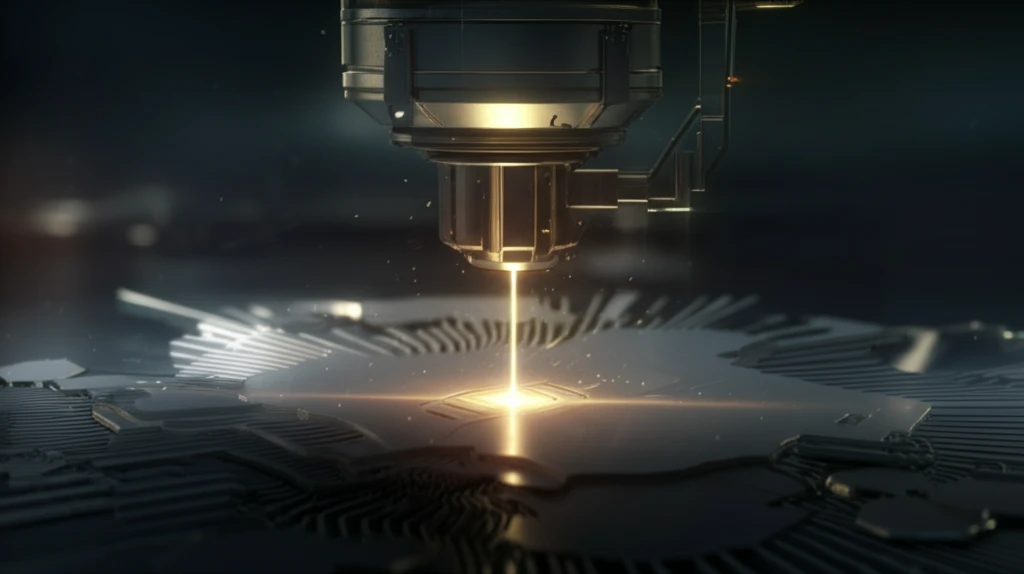
Laser Alchemy: Transforming Metal Properties with Light

"Unlocking the potential of laser irradiation to revolutionize materials science and create stronger, more durable alloys for advanced applications."
For centuries, the dream of alchemy—transforming one substance into another—has captured the human imagination. While turning lead into gold remains in the realm of fantasy, modern science has discovered a new form of alchemy: using lasers to alter the very structure and properties of metals. This groundbreaking technique, known as laser irradiation, is revolutionizing materials science, offering unprecedented control over the strength, durability, and electrical characteristics of metal alloys.
At the heart of this revolution lies the understanding that a material's properties are not set in stone. By precisely applying laser energy to the surface of a metal alloy, scientists can induce changes at the microstructural level. These changes can range from altering the size and distribution of crystals within the metal to creating entirely new surface topographies, each with unique and desirable characteristics.
One alloy garnering significant attention in laser irradiation research is the Fe-1.0 wt.% Cu alloy, a combination of iron and copper. This alloy is particularly relevant in the construction of reactor pressure vessels (RPV) for nuclear power plants, where it acts as a crucial barrier against radioactive material leakage. However, the harsh conditions inside a nuclear reactor can lead to embrittlement of the RPV steel over time. Understanding how to enhance the resilience of these alloys is vital for ensuring the long-term safety and efficiency of nuclear power generation.
Laser Hardening Delivers Precision Surface Properties
Laser hardening is a surface hardening process that enables high-quality results due to the controllability of energy input, with the hardened area determined by the heat distribution caused by the laser beam's intensity profile. Research on QT400 ductile iron using double-ring oscillation trajectories has emerged as a promising technique for precision surface modification. Studies reveal that maximum hardness is achieved 50–300 μm below the surface for all laser-hardened steels, and wear resistance is enhanced through implementation of laser hardening.
Automotive Demand Drives Laser Hardening Adoption
The automotive industry is a core application field for laser hardening, driven by the contradiction between high requirements for automotive molds and components and the limitations of traditional heat treatment methods. Laser hardening is a non-contact surface treatment process that uses a high-power laser beam to rapidly heat a metal surface, followed by self-quenching using the material's own thermal mass. Precision beam guidance allows full coverage of hardened layers on adjacent surfaces, with heating efficiency significantly higher than sequential single-pass methods.
Market Growth Signals Rising Industrial Adoption
The global laser hardening machine market is projected to reach several billion dollars in the coming years, propelled by rising adoption of laser technologies for efficient hardening processes. Coherent, a global leader in materials, networking, and lasers, builds equipment that maximizes throughput and yield using cutting-edge optics, lasers, and composite materials. The technology continues to evolve as firms like ScanSonic and others develop specialized laser hardening machines for industrial deployment.
The Science of Laser Hardening
A recent study published in Materials Research Express delves into the transformative effects of laser irradiation on Fe-1.0 wt.% Cu alloys. Researchers exposed samples of the alloy to varying numbers of laser shots from a pulsed Nd:YAG laser, carefully controlling parameters such as laser fluence (energy per unit area) and intensity. The results were striking, revealing significant alterations in the alloy's morphology (surface structure), crystallography (arrangement of atoms), and mechanical properties.
Homogenisation of Austenite Remains a Key Challenge
Laser surface hardening aims to develop a martensitic surface layer on steel components for improved surface mechanical properties, but a quantitative parameter to measure the efficacy of hardening processes is still lacking, hindering industrial adoption. Recent research emphasizes the importance of austenite homogenisation during laser surface hardening to achieve consistent martensitic transformation. Investigations into diode laser overlap on low-carbon and stainless steel show that hardness improves in overlap areas with a decrease in ferrite phase content.
Modelling Complexity and Traditional Method Trade-offs
Conventional hardening methods for press roller dies typically rely on furnace heating followed by rapid cooling in oil or water media, presenting limitations in precision and distortion control compared to laser innovation. An enthalpy-based computational model has been developed for analysing laser heating and melting of metals, using the Finite Difference Method to investigate transient heat transfer during laser hardening of AISI-4340 steel. These numerical investigations underscore that accurately predicting temperature evolution remains a significant technical challenge for process optimization.
Laser Hardening vs. Conventional Techniques
Laser hardening is today recognized as an efficient and cost-effective method of heat-treating ferrous metals, offering a precision alternative to traditional techniques. Reviews of laser use in transformation hardening cover the technical fundamentals, equipment, and economic aspects, relating research findings to industrial applications and comparisons with conventional hardening methods. The technology's benefits over conventional approaches include greater process controllability and the ability to selectively harden targeted surface zones.
The Future is Laser-Forged
Laser irradiation offers a compelling pathway to tailor the properties of metal alloys for specific applications. By precisely controlling the laser parameters, scientists and engineers can create materials with enhanced strength, durability, and resistance to wear and tear. This technology holds immense potential for a wide range of industries, from aerospace and automotive to medicine and energy. As research in this field continues to advance, we can expect to see even more innovative applications of laser alchemy, transforming the materials that shape our world.
Laser Hardening vs. Laser Annealing
Laser processing is transforming high-end manufacturing, and understanding the distinction between laser annealing and laser hardening is essential for choosing the right method for a given application. Laser hardening strengthens and hardens the surface of a workpiece using a laser beam, a process also known as laser heat treatment. Precision laser hardening services now use advanced laser technology and 6-axis industrial robots to focus the beam on specific areas, improving wear resistance and durability without changing core material properties.
Expanding Applications Across Industries
Compared with conventional hardening methods, laser hardening offers superior control, minimal distortion, localized heat treatment, and improved surface performance. The technology is increasingly used to strengthen flange surfaces in industries such as energy and heavy equipment, where wear resistance and long service life are critical. These advantages position laser hardening as a key enabler for next-generation manufacturing across diverse sectors.
Precision for Complex Geometries
Laser hardening, also referred to as laser case hardening, is a heat treating process used to improve the strength, durability, and wear resistance of component surfaces. While induction hardening excels with symmetrical parts, laser hardening offers unparalleled precision and flexibility for complex geometries using a highly focused laser beam as its heat source. Modern laser hardening systems incorporate fiber lasers, robots, and mobile worktables, with the laser converting electrical current into laser output delivered through optical fiber to the quenching head.
Automotive Case Studies Validate Effectiveness
Laser hardening is transforming the automotive industry by applying high-energy lasers to precisely heat metal surfaces, resulting in rapid and accurate hardening. Real-world case studies demonstrate its effectiveness in maintaining precision and reducing production time for automotive components. Anomaly detection systems using high-speed cameras and thermography are being deployed in laser hardening of crankshafts to monitor process quality in real time.