
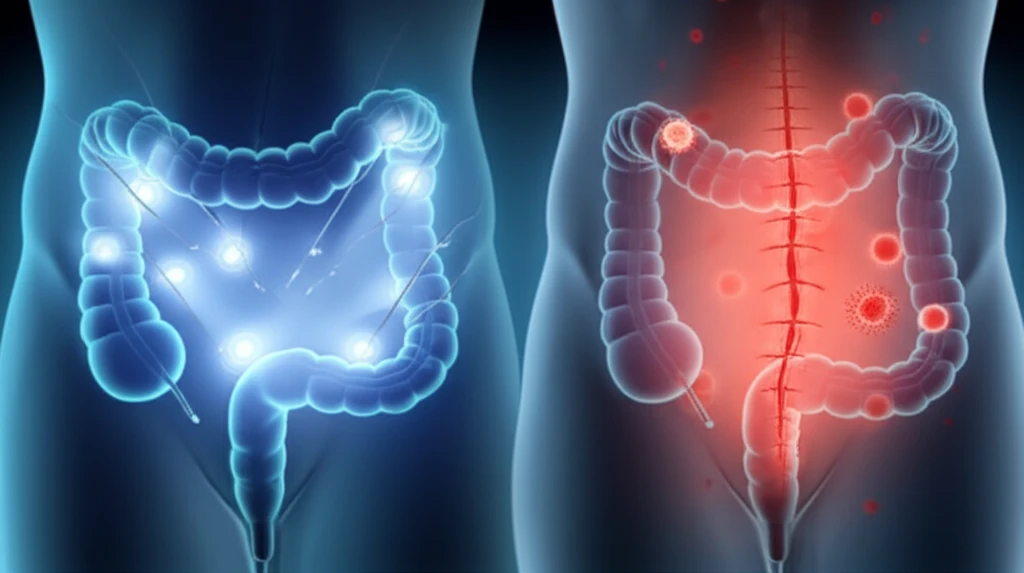
Comparison of laparoscopic and open surgery for colon cancer, illustrating reduced cancer cell spread in the laparoscopic approach.

Laparoscopic vs. Open Surgery for Colon Cancer: Which Method Best Minimizes Cancer Spread?

"Discover the surprising findings on how different surgical approaches impact the risk of intraluminal exfoliated malignant cells and what it means for your health."


For individuals facing colon cancer, the choice between surgical techniques is a critical decision. Laparoscopic colectomy, a minimally invasive approach, has gained popularity due to its potential for faster recovery and reduced morbidity compared to traditional open surgery. However, concerns linger about the possibility of cancer cells spreading during the procedure, particularly with intracorporeal anastomosis (IA), where the bowel is reconnected inside the body.

The presence of intraluminal exfoliated malignant cells – cancer cells that shed into the colon's interior – is a key consideration. If these cells spread during surgery, they could potentially lead to peritoneal dissemination (cancer spreading in the abdominal cavity) or port-site metastasis (cancer growth at the incision sites). Understanding how different surgical techniques affect the abundance of these cells is crucial for optimizing patient outcomes.

This article delves into a study that investigates the relationship between colon cancer surgery and the incidence of intraluminal exfoliated malignant cells. By comparing laparoscopic and open surgery, we aim to clarify which approach minimizes the risk of cancer spread, providing valuable insights for patients and healthcare professionals alike.

Does Laparoscopic Colectomy Really Reduce the Risk of Cancer Cell Spread?

Comparison of laparoscopic and open surgery for colon cancer, illustrating reduced cancer cell spread in the laparoscopic approach.

A recent study published in the Asian Journal of Endoscopic Surgery sheds light on this critical question. Researchers prospectively studied 89 patients undergoing either laparoscopic or open colectomy for colon cancer between 2007 and 2011. Before reconnecting the bowel (anastomosis), they carefully irrigated the proximal (upper) and distal (lower) sections of the colon with saline and examined the fluid for exfoliated cancer cells.

The study revealed that exfoliated cancer cells were detected in 27 patients (30.3%). However, a significant difference emerged when comparing the two surgical approaches. On the distal side of the colon, the frequency of positive cytology findings (indicating the presence of exfoliated malignant cells) was significantly lower in the laparoscopic colectomy group compared to the open colectomy group (P = 0.01).

  • Laparoscopic Colectomy (LC): A minimally invasive surgery using small incisions and a camera to guide the surgeon.
  • Open Colectomy (OC): Traditional surgery involving a larger abdominal incision.
  • Intracorporeal Anastomosis (IA): Reconnecting the bowel inside the body during laparoscopic surgery.
  • Exfoliated Malignant Cells: Cancer cells that have shed into the colon's interior.
  • Cytology: The study of cells, in this case, to detect the presence of cancer cells.
Furthermore, in the laparoscopic colectomy group, no positive cytology findings were found for exfoliated malignant cells more than 100 mm (approximately 4 inches) from the primary tumor. The incidence of positive cytology beyond this 100 mm threshold was significantly lower compared to areas closer to the tumor (P = 0.04). This suggests that laparoscopic surgery may effectively contain the spread of cancer cells within a limited area.

What This Means for Colon Cancer Patients

The findings of this study offer valuable insights for colon cancer patients and their healthcare providers. While exfoliated malignant cells can be detected at anastomosis sites regardless of the surgical approach, laparoscopic colectomy appears to reduce their presence on the distal side of the colon. This suggests that laparoscopic surgery may help minimize the risk of cancer cell spread during the procedure. However, it's important to note that the study also indicates a potential safe margin of 100 mm from the primary tumor in laparoscopic cases. When planning the anastomosis, surgeons should consider this distance to minimize the risk of encountering exfoliated malignant cells.

About this Article -

This article was crafted using a human-AI hybrid and collaborative approach. AI assisted our team with initial drafting, research insights, identifying key questions, and image generation. Our human editors guided topic selection, defined the angle, structured the content, ensured factual accuracy and relevance, refined the tone, and conducted thorough editing to deliver helpful, high-quality information.See our About page for more information.

This article is based on research published under:

DOI-LINK: 10.1111/ases.12617, Alternate LINK

Title: Extent Of Intraluminal Exfoliated Malignant Cells During Surgery For Colon Cancer: Differences In Cell Abundance Ratio Between Laparoscopic And Open Surgery

Subject: General Medicine

Journal: Asian Journal of Endoscopic Surgery

Publisher: Wiley

Authors: Shinichiro Kobayashi, Yusuke Inoue, Fumihiko Fujita, Shinichiro Ito, Izumi Yamaguchi, Masahiko Nakayama, Kengo Kanetaka, Mitsuhisa Takatsuki, Susumu Eguchi

Published: 2018-07-11

Everything You Need To Know

1

What are intraluminal exfoliated malignant cells, and why are they a concern in colon cancer surgery?

Intraluminal exfoliated malignant cells are cancer cells that have detached and are present within the colon's interior. They are a significant concern during colon cancer surgery because their spread could lead to peritoneal dissemination, where cancer spreads in the abdominal cavity, or port-site metastasis, which is cancer growth at the incision sites. The goal of surgical techniques is to minimize the risk of spreading these cells during the procedure to improve patient outcomes. The study investigates how different surgical approaches affect the presence and spread of these cells.

2

How does laparoscopic colectomy differ from open colectomy, and what are the potential benefits of the laparoscopic approach?

Laparoscopic colectomy (LC) is a minimally invasive surgical technique that uses small incisions and a camera to guide the surgeon. Open colectomy (OC), on the other hand, is a traditional surgery that involves a larger abdominal incision. Laparoscopic colectomy is often favored due to its potential for faster recovery and reduced morbidity compared to open surgery. The study specifically looks at whether the laparoscopic approach might also reduce the risk of cancer cell spread during surgery, making it a potentially safer option from an oncological perspective. The benefits need to be weighed against any potential drawbacks, such as the technical challenges of intracorporeal anastomosis.

3

What did the study reveal about the presence of exfoliated malignant cells in laparoscopic colectomy versus open colectomy?

The study showed that while exfoliated malignant cells were detected in some patients undergoing both laparoscopic and open colectomy, there was a significant difference in their presence on the distal side of the colon. Specifically, the frequency of positive cytology findings, indicating the presence of exfoliated malignant cells, was significantly lower in the laparoscopic colectomy group compared to the open colectomy group. This suggests that laparoscopic colectomy may be more effective at minimizing the presence of these cells in certain areas of the colon. However, it's important to remember that exfoliated malignant cells could be found in both approaches, and further investigation is needed to understand the long-term implications.

4

What is intracorporeal anastomosis (IA), and how does it relate to concerns about cancer cell spread during laparoscopic colectomy?

Intracorporeal anastomosis (IA) refers to reconnecting the bowel inside the body during laparoscopic surgery. While IA is a standard technique in laparoscopic colectomy, there have been concerns that manipulating the bowel within the abdominal cavity during IA could potentially increase the risk of cancer cell spread. The study investigated these concerns by examining the presence of exfoliated malignant cells in relation to different surgical approaches, including laparoscopic colectomy with intracorporeal anastomosis. Understanding the impact of IA on cancer cell spread is crucial for optimizing surgical techniques and ensuring patient safety.

5

The study mentions a 'safe margin' of 100 mm from the tumor in laparoscopic cases. What does this mean for surgeons planning anastomosis?

The 'safe margin' of 100 mm refers to the finding that in the laparoscopic colectomy group, no positive cytology findings were found for exfoliated malignant cells more than 100 mm (approximately 4 inches) from the primary tumor. This suggests that laparoscopic surgery may effectively contain the spread of cancer cells within a limited area. For surgeons planning the anastomosis (reconnection of the bowel) during laparoscopic colectomy, this finding implies that they should consider this 100 mm distance from the tumor to minimize the risk of encountering exfoliated malignant cells at the anastomosis site. Considering this margin may help reduce the potential for local recurrence and improve oncological outcomes.

Newsletter Subscribe

Subscribe to get the latest articles and insights directly in your inbox.