
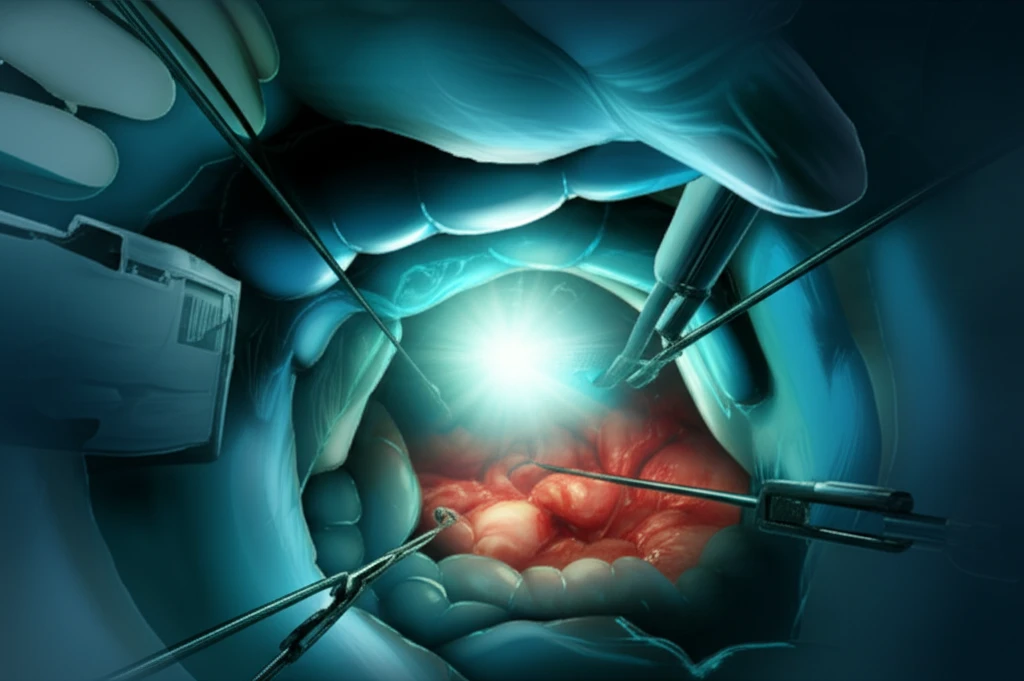
Surgical team performing a precise laparoscopic colectomy.

Laparoscopic Right Colectomy: A Modern Approach to Colon Cancer Surgery

"Discover the benefits of minimally invasive colectomy for adenocarcinoma, offering faster recovery and reduced scarring."


Adenocarcinoma of the right colon is a common diagnosis, often requiring surgical intervention. Laparoscopic right colectomy has emerged as a favored approach, offering a minimally invasive alternative to traditional open surgery. This technique emphasizes a 'medial-to-lateral' approach, prioritizing early vessel ligation to optimize oncologic outcomes.

This approach is illustrated in a video demonstrating the key steps of a laparoscopic right colectomy for a tumor located at the hepatic flexure (right colic angle). The procedure focuses on meticulous dissection and precise vessel control to ensure complete tumor removal while minimizing patient morbidity.

The following article details the critical steps of this procedure, offering insights into patient positioning, trocar placement, and surgical techniques. This aims to enhance understanding and promote best practices in the surgical management of right colon adenocarcinoma.

Mastering the Laparoscopic Right Colectomy: Step-by-Step Surgical Technique

Surgical team performing a precise laparoscopic colectomy.

The laparoscopic right colectomy begins with careful patient positioning. The patient is placed in a supine position with both arms alongside the body and legs secured. The surgical team, including the surgeon and camera assistant, is positioned on the patient's left side. Trendelenburg positioning with left lateral rotation is then employed to optimize visualization and access to the surgical field.

Access to the abdominal cavity is typically achieved using five trocars, including a 12mm optical trocar placed peri-umbilically using an open technique. Additional trocars include a 10mm trocar in the left iliac fossa and three 5mm trocars positioned in the right hypochondrium, left hypochondrium, and right iliac fossa, respectively.

  • Exposure and Traction: The procedure commences with exposure of the right ileocolic pedicle. Gentle traction on the cecum facilitates tension on the right mesocolon, aiding in dissection.
  • Meso-colic Incision: An incision is made in the right meso-colon along the axis of the ileocolic pedicle, freeing the meso-colon from the right pre-renal fascia. This step allows for identification of the second portion of the duodenum (D2) and the genu inferius, which are carefully mobilized toward the transverse colon.
  • Vascular Control: The ileocolic and right colic pedicles are meticulously identified and dissected close to their origins. Vascular clips are applied using an endo-GIA® stapler, ensuring secure ligation of the ileocolic pedicle.
Following vascular control, a colo-epiploic dissection is performed, lowering the right colic angle and separating the colon from the greater omentum. Subsequently, a coloparietal dissection is carried out towards the cecum, with medial traction on the right colon to mobilize it fully. Partial resection of the greater omentum near the right colic angle may be necessary due to tumor proximity. The specimen is extracted through a small (5cm) midline supra-umbilical mini-laparotomy. Finally, the ileal and colonic ends are assessed with indocyanine green (ICG) to confirm adequate perfusion before performing a stapled side-to-side anastomosis.

The Future of Colon Cancer Surgery: Enhanced Recovery and Precision

Laparoscopic right colectomy offers a safe and effective approach for managing right colon adenocarcinoma. The medial-to-lateral technique with early vascular ligation is crucial for optimal oncologic outcomes.

This minimally invasive approach translates to reduced postoperative pain, shorter hospital stays, and improved cosmetic results for patients. As surgical technology advances, techniques like ICG angiography will continue to refine and improve outcomes.

Surgeons seeking to refine their skills in laparoscopic colectomy will find value in understanding these techniques, ultimately leading to better patient care and improved survival rates in colon cancer management.

About this Article -

This article was crafted using a human-AI hybrid and collaborative approach. AI assisted our team with initial drafting, research insights, identifying key questions, and image generation. Our human editors guided topic selection, defined the angle, structured the content, ensured factual accuracy and relevance, refined the tone, and conducted thorough editing to deliver helpful, high-quality information.See our About page for more information.

This article is based on research published under:

DOI-LINK: 10.1016/j.jchirv.2018.08.004, Alternate LINK

Title: Colectomie Droite Laparoscopique Pour Adénocarcinome (Avec Vidéo)

Subject: Surgery

Journal: Journal de Chirurgie Viscérale

Publisher: Elsevier BV

Authors: N. Ammar-Khodja, C. Sabbagh, J.-M. Regimbeau

Published: 2018-12-01

Everything You Need To Know

1

What is a laparoscopic right colectomy and why is it performed?

Laparoscopic right colectomy is a minimally invasive surgical procedure used to treat adenocarcinoma located in the right colon. It involves removing the affected part of the colon through small incisions, using specialized instruments and a camera to guide the surgeon. The procedure emphasizes a 'medial-to-lateral' approach, prioritizing early vessel ligation, to ensure complete tumor removal and minimize patient morbidity.

2

What does the 'medial-to-lateral' approach mean in a laparoscopic right colectomy, and why is it important?

The 'medial-to-lateral' approach in a laparoscopic right colectomy involves starting the dissection near the blood vessels that supply the right colon, specifically the ileocolic and right colic pedicles. These vessels are identified and ligated (tied off) early in the procedure. This early vascular control helps to minimize bleeding during the rest of the surgery and optimizes oncologic outcomes by ensuring complete removal of the tumor and its blood supply.

3

How is the patient positioned and what trocar placements are typically used during a laparoscopic right colectomy?

During a laparoscopic right colectomy, the patient is positioned supine with arms alongside the body and legs secured. The surgical team typically uses five trocars to access the abdominal cavity: one 12mm optical trocar peri-umbilically, a 10mm trocar in the left iliac fossa, and three 5mm trocars in the right hypochondrium, left hypochondrium, and right iliac fossa. Trendelenburg positioning with left lateral rotation optimizes visualization and access.

4

What is indocyanine green (ICG) used for in a laparoscopic right colectomy, and why is it important?

Indocyanine green (ICG) is used at the end of a laparoscopic right colectomy to assess the perfusion (blood flow) of the ileal and colonic ends before performing the anastomosis (reconnection of the bowel). ICG is a fluorescent dye that, when injected, allows the surgeon to visually assess the blood supply to the tissues, ensuring that the newly connected bowel has adequate blood flow to heal properly. This helps to prevent complications like leaks or ischemia.

5

What are the benefits of laparoscopic right colectomy, and what future advancements might further improve this procedure?

Laparoscopic right colectomy offers several advantages over traditional open surgery for adenocarcinoma, including smaller incisions, reduced scarring, faster recovery times, and decreased patient morbidity. The medial-to-lateral technique with early vascular ligation also optimizes oncologic outcomes. While the text focuses on the surgical technique, future advancements might include robotic assistance for even greater precision, enhanced imaging techniques for better visualization, and personalized approaches based on the patient's genetic and tumor profiles. Further research into adjuvant therapies and long-term outcomes is also crucial to continue improving the care of patients undergoing right colectomy.

Newsletter Subscribe

Subscribe to get the latest articles and insights directly in your inbox.