
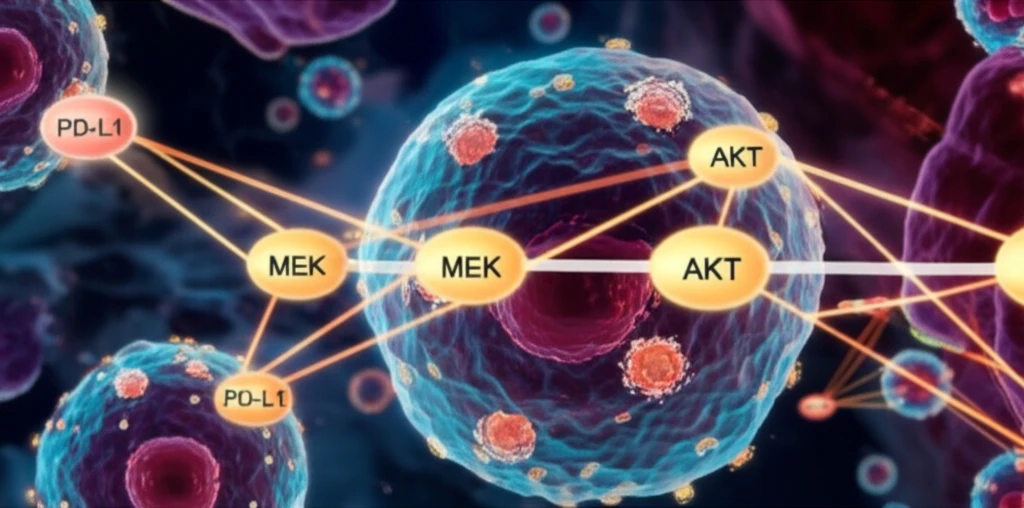
Microscopic view of KRAS mutant lung cancer cells with interconnected MEK/AKT pathways and PD-L1 proteins.

KRAS Mutant Lung Cancer: New Hope in Targeted Therapies?

"Discover how MEK and AKT inhibitors could revolutionize treatment for non-small cell lung cancer, offering a beacon of hope for patients with KRAS mutations."


Lung cancer remains a leading cause of cancer-related deaths worldwide, affecting millions each year. While standard treatments have traditionally involved chemotherapy, recent advances have introduced targeted therapies that focus on specific genetic mutations within cancer cells. These targeted approaches, such as EGFR and ALK inhibitors, have shown promise in improving outcomes for certain subsets of patients.

One area of intense research is the KRAS mutation, found in a significant percentage of advanced lung adenocarcinomas. Unfortunately, directly targeting KRAS has proven challenging, leading scientists to explore indirect methods, such as MEK and AKT inhibitors, to disrupt the pathways that KRAS activates. These pathways are critical for cancer cell growth and survival, making them attractive targets for therapeutic intervention.

Recent studies have also highlighted the role of PD-L1, a protein that helps cancer cells evade the immune system. Understanding how PD-L1 expression changes in response to targeted therapies could provide insights into resistance mechanisms and potentially lead to new strategies for overcoming them. This article delves into a groundbreaking study investigating PD-L1 expression in KRAS mutant lung cancer cell lines exposed to MEK and AKT inhibitors, offering a glimpse into the future of personalized cancer treatment.

Unlocking the Potential of MEK and AKT Inhibitors in KRAS Mutant Lung Cancer

Microscopic view of KRAS mutant lung cancer cells with interconnected MEK/AKT pathways and PD-L1 proteins.

The study meticulously examined five KRAS mutant cell lines, each known for high PD-L1 expression. Researchers exposed these cell lines to Gl50 inhibitor concentrations of trametinib (a MEK inhibitor) and AZD5363 (an AKT inhibitor) over a three-week period. The goal was to observe how PD-L1 expression changed in response to these inhibitors, providing clues about potential resistance mechanisms.

PD-L1 expression was quantified using immunofluorescence, a technique that allows researchers to visualize proteins within cells. Additionally, a co-culture assay using a Jurkat cell line transfected with NFAT-luciferase was employed to determine if changes in PD-L1 expression were functionally relevant, meaning they affected the interaction between cancer cells and immune cells.

  • Immunofluorescence: Visualized and quantified PD-L1 protein levels in cancer cells.
  • NFAT-Luciferase Assay: Assessed the functional impact of PD-L1 expression on immune cell activity.
  • Trametinib: A MEK inhibitor targeting the MEK pathway.
  • AZD5363: An AKT inhibitor targeting the AKT pathway.
The results revealed that trametinib led to functionally significant increases in PD-L1 expression in three out of five cell lines (H23, H2030, and A549). AZD5363 also increased PD-L1 expression, but only in two cell lines (H441 and H23). This suggests that while MEK and AKT inhibitors can influence PD-L1 expression, the response is not consistent across all KRAS mutant lung cancer cells. Therefore, PD-L1 overexpression is unlikely to be a universal early resistance mechanism to these treatments.

Implications and Future Directions

While the study indicates that PD-L1 overexpression may not be a primary resistance mechanism, it highlights the complex interplay between signaling pathways and immune evasion in KRAS mutant lung cancer. Further research is needed to fully understand the mechanisms that regulate PD-L1 expression in response to targeted therapies and to identify strategies for overcoming resistance.

About this Article -

This article was crafted using a human-AI hybrid and collaborative approach. AI assisted our team with initial drafting, research insights, identifying key questions, and image generation. Our human editors guided topic selection, defined the angle, structured the content, ensured factual accuracy and relevance, refined the tone, and conducted thorough editing to deliver helpful, high-quality information.See our About page for more information.

Everything You Need To Know

1

What role do MEK and AKT inhibitors play in treating KRAS mutant lung cancer?

MEK and AKT inhibitors are being investigated as potential targeted therapies for KRAS mutant lung cancer. Since directly targeting KRAS has been challenging, researchers are exploring these inhibitors to disrupt the pathways that KRAS activates, which are critical for cancer cell growth and survival. The study specifically used trametinib, a MEK inhibitor, and AZD5363, an AKT inhibitor, to observe their effects on PD-L1 expression in KRAS mutant cell lines.

2

How do MEK and AKT inhibitors affect PD-L1 expression in KRAS mutant lung cancer cells?

The study found that MEK and AKT inhibitors, such as trametinib and AZD5363, can influence PD-L1 expression in KRAS mutant lung cancer cells. Trametinib led to increases in PD-L1 expression in three out of five cell lines (H23, H2030, and A549). AZD5363 also increased PD-L1 expression, but only in two cell lines (H441 and H23). This suggests that the response to these inhibitors is not uniform across all KRAS mutant cell lines. Understanding how these inhibitors affect PD-L1 could provide insights into potential resistance mechanisms and inform future treatment strategies.

3

What is the significance of PD-L1 expression in the context of KRAS mutant lung cancer and its treatment?

PD-L1, a protein expressed on cancer cells, helps them evade the immune system. In KRAS mutant lung cancer, the study explored how MEK and AKT inhibitors affect PD-L1 expression. The findings suggest that PD-L1 overexpression might not be a universal early resistance mechanism to these inhibitors. However, understanding the interplay between signaling pathways and immune evasion is crucial for developing effective therapies. The changes in PD-L1 expression are functionally relevant, as they affect the interaction between cancer cells and immune cells. Further research is needed to understand the mechanisms regulating PD-L1 expression in response to targeted therapies.

4

What methods were used to assess the impact of MEK and AKT inhibitors on KRAS mutant lung cancer cells?

The study utilized immunofluorescence to visualize and quantify PD-L1 protein levels in KRAS mutant cell lines. Immunofluorescence is a technique allowing researchers to see proteins within cells. Furthermore, a co-culture assay using a Jurkat cell line transfected with NFAT-luciferase was used to determine if changes in PD-L1 expression were functionally relevant, meaning they affected the interaction between cancer cells and immune cells. The study exposed five KRAS mutant cell lines to specific concentrations of trametinib (a MEK inhibitor) and AZD5363 (an AKT inhibitor) over a three-week period.

5

Why is targeting KRAS mutations important in lung cancer treatment, and what challenges exist?

KRAS mutations are found in a significant percentage of advanced lung adenocarcinomas. Because KRAS mutations are common in lung cancer, it is important to develop effective therapies. Directly targeting KRAS has been challenging. That's why research focuses on indirect methods, like MEK and AKT inhibitors, to disrupt the pathways KRAS activates, which are crucial for cancer cell growth. The study explored these inhibitors' effects on PD-L1 expression, offering insights into potential resistance mechanisms and paving the way for new, effective therapies.

Newsletter Subscribe

Subscribe to get the latest articles and insights directly in your inbox.