
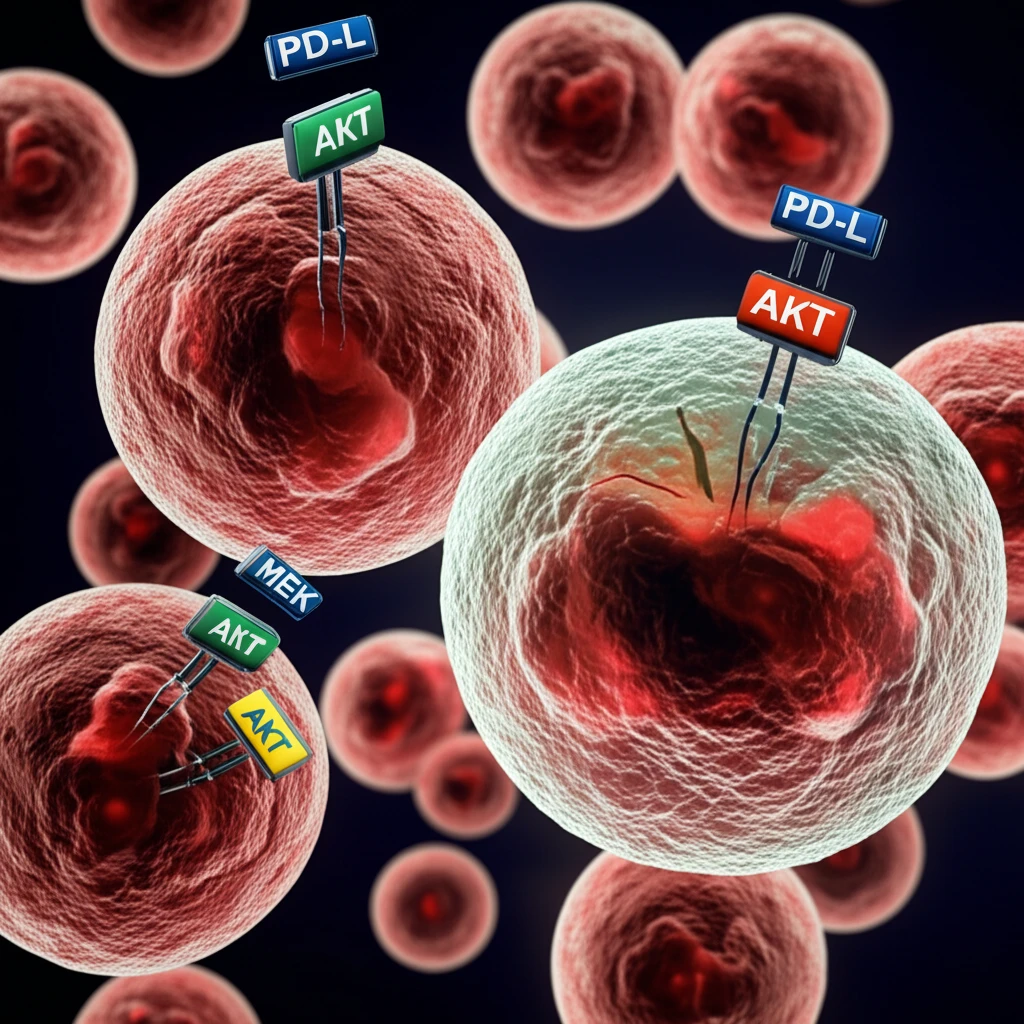
Illustration of KRAS mutant lung cancer cells interacting with MEK and AKT inhibitors, showing dynamic changes in PD-L1 expression.

KRAS Mutant Lung Cancer: Can Targeted Treatments Influence PD-L1 Expression?

"New Research Explores How MEK and AKT Inhibitors Affect PD-L1 in Non-Small Cell Lung Cancer, Potentially Impacting Immunotherapy Strategies"


Lung cancer remains a leading cause of cancer-related deaths worldwide, with approximately 1.8 million new diagnoses each year. While chemotherapy has long been a standard treatment, targeted therapies like EGFR and ALK inhibitors have emerged as effective options for specific subsets of patients. More recently, immune checkpoint inhibitors have shown remarkable promise in treating lung cancer.

Programmed cell death protein 1 (PD-1) and its ligand, PD-L1, play a crucial role in regulating the immune response. Interaction between PD-1, found on T-cells, and PD-L1, present on cancer cells, suppresses the immune system's ability to attack cancer. Immune checkpoint inhibitors disrupt this interaction, boosting the immune response against cancer cells. These inhibitors have demonstrated benefit in both first- and second-line treatment settings for squamous and non-squamous non-small cell lung cancer (NSCLC).

KRAS mutations are prevalent in approximately 33% of advanced lung adenocarcinomas. Currently, no drugs directly target KRAS, leading to exploration of indirect strategies, such as MEK and AKT inhibitors. Researchers are investigating how these inhibitors impact PD-L1 expression, which could influence the effectiveness of immunotherapies.

MEK and AKT Inhibitors: Do They Change PD-L1 Levels?

Illustration of KRAS mutant lung cancer cells interacting with MEK and AKT inhibitors, showing dynamic changes in PD-L1 expression.

While inhibiting MEK or PI3K pathways alone has shown limited success, combining these inhibitors with chemotherapy has demonstrated promise. Researchers are exploring drug combinations that target both MEK and PI3K pathways to improve outcomes. Recent studies suggest that KRAS mutations can increase PD-L1 expression, potentially through the AKT-mTOR pathway or ERK.

Given the link between KRAS mutations and increased PD-L1 expression, some researchers propose that PD-L1 levels might rise as cancer cells develop resistance to targeted therapies. This study investigates whether prolonged exposure to MEK and AKT inhibitors affects PD-L1 expression in KRAS-mutant lung cancer cell lines.

  • Cell Lines and Drug Exposure: The study used five KRAS-mutant lung cancer cell lines with high PD-L1 expression (H441, H2291, H23, H2030, and A549). These cells were exposed to GI50 concentrations of a MEK inhibitor (trametinib) and an AKT inhibitor (AZD5363) for three weeks.
  • PD-L1 Quantification: PD-L1 expression was quantified using immunofluorescence. The functional relevance of changes in PD-L1 expression was assessed through co-culture with a Jurkat cell line transfected with NFAT-luciferase.
  • Functional Significance: Only some cell lines showed functionally significant increases in PD-L1 expression after exposure to trametinib or AZD5363. Specifically, 3 out of 5 cell lines (H23, H2030, and A549) showed increased PD-L1 expression with trametinib, while 2 out of 5 (H441 and H23) showed increased expression with AZD5363.
The study found that PD-L1 overexpression was not consistent across all cell lines and may not be a primary mechanism of resistance in KRAS-mutant lung adenocarcinoma cells treated with MEK or AKT inhibitors.

Implications and Future Directions

This research suggests that PD-L1 overexpression is not a universal response to MEK and AKT inhibitors in KRAS-mutant lung cancer. Further studies are needed to understand the complex interplay between signaling pathways and immune evasion in these cancers. Investigating PD-L1 dynamics in circulating tumor cells or serous effusions could provide valuable insights. Ultimately, these findings may help refine strategies to combine targeted therapies and immunotherapies for more effective treatment of KRAS-mutant lung cancer.

About this Article -

This article was crafted using a human-AI hybrid and collaborative approach. AI assisted our team with initial drafting, research insights, identifying key questions, and image generation. Our human editors guided topic selection, defined the angle, structured the content, ensured factual accuracy and relevance, refined the tone, and conducted thorough editing to deliver helpful, high-quality information.See our About page for more information.

Everything You Need To Know

1

What are KRAS mutations and why are they important in lung cancer?

KRAS mutations are changes in the KRAS gene, which are found in a significant portion of lung adenocarcinomas. These mutations are important because they can drive cancer growth. Currently, there are no direct drugs that target KRAS, so researchers are exploring indirect strategies like using MEK and AKT inhibitors to combat the effects of these mutations. The presence of KRAS mutations can influence how cancer responds to different treatments, including immunotherapies, by affecting the expression of PD-L1.

2

What is PD-L1 and why is it relevant to lung cancer treatment?

PD-L1, or Programmed cell death protein 1 ligand 1, is a protein found on cancer cells that interacts with PD-1 on T-cells. This interaction suppresses the immune system's ability to attack cancer cells. PD-L1 is significant because its presence and level of expression can determine whether immune checkpoint inhibitors, which block this interaction and boost the immune response, will be effective in treating the cancer. The amount of PD-L1 can change in response to different treatments, potentially influencing the success of immunotherapy.

3

What are MEK and AKT inhibitors and how are they being used to treat lung cancer?

MEK inhibitors and AKT inhibitors are types of targeted therapies being investigated for lung cancer with KRAS mutations. Since there are no drugs that directly target KRAS, these inhibitors target pathways downstream of KRAS to suppress cancer growth. MEK and AKT inhibitors are important because they offer a potential way to manage KRAS-mutant cancers, especially when combined with other treatments. Research is focused on how these inhibitors affect PD-L1 levels, which can have implications for immunotherapy effectiveness.

4

What are immune checkpoint inhibitors and how do they work?

Immune checkpoint inhibitors are a class of drugs that block the interaction between PD-1 on T-cells and PD-L1 on cancer cells. This blockage prevents cancer cells from suppressing the immune system, thereby boosting the immune response against the cancer. Immune checkpoint inhibitors are important because they have shown significant promise in treating lung cancer, offering a new approach compared to traditional chemotherapy. The effectiveness of these inhibitors can be influenced by factors like the level of PD-L1 expression on cancer cells.

5

Which specific cell lines were used in the study, and why are they important?

The study examined several KRAS-mutant lung cancer cell lines, including H441, H2291, H23, H2030, and A549. These cell lines are significant because they represent different models of KRAS-mutant lung cancer, allowing researchers to study how these cancers respond to various treatments. These specific cell lines were used to assess how MEK and AKT inhibitors affect PD-L1 expression, helping to understand the potential for combining targeted therapies with immunotherapies.

Newsletter Subscribe

Subscribe to get the latest articles and insights directly in your inbox.