
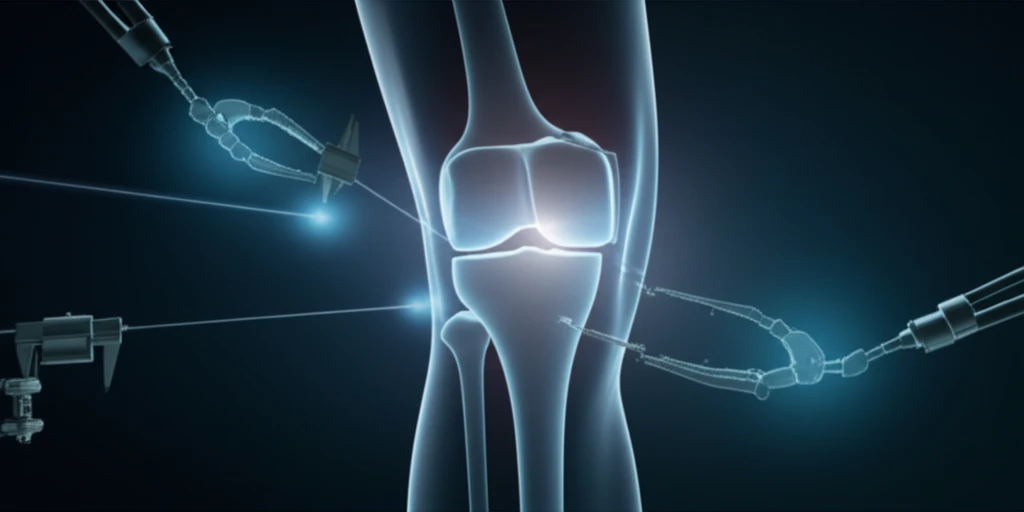
Knee Replacement Breakthrough: Customizing Alignment for Better Outcomes

"New research highlights how personalized alignment in knee replacement surgery can improve implant success, especially for women."
Total knee arthroplasty (TKA) stands as a cornerstone in orthopedic surgery, aimed at restoring function and alleviating pain for individuals grappling with severe knee joint damage. The procedure's success hinges significantly on the precise alignment of the implanted components, directly influencing the longevity and overall outcome of the replacement. Achieving optimal alignment ensures balanced weight distribution and reduces undue stress on the implant and surrounding tissues, thereby minimizing the risk of premature wear, loosening, or failure.
Traditionally, surgeons have relied on alignment systems, both intramedullary and extramedullary, to guide the positioning of the tibial component during TKA. These systems offer a standardized approach, aiming to replicate the natural biomechanics of the knee joint. However, emerging evidence suggests that a one-size-fits-all approach may not cater adequately to the diverse anatomical variations present across different populations and between genders.
Recent research focusing on Korean patients reveals significant differences in tibial morphology compared to Caucasian populations, particularly in the degree of varus bowing (a condition where the leg angles inward). These anatomical variations can impact the accuracy of traditional alignment systems, potentially leading to suboptimal implant positioning and compromised outcomes. Recognizing and addressing these population-specific differences is crucial for optimizing TKA results and ensuring long-term success for all patients.
Why Custom Alignment Matters for Knee Replacement Success
The primary goal of TKA is to replicate the natural alignment of the knee joint, ensuring proper weight distribution and minimizing stress on the implant. Traditional alignment systems often target a neutral mechanical axis, aiming for a straight leg alignment. However, studies have shown that a significant proportion of the population has a constitutional varus alignment, where the leg naturally angles slightly inward. For these individuals, forcing a neutral alignment may lead to abnormal joint loading and increased risk of implant failure.
- Improved Implant Longevity: Proper alignment reduces abnormal stress and wear on the implant, potentially extending its lifespan.
- Enhanced Joint Stability: Customized alignment can improve joint stability and reduce the risk of dislocation or instability.
- Reduced Pain and Improved Function: By restoring natural biomechanics, custom alignment can lead to reduced pain and improved functional outcomes.
- Better Range of Motion: Optimized alignment may facilitate a greater range of motion and improved knee flexibility.
The Future of Knee Replacement: Personalized Alignment for Optimal Outcomes
As our understanding of knee joint biomechanics and anatomical variations deepens, the future of TKA is likely to embrace personalized alignment strategies. By tailoring the alignment to each patient's unique characteristics, surgeons can potentially optimize implant positioning, improve joint function, and extend the longevity of the replacement. This may involve utilizing advanced imaging techniques, computer-assisted surgery, and patient-specific implants to achieve a truly customized approach to knee replacement.