
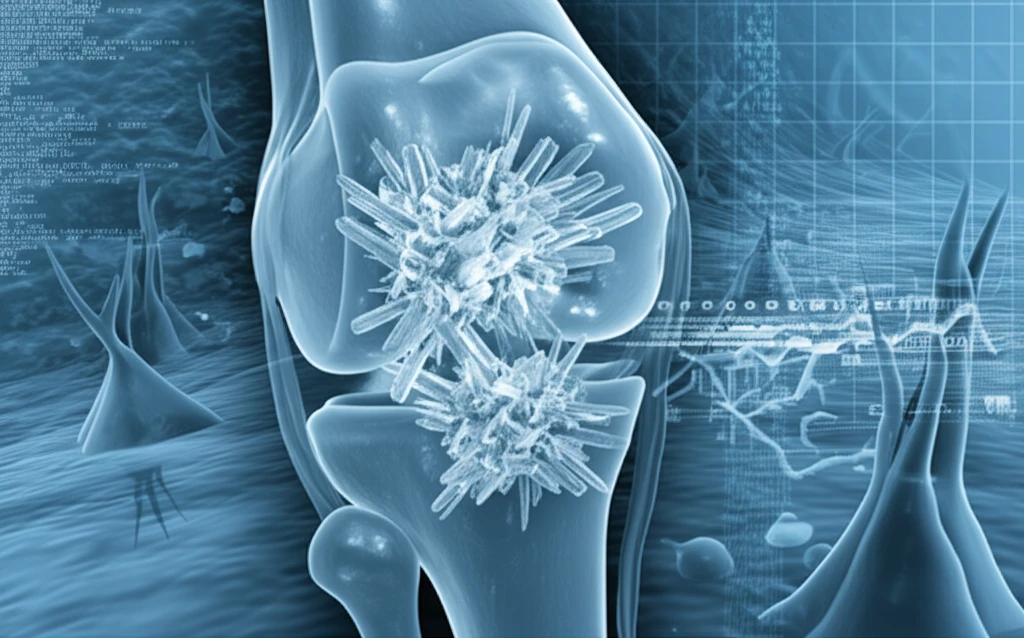
Microscopic view of BCP crystals inside a knee joint, symbolizing the potential link between crystals and osteoarthritis.

Knee Osteoarthritis and Bisphosphonates: Uncovering the Missing Link

"Could BCP crystals hold the key to understanding and treating knee osteoarthritis? Explore the potential connection and what it means for your joint health."


Knee osteoarthritis (OA) is a common and debilitating condition affecting millions worldwide. While factors like age, genetics, and lifestyle contribute to its development, the exact mechanisms driving OA remain elusive. Recent research has focused on the potential role of basic calcium phosphate (BCP) crystals in the onset and progression of knee OA, sparking new avenues for investigation and treatment strategies.

A letter from Murphy and McCarthy highlighted a potential connection between knee osteoarthritis and bisphosphonates, suggesting that BCP crystals could be the missing link in understanding this complex condition. This theory proposes that BCP crystals, which are found in the cartilage of individuals with OA, may contribute to inflammation and joint damage.

This article will delve into the potential role of BCP crystals in knee osteoarthritis, exploring the arguments for and against this hypothesis. We'll examine the current understanding of OA, the potential mechanisms by which BCP crystals could contribute to the disease, and the implications for future research and treatment.

Understanding the BCP Crystal Connection: How Might These Crystals Contribute to Knee OA?

Microscopic view of BCP crystals inside a knee joint, symbolizing the potential link between crystals and osteoarthritis.

The idea that BCP crystals play a significant role in knee OA stems from their presence in the cartilage of many individuals with the condition. These crystals can trigger inflammatory responses within the joint, potentially leading to cartilage degradation and pain. Here's a closer look at how BCP crystals might contribute to the development and progression of knee OA:

It's crucial to consider that knee OA is a multifactorial disease influenced by:

  • Genetics: Predisposition plays a significant role.
  • Lifestyle Factors: Obesity and physical activity.
  • Joint Alignment: Impact on stress distribution.
  • Muscle Strength: Affects joint stability.
The interplay between these elements underscores the complexity of addressing knee OA. Further research is needed to fully understand the role of BCP crystals, acknowledging the contributions of other risk factors.

The Future of Knee OA Research: Where Do BCP Crystals Fit In?

While the exact role of BCP crystals in knee OA remains under investigation, this area of research holds significant promise for developing new and more effective treatments. By gaining a deeper understanding of the mechanisms by which these crystals contribute to joint damage and inflammation, scientists can explore targeted therapies to reduce their impact. This could involve strategies to prevent crystal formation, dissolve existing crystals, or block the inflammatory pathways they trigger.

About this Article -

This article was crafted using a human-AI hybrid and collaborative approach. AI assisted our team with initial drafting, research insights, identifying key questions, and image generation. Our human editors guided topic selection, defined the angle, structured the content, ensured factual accuracy and relevance, refined the tone, and conducted thorough editing to deliver helpful, high-quality information.See our About page for more information.

This article is based on research published under:

DOI-LINK: 10.1136/annrheumdis-2018-214493, Alternate LINK

Title: Response To: ‘Knee Osteoarthritis And Bisphosphonates: Could Bcp Crystals Be The Missing Link?’ By Murphy Et Al

Subject: General Biochemistry, Genetics and Molecular Biology

Journal: Annals of the Rheumatic Diseases

Publisher: BMJ

Authors: Willem Lems

Published: 2018-11-02

Everything You Need To Know

1

What is the potential link between BCP crystals and knee osteoarthritis?

The potential link between Basic Calcium Phosphate (BCP) crystals and knee osteoarthritis (OA) is that these crystals are found in the cartilage of individuals with OA. They can trigger inflammation within the joint, potentially leading to cartilage degradation and pain. The presence of BCP crystals is considered a potential contributor to the onset and progression of knee OA, though the exact mechanisms are still under investigation. Understanding how BCP crystals contribute to joint damage and inflammation could lead to targeted therapies.

2

What are the known contributing factors to the development of knee osteoarthritis, besides BCP crystals?

Besides the potential role of Basic Calcium Phosphate (BCP) crystals, knee osteoarthritis (OA) is a multifactorial disease influenced by several other factors. These include genetics, which can predispose individuals to OA; lifestyle factors such as obesity and physical activity levels; joint alignment, which affects stress distribution within the joint; and muscle strength, which plays a role in joint stability. The interplay of these elements underlines the complexity of addressing knee OA.

3

How might BCP crystals trigger inflammation and joint damage in the context of knee osteoarthritis?

Basic Calcium Phosphate (BCP) crystals, when present in the cartilage of individuals with knee osteoarthritis (OA), can initiate inflammatory responses within the joint. This inflammatory process may lead to the degradation of cartilage, which is a key feature of OA. The crystals' presence and their ability to trigger inflammation are hypothesized to contribute to the pain and progressive damage associated with the condition. Further research aims to clarify these mechanisms.

4

What is the current understanding of knee osteoarthritis, and why is research into BCP crystals important?

The current understanding of knee osteoarthritis (OA) highlights it as a complex and debilitating condition, with its exact mechanisms still being investigated. Factors like age, genetics, and lifestyle contribute, but the complete picture remains elusive. Research into Basic Calcium Phosphate (BCP) crystals is important because these crystals are found in the cartilage of many individuals with OA and may trigger inflammation and joint damage. Understanding the role of BCP crystals could revolutionize treatment by providing new targeted therapies that prevent crystal formation, dissolve existing crystals, or block inflammatory pathways.

5

What future treatment strategies might be developed based on the research into BCP crystals and knee osteoarthritis?

Future treatment strategies based on the research into Basic Calcium Phosphate (BCP) crystals and knee osteoarthritis (OA) could focus on several key areas. Scientists could explore strategies to prevent the formation of BCP crystals within the joint. Another approach could involve developing methods to dissolve existing BCP crystals, potentially reducing their inflammatory effects. Additionally, researchers may investigate ways to block the inflammatory pathways triggered by BCP crystals, thereby mitigating joint damage and pain. The ultimate goal is to develop more effective and targeted therapies for those suffering from OA.

Newsletter Subscribe

Subscribe to get the latest articles and insights directly in your inbox.