
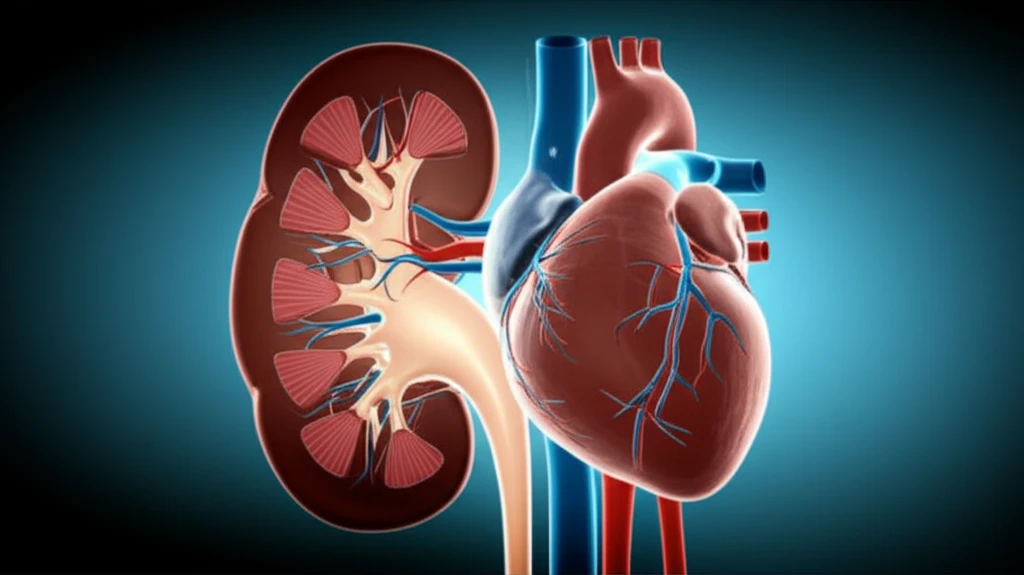
Surreal illustration of a heart and kidney intertwined, symbolizing the connection between cardiac and renal health in transplant success.

Kidney Transplants: Are We Missing a Trick? How Heart Scans Can Predict Success

"New research shows heart scans could revolutionize how we assess kidney transplant candidates, leading to better outcomes and longer lives."


For individuals with chronic kidney disease (CKD), a kidney transplant offers a renewed lease on life. However, the journey to transplantation is fraught with challenges, one of the most significant being cardiovascular disease (CAD). CAD is a leading cause of death in kidney transplant candidates, making it crucial to accurately assess and mitigate cardiac risks before transplantation.

Traditional methods of evaluating cardiac risk, such as assessing clinical risk factors, often fall short in accurately predicting outcomes. This has led researchers to explore more advanced imaging techniques to identify individuals at high risk of major adverse cardiac events (MACE) and mortality. Recent studies suggest that noninvasive stress imaging, despite its limitations, is a recommended approach, underscoring the ongoing quest for better diagnostic tools.

Now, a new study published in the Journal of the American College of Cardiology: Cardiovascular Imaging sheds light on the potential of heart scans to revolutionize the assessment of kidney transplant candidates. The study offers compelling evidence that coronary artery calcium scoring (CACS) and coronary computed tomography angiography (CTA) are superior to traditional risk factors and other cardiac imaging modalities in predicting outcomes. Let's dive into the details of this groundbreaking research and explore its implications for patient care.

Heart Scans vs. Traditional Risk Factors: Which Predicts Transplant Success?

Surreal illustration of a heart and kidney intertwined, symbolizing the connection between cardiac and renal health in transplant success.

The study, led by Simon Winther and colleagues, sought to compare the predictive value of clinical risk factors with various cardiac imaging modalities, including CACS, CTA, single-photon emission computed tomography (SPECT), and invasive coronary angiography (ICA). The researchers prospectively evaluated 154 patients referred for kidney transplantation, all of whom underwent CACS, CTA, SPECT, and ICA testing.

Here’s a breakdown of the key findings:

  • CACS: Both risk factors and CACS predicted death, but only CACS predicted MACE. Combining risk factors with CACS identified a very-low-risk group with a 2.1% MACE event rate and a 1.0% mortality rate per year.
  • CTA and ICA: Coronary CTA and ICA significantly predicted MACE, but only coronary CTA predicted death.
  • SPECT: SPECT did not predict either MACE or death.
These results suggest that CACS and CTA are more effective than traditional risk factors and SPECT in identifying kidney transplant candidates at high risk of adverse events. The ability to identify a very-low-risk cohort using a combination of risk factors and CACS is particularly promising, as it could help avoid unnecessary invasive procedures in this population.

The Future of Kidney Transplant Assessments

This study provides a compelling case for incorporating heart scans into the standard evaluation of kidney transplant candidates. By using CACS and CTA, clinicians can more accurately assess cardiovascular risk, identify low-risk individuals who may not require further invasive testing, and potentially improve long-term outcomes for transplant recipients. As research continues to evolve, expect to see more refined strategies that integrate advanced imaging techniques to personalize and optimize patient care in kidney transplantation.

About this Article -

This article was crafted using a human-AI hybrid and collaborative approach. AI assisted our team with initial drafting, research insights, identifying key questions, and image generation. Our human editors guided topic selection, defined the angle, structured the content, ensured factual accuracy and relevance, refined the tone, and conducted thorough editing to deliver helpful, high-quality information.See our About page for more information.

Everything You Need To Know

1

Why is assessing cardiovascular disease (CAD) so critical for kidney transplant candidates?

Cardiovascular disease (CAD) is a major concern for individuals with chronic kidney disease (CKD) seeking a kidney transplant. CAD is a leading cause of death in this population, making it crucial to accurately evaluate and mitigate cardiac risks before the procedure. Traditional methods often fall short in accurately predicting outcomes, necessitating more advanced imaging techniques to improve patient care and long-term health.

2

How do heart scans like CACS and CTA compare to traditional risk factors and other cardiac imaging modalities in predicting kidney transplant outcomes?

The study compared the predictive value of clinical risk factors, CACS, CTA, SPECT, and ICA. The key findings show that CACS and CTA are more effective than traditional risk factors and SPECT in identifying high-risk kidney transplant candidates. While both CACS and traditional risk factors predicted death, only CACS predicted MACE. Combining risk factors with CACS identified a very-low-risk group. CTA and ICA significantly predicted MACE, but only CTA predicted death. SPECT did not predict either MACE or death.

3

What are the specific benefits of using Coronary Artery Calcium Scoring (CACS) and Coronary Computed Tomography Angiography (CTA) in evaluating kidney transplant candidates?

CACS and CTA offer significant advantages over traditional methods. Using CACS and CTA, clinicians can more accurately assess cardiovascular risk. CACS is particularly useful in identifying a very-low-risk group when combined with risk factors, potentially avoiding unnecessary invasive procedures. CTA also helps in identifying individuals at high risk of major adverse cardiac events (MACE) and mortality. These heart scans provide a more precise assessment, leading to improved patient selection and better outcomes.

4

In the context of kidney transplants, what are MACE and how do heart scans help predict them?

MACE, or Major Adverse Cardiac Events, include serious cardiac events like heart attack and stroke, which can significantly impact the success of a kidney transplant. Heart scans, particularly CACS and CTA, are effective in predicting MACE. The study showed that CACS and CTA significantly predicted MACE, allowing clinicians to identify patients at high risk. This early identification enables proactive intervention and management of cardiovascular risks, improving the likelihood of a successful transplant and patient survival.

5

How might the use of heart scans, like CACS and CTA, impact the future of kidney transplant assessments and patient care?

Incorporating heart scans, specifically CACS and CTA, into the standard evaluation of kidney transplant candidates has the potential to revolutionize patient care. By providing a more accurate assessment of cardiovascular risk, clinicians can make more informed decisions about patient eligibility for transplant and the need for further invasive testing. This could lead to better patient selection, reduced complications, and improved long-term outcomes for transplant recipients. As research continues, there is potential for more refined strategies that integrate these advanced imaging techniques to personalize and optimize patient care in kidney transplantation.

Newsletter Subscribe

Subscribe to get the latest articles and insights directly in your inbox.