
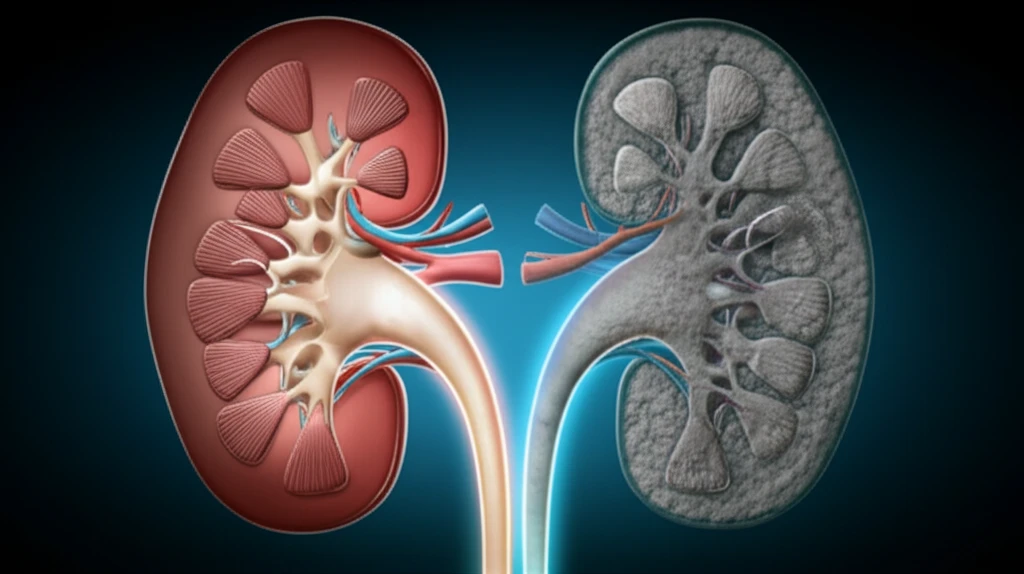
Illustration showing a healthy kidney linked to a damaged kidney by a glowing BMP signaling pathway.

Kidney Recovery Breakthrough: Can We Stop AKI from Turning into Chronic Kidney Disease?

"New research illuminates how stimulating a specific signaling pathway in kidney cells can prevent acute kidney injury from leading to long-term kidney damage."


Acute kidney injury (AKI) is a serious condition that can have lasting consequences. While the kidneys possess an impressive ability to repair themselves, severe or repeated AKI episodes can lead to maladaptive repair and the development of tubulointerstitial fibrosis, a hallmark of chronic kidney disease (CKD). Understanding the molecular pathways that govern kidney repair is crucial for developing effective treatments to prevent AKI from progressing to CKD.

Bone morphogenetic protein (BMP) signaling has emerged as a key player in modulating the development of renal fibrosis. Recent research has shed light on how canonical BMP signaling, mediated by SMAD1/5/8 transcription factors, plays a protective role in kidney recovery after AKI. This article delves into the groundbreaking findings of a study that uncovers the mechanisms by which BMP signaling in tubular cells prevents the progression of AKI to CKD.

The study focuses on the activation of BMP signaling in tubular cells, the cells lining the kidney tubules responsible for filtering waste and maintaining fluid balance. By investigating mice with a specific deletion of the BMP receptor 1A (BMPR1A) in tubular cells, researchers were able to demonstrate the crucial role of BMP signaling in suppressing pro-fibrotic pathways and promoting kidney regeneration.

How BMP Signaling Works to Protect Your Kidneys

Illustration showing a healthy kidney linked to a damaged kidney by a glowing BMP signaling pathway.

The research team began by observing the natural activity of BMP signaling in healthy kidneys. They found that canonical BMP signaling, mediated by SMAD1/5/8, was constitutively active in the tubular cells of healthy mice. However, after inducing ischemia reperfusion injury (IRI), a condition that mimics AKI, this signaling was temporarily reduced. Interestingly, in mice that successfully recovered from IRI, BMP signaling was reactivated during the tubular regeneration process.

To further investigate the role of BMP signaling, the researchers created mice with a tubular-specific deletion of BMPR1A, a key receptor in the BMP signaling pathway. These mice were unable to reactivate SMAD1/5/8 signaling in the post-ischemic phase after IRI. The results were striking: these mice developed renal fibrosis after injury, indicating that BMPR1A plays a crucial role in preventing the progression of AKI to CKD.

  • Identifying Key Target Genes: The research team used unbiased genomic analyses to identify the genes targeted by BMPR1A-SMAD1/5/8 signaling. They discovered that three genes encoding inhibitor of DNA-binding (ID) proteins (Id1, Id2, and Id4) were key targets.
  • The Role of ID Proteins: In BMPR1A-deficient mice, these ID target genes failed to re-induce following IRI. Instead, the deficiency resulted in the activation of pro-fibrotic signaling proteins normally repressed by ID proteins.
  • P38 MAPK and p27 Activation: Specifically, the researchers observed the activation of p38 mitogen-activated protein kinase (p38 MAPK) and cell cycle inhibitor p27. These proteins are typically kept in check by ID proteins, suggesting that BMP signaling through ID proteins is essential for suppressing pro-fibrotic signals.
These findings suggest that the post-ischemic activation of canonical BMP signaling acts endogenously to repress pro-fibrotic signaling in tubular cells. By keeping these pro-fibrotic pathways in check, BMP signaling may help prevent the progression of AKI to CKD, offering a potential therapeutic target for preventing long-term kidney damage.

Future Implications and Therapeutic Potential

This research provides a strong rationale for exploring therapeutic interventions that target the BMP signaling pathway to prevent AKI from progressing to CKD. By understanding the precise mechanisms by which BMP signaling regulates pro-fibrotic pathways, researchers can develop targeted therapies that promote kidney regeneration and prevent long-term damage. These findings offer hope for improved outcomes for individuals at risk of developing chronic kidney disease after experiencing acute kidney injury.

About this Article -

This article was crafted using a human-AI hybrid and collaborative approach. AI assisted our team with initial drafting, research insights, identifying key questions, and image generation. Our human editors guided topic selection, defined the angle, structured the content, ensured factual accuracy and relevance, refined the tone, and conducted thorough editing to deliver helpful, high-quality information.See our About page for more information.

Everything You Need To Know

1

What is the main focus of the research discussed, and why is it significant?

The main focus is the activation of the BMP signaling pathway in tubular cells to prevent the progression of acute kidney injury (AKI) to chronic kidney disease (CKD). This is significant because AKI can lead to CKD, a serious condition, and understanding the molecular pathways involved can lead to effective treatments. The research highlights the protective role of BMP signaling, mediated by SMAD1/5/8 transcription factors, in kidney recovery after AKI.

2

How does the BMP signaling pathway protect the kidneys after an acute kidney injury (AKI)?

The BMP signaling pathway protects the kidneys by activating SMAD1/5/8 transcription factors in tubular cells. This activation suppresses pro-fibrotic pathways and promotes kidney regeneration. The research found that the BMP signaling pathway targets genes encoding inhibitor of DNA-binding (ID) proteins (Id1, Id2, and Id4). In BMPR1A-deficient mice, these ID target genes failed to re-induce following IRI, resulting in the activation of pro-fibrotic signaling proteins. The activation of p38 MAPK and cell cycle inhibitor p27 were observed, suggesting that BMP signaling through ID proteins is essential for suppressing pro-fibrotic signals. This prevents AKI from turning into CKD.

3

What role do ID proteins play in kidney recovery after an AKI, and how does BMP signaling influence them?

ID proteins (Id1, Id2, and Id4) are key targets of the BMPR1A-SMAD1/5/8 signaling pathway. These proteins act to suppress pro-fibrotic signaling. When BMP signaling is active, it promotes the expression of ID proteins, which in turn, keep pro-fibrotic pathways in check. In mice lacking the BMPR1A receptor, the ID target genes failed to activate after injury, leading to the activation of pro-fibrotic signals and ultimately, renal fibrosis and CKD.

4

What are the implications of these findings for future treatments of AKI and CKD?

The research provides a strong basis for exploring therapeutic interventions that target the BMP signaling pathway. By understanding the mechanisms by which BMP signaling regulates pro-fibrotic pathways, researchers can develop targeted therapies that promote kidney regeneration and prevent long-term damage. This suggests the possibility of developing drugs or treatments that can activate or enhance BMP signaling to protect the kidneys after an acute injury, reducing the risk of developing CKD and improving outcomes for those at risk.

5

Can you describe the process by which researchers investigated BMP signaling in the context of AKI?

Researchers began by observing the natural activity of BMP signaling in healthy kidneys, noting the constitutive activity of SMAD1/5/8 in tubular cells. They then induced ischemia reperfusion injury (IRI), mimicking AKI, and observed a temporary reduction in BMP signaling. In mice that recovered from IRI, BMP signaling was reactivated during tubular regeneration. To further investigate, they created mice with a tubular-specific deletion of BMPR1A, a key receptor in the BMP signaling pathway. These mice were unable to reactivate SMAD1/5/8 signaling after IRI and developed renal fibrosis. They then used unbiased genomic analyses to identify the genes targeted by BMPR1A-SMAD1/5/8 signaling, discovering the role of ID proteins and the activation of p38 MAPK and p27 in BMPR1A-deficient mice.

Newsletter Subscribe

Subscribe to get the latest articles and insights directly in your inbox.