
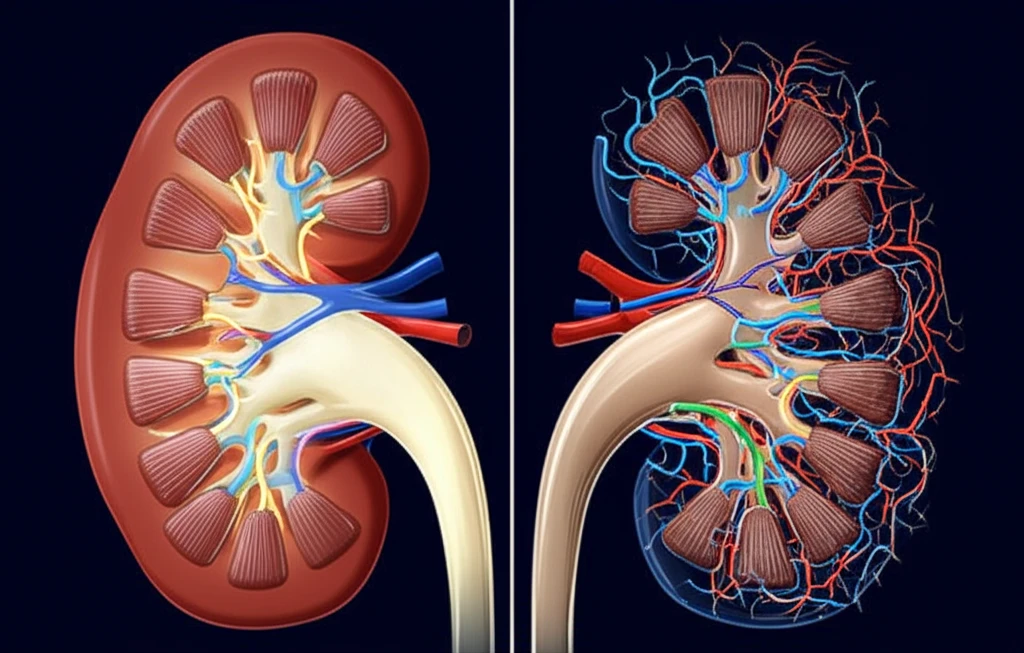
Healthy kidney with interwoven light pathways contrasting against a damaged kidney.

Kidney Recovery Breakthrough: Can We Prevent Chronic Kidney Disease After Injury?

"New research uncovers how stimulating a specific signaling pathway in kidney cells may prevent the progression of acute kidney injury to chronic kidney disease."


Acute kidney injury (AKI) is a serious condition that significantly increases the risk of developing chronic kidney disease (CKD). While kidneys possess a remarkable capacity for repair, severe or repeated AKI episodes can lead to maladaptive repair processes and the development of tubulointerstitial fibrosis, a hallmark of CKD.

Understanding the molecular pathways that determine whether the kidney recovers fully or progresses to chronic damage is crucial for developing effective treatments. Recent studies have focused on the bone morphogenetic protein (BMP) signaling pathway as a key player in this process.

A groundbreaking study published in Kidney International sheds light on how canonical BMP signaling in tubular cells can mediate recovery after acute kidney injury. Researchers have identified a specific mechanism that, when activated, helps prevent the progression of AKI to CKD, offering potential new therapeutic targets.

How Does BMP Signaling Work in Kidney Recovery?

Healthy kidney with interwoven light pathways contrasting against a damaged kidney.

BMPs are part of the transforming growth factor-β superfamily and communicate by binding to type II BMP receptors. This initiates a cascade where type II receptors activate type I BMP receptors (BMPR1A and BMP receptor 1B), which then recruit and phosphorylate SMAD proteins (SMAD1, SMAD5, and SMAD8).

These phosphorylated SMAD proteins form complexes with SMAD4, allowing them to enter the nucleus and regulate the transcription of specific target genes. This intricate signaling pathway has been shown to influence renal fibrosis and CKD progression.

  • Constitutive Activity: In healthy kidneys, canonical BMP signaling via SMAD1/5/8 is continuously active in renal tubules.
  • Transient Downregulation: After an ischemic event, this signaling is temporarily reduced.
  • Reactivation is Key: Successful tubular regeneration sees a reactivation of this BMP signaling.
To investigate the role of BMPR1A, researchers studied mice with a specific deletion of this receptor in their tubules. They observed that these mice couldn't reactivate SMAD1/5/8 signaling post-ischemia and subsequently developed renal fibrosis. This suggested that BMPR1A plays a protective role during kidney injury.

A New Path Forward in Kidney Disease?

This research highlights the potential of harnessing the BMP signaling pathway to prevent the progression from AKI to CKD. By understanding and stimulating the mechanisms that promote kidney cell recovery, scientists hope to develop new therapeutic interventions that improve outcomes for individuals at risk of chronic kidney disease.

About this Article -

This article was crafted using a human-AI hybrid and collaborative approach. AI assisted our team with initial drafting, research insights, identifying key questions, and image generation. Our human editors guided topic selection, defined the angle, structured the content, ensured factual accuracy and relevance, refined the tone, and conducted thorough editing to deliver helpful, high-quality information.See our About page for more information.

Everything You Need To Know

1

What exactly is Acute Kidney Injury, and why should I be concerned about it?

Acute Kidney Injury (AKI) is when the kidneys suddenly stop working properly. This is significant because AKI can increase the risk of developing Chronic Kidney Disease (CKD). AKI can result from things like reduced blood flow to the kidneys, certain medications, or infections. Although kidneys can often repair themselves, severe or repeated AKI can lead to maladaptive repair and tubulointerstitial fibrosis, which is a key characteristic of CKD.

2

What is the BMP signaling pathway, and why is it so important for kidney health?

The Bone Morphogenetic Protein (BMP) signaling pathway is a crucial communication system within kidney cells. It's important because it appears to play a key role in determining whether a kidney recovers fully after an injury or progresses to chronic damage. The BMP signaling pathway involves a series of proteins, including BMP receptors and SMAD proteins, that work together to regulate gene expression and influence processes like renal fibrosis and CKD progression. Understanding this pathway could allow for new treatments.

3

How does BMP signaling actually work inside kidney cells?

BMPs communicate by binding to type II BMP receptors, initiating a cascade. The type II receptors activate type I BMP receptors (BMPR1A and BMP receptor 1B), which then recruit and phosphorylate SMAD proteins (SMAD1, SMAD5, and SMAD8). These phosphorylated SMAD proteins form complexes with SMAD4, allowing them to enter the nucleus and regulate the transcription of specific target genes. This process is crucial because it influences renal fibrosis and CKD progression. It is important to note the transforming growth factor-β superfamily is also involved.

4

How does BMP signaling change in the kidney after an injury?

In healthy kidneys, canonical BMP signaling via SMAD1/5/8 is continuously active in renal tubules. After an ischemic event, this signaling is temporarily reduced. Successful tubular regeneration sees a reactivation of this BMP signaling. It is important because it highlights the dynamic nature of BMP signaling in the kidney and its role in maintaining kidney health and promoting recovery after injury. The temporary downregulation and subsequent reactivation of this signaling are critical steps in the kidney's response to injury.

5

What did the researchers find out about BMPR1A in their studies, and why is it significant?

Researchers studied mice with a specific deletion of BMPR1A in their tubules and observed that these mice couldn't reactivate SMAD1/5/8 signaling post-ischemia and subsequently developed renal fibrosis. This suggests that BMPR1A plays a protective role during kidney injury. The implications are that BMPR1A could be a potential target for therapeutic interventions aimed at preventing the progression of AKI to CKD. Understanding the role of BMPR1A could lead to new treatments.

Newsletter Subscribe

Subscribe to get the latest articles and insights directly in your inbox.