
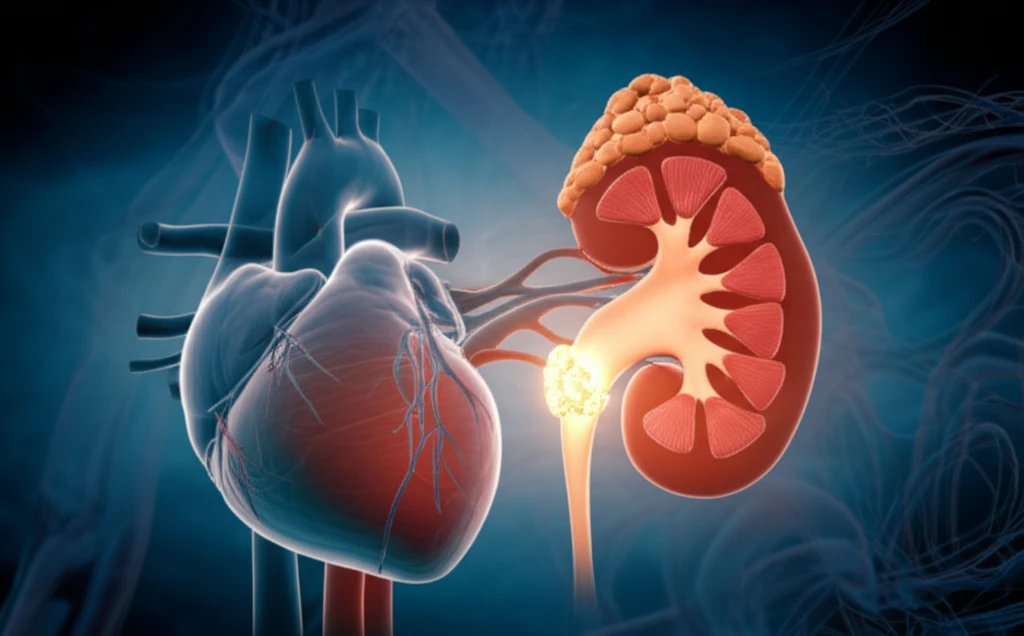
Illustration depicting the heart, kidney, and parathyroid gland connected, showing the relationship between organs.

Kidney Health & Your Heart: How a Tiny Gland Impacts Both

"New research reveals the surprising link between your parathyroid, kidney health, and heart function."


Most people know their kidneys are vital, but few realize how intimately connected they are to the heart. What's even less known is the critical role a tiny gland in your neck, the parathyroid, plays in this delicate balance. Recent research has uncovered fascinating links between the parathyroid, kidney health, and heart function, opening new avenues for understanding and managing these interconnected systems.

This article delves into a groundbreaking study exploring the effects of parathyroidectomy (PTX) – the surgical removal of the parathyroid glands – on blood bone markers and heart rate variability (HRV) in patients with stage 5 chronic kidney disease (CKD). We'll unravel how these seemingly disparate elements are intertwined, offering insights that could transform how we approach kidney and heart health.

Prepare to be surprised as we explore how this tiny gland influences your well-being, offering practical implications for those with kidney disease and valuable information for anyone interested in maintaining optimal health.

The Parathyroid's Surprising Role: More Than Just Bones

Illustration depicting the heart, kidney, and parathyroid gland connected, showing the relationship between organs.

The parathyroid glands, four pea-sized structures located near the thyroid, are primarily known for regulating calcium levels in the blood. They achieve this by producing parathyroid hormone (PTH), which influences bone health and calcium absorption. However, as research progresses, we are learning that the parathyroid's influence extends far beyond the skeletal system.

In patients with CKD, the kidneys' ability to regulate calcium and phosphate becomes impaired. This can lead to a condition called secondary hyperparathyroidism (SHPT), where the parathyroid glands become overactive, producing excessive PTH. This overproduction can result in elevated levels of certain bone markers and other complications.

  • iPTH (intact parathyroid hormone): This hormone is a key regulator of bone remodeling.
  • BAP (bone-specific alkaline phosphatase): This enzyme indicates bone formation activity.
  • TRACP-5b (tartrate-resistant acid phosphatase 5b): This enzyme signals bone resorption.
  • FGF23 (fibroblast growth factor 23): This hormone is involved in phosphate and vitamin D regulation.
This study examined how these bone markers relate to HRV in CKD patients. HRV is a measure of the variation in time intervals between heartbeats, reflecting the autonomic nervous system's function. Reduced HRV is often associated with an increased risk of cardiovascular events. The research found that the levels of these bone markers were significantly elevated in CKD patients and were linked to decreased HRV.

Looking Ahead: Implications for Health and Management

This research highlights the importance of managing CKD-MBD and its impact on heart health. By understanding the interplay between the parathyroid, bone markers, and HRV, healthcare professionals can develop more tailored interventions. While more research is needed, this study provides a valuable framework for future studies, underscoring the importance of a holistic approach to patient care. This includes monitoring bone health, addressing PTH imbalances, and promoting overall cardiovascular well-being. By doing so, we can improve the lives of those affected by kidney disease, giving them a stronger heart for a healthier future.

About this Article -

This article was crafted using a human-AI hybrid and collaborative approach. AI assisted our team with initial drafting, research insights, identifying key questions, and image generation. Our human editors guided topic selection, defined the angle, structured the content, ensured factual accuracy and relevance, refined the tone, and conducted thorough editing to deliver helpful, high-quality information.See our About page for more information.

This article is based on research published under:

DOI-LINK: 10.1007/s11255-018-1995-6, Alternate LINK

Title: Effects Of Parathyroidectomy On Blood Bone Markers And Heart Rate Variability In Patients With Stage 5 Chronic Kidney Disease

Subject: Urology

Journal: International Urology and Nephrology

Publisher: Springer Science and Business Media LLC

Authors: Huimin Chen, Ying Cui, Changying Xing, Yogendranath Purrunsing, Xiaoming Zha, Chong Shen, Ming Zeng, Guang Yang, Xiangbao Yu, Lina Zhang, Yao Jiang, Zhixiang Shen, Haoyang Ma, Caixia Yin, Yunfei Li, Ningning Wang

Published: 2018-10-25

Everything You Need To Know

1

What role does the parathyroid gland play in maintaining overall health, and why is it important to understand its function?

The parathyroid glands, though small, are critical for regulating calcium levels in the blood by producing parathyroid hormone (PTH). This hormone influences bone health and calcium absorption. Understanding the parathyroid's function is important because its influence extends beyond the skeletal system, affecting kidney health and heart function, especially in individuals with chronic kidney disease (CKD). Imbalances in PTH can lead to complications like secondary hyperparathyroidism (SHPT), affecting bone markers and heart rate variability (HRV).

2

How does chronic kidney disease (CKD) affect the parathyroid gland and lead to secondary hyperparathyroidism (SHPT)?

In individuals with CKD, the kidneys' ability to regulate calcium and phosphate becomes impaired, leading to secondary hyperparathyroidism (SHPT). The parathyroid glands become overactive in response, producing excessive parathyroid hormone (PTH). This overproduction results in elevated levels of bone markers like iPTH, BAP, TRACP-5b, and FGF23, contributing to bone remodeling issues and decreased heart rate variability (HRV). Monitoring and managing PTH imbalances is crucial in CKD patients to mitigate these effects.

3

What are bone markers, such as iPTH, BAP, TRACP-5b, and FGF23, and how do they relate to heart rate variability (HRV) in patients with chronic kidney disease (CKD)?

Bone markers such as iPTH (intact parathyroid hormone), BAP (bone-specific alkaline phosphatase), TRACP-5b (tartrate-resistant acid phosphatase 5b), and FGF23 (fibroblast growth factor 23) are indicators of bone remodeling activity. iPTH regulates bone remodeling, BAP indicates bone formation, TRACP-5b signals bone resorption, and FGF23 is involved in phosphate and vitamin D regulation. In CKD patients, elevated levels of these bone markers are linked to decreased heart rate variability (HRV), a measure of the variation in time intervals between heartbeats, reflecting the autonomic nervous system's function and increased risk of cardiovascular events.

4

What is parathyroidectomy (PTX), and why is it relevant in the context of managing kidney disease and heart health?

Parathyroidectomy (PTX) is the surgical removal of the parathyroid glands. It's relevant in managing kidney disease and heart health because it addresses secondary hyperparathyroidism (SHPT), a condition common in chronic kidney disease (CKD) where the parathyroid glands overproduce parathyroid hormone (PTH). By removing the overactive glands, PTX aims to restore calcium balance, reduce bone marker levels, and improve heart rate variability (HRV), thus decreasing the risk of cardiovascular events associated with CKD-MBD.

5

Beyond medical interventions like parathyroidectomy, what lifestyle adjustments and holistic approaches can individuals with kidney disease adopt to support both their kidney and heart health?

Beyond medical interventions like parathyroidectomy (PTX), individuals with kidney disease can adopt several lifestyle adjustments and holistic approaches to support both kidney and heart health. These include dietary management to control phosphate and calcium levels, regular monitoring of bone markers such as iPTH, BAP, TRACP-5b, and FGF23, and promoting overall cardiovascular well-being through exercise and stress reduction techniques. Addressing parathyroid hormone (PTH) imbalances and maintaining a healthy heart rate variability (HRV) are crucial components of comprehensive care.

Newsletter Subscribe

Subscribe to get the latest articles and insights directly in your inbox.