
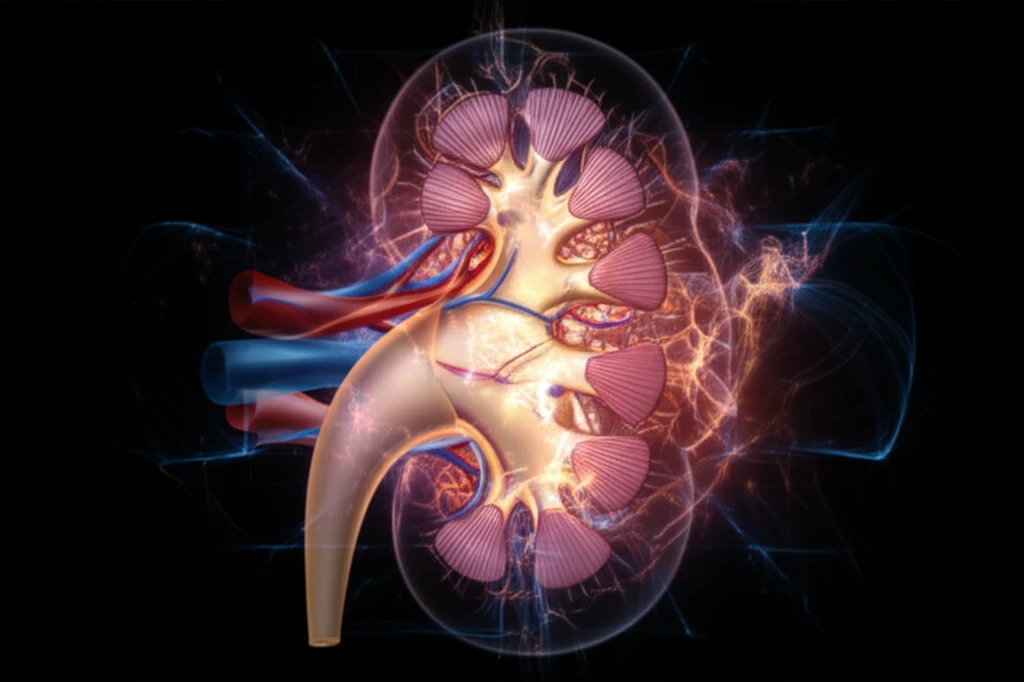
Stylized kidney with glowing pathways representing methylglyoxal levels.

Kidney Disease Breakthrough: New Hope with Methylglyoxal?

"Could monitoring methylglyoxal levels revolutionize chronic kidney disease prognosis and treatment?"


Chronic kidney disease (CKD) is a growing global health crisis, affecting millions worldwide. Its silent progression often leads to serious complications, including hypertension, cardiovascular events, and end-stage renal disease (ESRD). Early detection and effective management are crucial for slowing the disease's advancement and improving patient outcomes.

Advanced glycation end products (AGEs) and their precursors have emerged as significant contributors to vascular damage through oxidative stress. Scientists are particularly interested in how substances like methylglyoxal (MG), 3-deoxyglucosone (3-DG), and pentosidine might influence the course of CKD.

A groundbreaking study has investigated the prognostic value of methylglyoxal (MG) in patients with chronic kidney disease (CKD). This research sheds light on how MG levels could be a game-changer in predicting disease progression and tailoring treatment plans.

The Methylglyoxal Connection: What the Study Revealed

Stylized kidney with glowing pathways representing methylglyoxal levels.

A prospective observational study was conducted over three years, involving 150 outpatients with CKD in stages 3 to 5. Researchers measured plasma concentrations of MG, 3-DG, and pentosidine at the beginning of the study and divided patients into tertiles based on these concentrations. The primary endpoint was defined as death, a cardiovascular event, or progression to end-stage renal disease.

The study's findings highlighted a significant association between MG levels and CKD outcomes:

  • Higher MG concentrations were linked to poorer survival rates.
  • MG was identified as an independent risk factor for the primary endpoint, even after adjusting for other baseline characteristics.
  • Unlike MG, 3-DG and pentosidine were not found to be related to the primary outcome.
These results suggest that monitoring MG levels could offer valuable insights into the prognosis of CKD patients. "MG has a close clinical association with CKD," the researchers noted. "Higher MG concentrations may contribute [to] renal function deterioration in CKD. In CKD patients, MG concentration might be useful when determining the prognosis."

The Future of CKD Management: A Personalized Approach?

This study opens exciting new avenues for managing chronic kidney disease. By incorporating MG level monitoring into routine clinical practice, healthcare professionals may be able to:

About this Article -

This article was crafted using a human-AI hybrid and collaborative approach. AI assisted our team with initial drafting, research insights, identifying key questions, and image generation. Our human editors guided topic selection, defined the angle, structured the content, ensured factual accuracy and relevance, refined the tone, and conducted thorough editing to deliver helpful, high-quality information.See our About page for more information.

Everything You Need To Know

1

What is Chronic Kidney Disease?

Chronic Kidney Disease (CKD) is a long-term condition where the kidneys don't function properly. This can lead to a buildup of toxins in the body and, if left unmanaged, can progress to End-Stage Renal Disease (ESRD), requiring dialysis or a kidney transplant. Early detection and management of CKD are crucial to slow its progression and prevent complications such as hypertension and cardiovascular events.

2

Why is Methylglyoxal important in the context of kidney disease?

Methylglyoxal (MG) is significant because studies suggest it can serve as an indicator of disease progression in individuals with Chronic Kidney Disease (CKD). Elevated levels of Methylglyoxal (MG) have been associated with poorer survival rates and are identified as an independent risk factor for adverse outcomes, like progression to End-Stage Renal Disease (ESRD) or cardiovascular events. Monitoring Methylglyoxal (MG) levels can potentially help in early detection and personalized treatment strategies for Chronic Kidney Disease (CKD).

3

What are Advanced Glycation End Products, and why are they important in Chronic Kidney Disease?

Advanced Glycation End Products (AGEs) are compounds that form when sugar molecules bind to proteins or fats. In the context of Chronic Kidney Disease (CKD), Advanced Glycation End Products (AGEs) are significant because they contribute to vascular damage through oxidative stress, potentially worsening the condition. Substances like Methylglyoxal (MG), 3-deoxyglucosone (3-DG), and pentosidine are precursors to Advanced Glycation End Products (AGEs) and are being studied for their influence on the course of Chronic Kidney Disease (CKD).

4

What were the key findings of the study regarding Methylglyoxal levels and Chronic Kidney Disease outcomes?

The study found that higher concentrations of Methylglyoxal (MG) were linked to poorer survival rates in Chronic Kidney Disease (CKD) patients. Methylglyoxal (MG) was also identified as an independent risk factor for adverse outcomes such as death, cardiovascular events, or progression to End-Stage Renal Disease (ESRD). Unlike Methylglyoxal (MG), other substances studied, like 3-deoxyglucosone (3-DG) and pentosidine, were not found to have a significant relationship with the primary outcome.

5

How might monitoring Methylglyoxal levels improve the management of Chronic Kidney Disease?

By incorporating Methylglyoxal (MG) level monitoring into routine clinical practice, healthcare professionals may be able to gain valuable insights into the prognosis of patients with Chronic Kidney Disease (CKD). This approach could enable early interventions and personalized treatment plans tailored to individual patient needs, potentially improving outcomes and slowing the progression of the disease. This proactive strategy can also provide patients with timely access to necessary support and resources.

Newsletter Subscribe

Subscribe to get the latest articles and insights directly in your inbox.