
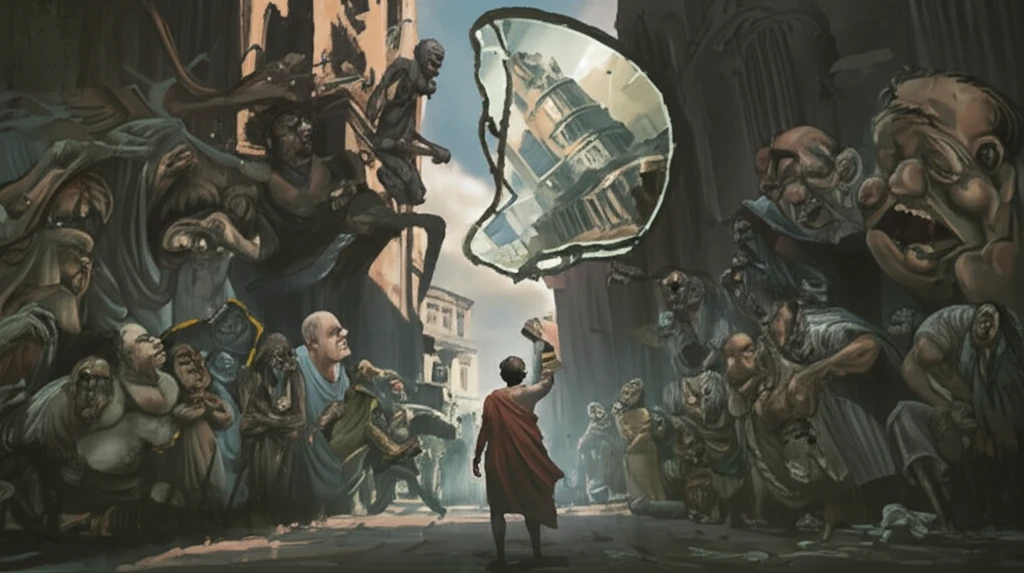
Juvenal: Unmasking Roman Society's Dark Side - A Modern Guide to Ancient Satire

"Explore the timeless relevance of Juvenal's biting critiques, from political corruption to social hypocrisy, and discover why his words still resonate today."
Imagine a world where political corruption, social hypocrisy, and moral decay run rampant. Now, picture a writer brave enough to expose it all with biting wit and savage irony. This was the Rome of Juvenal, a satirist whose words still echo through the centuries. Juvenal, also known as Decimus Iunius Iuvenalis, lived in a Rome rife with excess and inequality during the late 1st and early 2nd centuries CE. His Satires offer a dark, often humorous, glimpse into the lives of those who inhabited this world.
Juvenal's work provides a window into the complex and often contradictory values of Roman society. While his satire is deeply rooted in his time, the themes he explores—the abuse of power, the emptiness of materialism, and the struggle for personal integrity—remain strikingly relevant. For today's audience, grappling with similar issues, Juvenal's writings offer both historical insight and a provocative mirror reflecting our own society.
This article seeks to unpack Juvenal's legacy, exploring the key themes and stylistic elements that made him such a compelling figure. We'll examine how his work was received in antiquity and how it continues to be interpreted and reinterpreted today. So, let's journey back to ancient Rome and discover why Juvenal's satire continues to resonate with modern readers.
Juvenal's Enduring Legacy
Decimus Junius Juvenalis, known as Juvenal (c. AD 55–128), authored 16 satirical poems published in five books between 100–127 AD that survive in nearly 500 manuscripts. His Satires address perceived societal threats including socially ascendant foreigners, infidelity, and aristocratic excess. Phrases like 'bread and circuses' and 'Who will guard the guards themselves?' have entered common parlance, demonstrating his lasting cultural impact. Juvenal is widely regarded as the most powerful of all Roman satiric poets.
Scholarly Approaches to Juvenal
Scholars traditionally approach Juvenal through literary analysis of his satirical techniques, historical contextualization of his references to late first and early second century figures, and textual criticism of the manuscript tradition. The fragmentary biographical details and uncertainty around composition dates create inherent limitations in reconstructing his precise intentions. Modern interpretations must navigate the gap between Juvenal's persona as an indignant moralist and the literary artifice of his poetic voice.
Juvenal in Historical Context
Classicist Edith Hamilton characterized Juvenal as a 'sensible genius who hated himself for accepting table scraps tossed to him by men he hated,' highlighting his complex relationship with patronage. He was a contemporary of Tacitus (c. 56–118 CE), and Hamilton argued that the great literature of the first two centuries CE brought about its own destruction. After two centuries of obscurity, Juvenal was widely read from late antiquity through the Middle Ages, establishing his foundational role in the satirical tradition.
What Made Juvenal's Satire So Powerful?
Juvenal's Satires are characterized by their raw, unflinching portrayal of Roman life. Unlike some of his predecessors, who favored a more subtle approach, Juvenal went straight for the jugular, using vivid imagery and scathing language to expose the moral failings of his contemporaries. This directness, combined with his mastery of poetic form, made his satire both effective and memorable. Juvenal's writing, penned in hexameter verse, showcased the follies and vices prevalent during the late Flavian and early Hadrianic periods. His work wasn't just a chronicle of events; it was an outright assault on moral depravity and societal decay.
- Targets of Juvenal's Satire:
- Corrupt politicians who abused their power for personal gain.
- Social climbers obsessed with status and wealth.
- Degenerate aristocrats indulging in extravagance and vice.
- Foreign immigrants, who were often the subject of xenophobic anxieties.
- Women, who Juvenal often presented with misogynistic undertones.
Current Scholarship Trends
Recent scholarship continues to debate the dating, structure, and philosophical stance of Juvenal's Satires, with some arguing for a development from aggressive indignation to more ironic detachment across the corpus. Textual critics work to establish authoritative editions from the manuscript tradition, while literary scholars examine intertextuality with earlier satirists like Lucilius and Horace. The relationship between Juvenal's poetic persona and historical reality remains a central methodological challenge.
Critiques of Juvenal's Vision
Critics have long noted Juvenal's misogynistic portrayal of Roman women, xenophobic depictions of foreigners, and potential exaggeration for satirical effect that complicates historical reliability. Some argue his indignation masks conservative nostalgia rather than genuine reformist impulse. The extreme obscenity and violence in certain satires have led readers from antiquity to the present to question whether Juvenal's cure is worse than the societal ills he diagnoses.
Juvenal Among Satirists
Juvenalian satire—named for his unrelenting, abrasive style—stands in contrast to the more urbane, conversational Horatian mode, establishing a binary that structures Western satirical theory. Unlike Lucilius' fragmentary experimentation or Persius' condensed Stoic allegory, Juvenal's sixteen poems form a sustained, systematic anatomy of Roman vice. His influence extends through the Renaissance revival of satire to modern practitioners who adopt his unflinching moral outrage as a rhetorical strategy.
The Enduring Relevance of Juvenal's Satire
Juvenal's work has continued to be read and studied for centuries, not only for its historical value but also for its artistic merit. His vivid language, memorable characters, and biting wit have inspired countless writers and artists. From the Middle Ages to the modern era, Juvenal's influence can be seen in various forms of literature, art, and political discourse. His work serves as a reminder of the enduring power of satire to challenge authority, expose hypocrisy, and provoke social change. So, the next time you encounter political corruption or social absurdity, remember Juvenal and his timeless satire. His voice, though ancient, continues to speak to us today, urging us to question the world around us and to strive for a more just and equitable society.
Assessing Juvenal's Significance
Juvenal occupies a unique position as both a documentarian of Roman social history and a literary architect whose satiric persona shaped the genre's evolution. His work simultaneously reflects elite anxieties about status, gender, and identity in the early Empire while constructing a rhetorical framework for moral critique that transcends its historical moment. The tension between Juvenal as historical witness and Juvenal as literary construct continues to animate scholarly discourse.
Emerging Directions in Juvenal Studies
Scholarship increasingly traces a stylistic evolution in Juvenal's corpus from aggressive social critique toward more ironic, reflective modes, suggesting a sophisticated development rather than mere repetition. Digital humanities projects are mapping manuscript transmission and intertextual networks at new scales. The categories of Juvenalian satire continue to inform contemporary satire studies, while reception history examines how each era reshapes Juvenal for its own critical purposes.
Satire and Power Structures
Juvenal's work illuminates how satire functions within authoritarian systems—simultaneously tolerated as a safety valve and dangerous as truth-telling. The obscure motives behind attempted suppression of verse satire in Rome echo modern tensions between power and comedic critique. His focus on systemic corruption, performative virtue, and the complicity of audiences resonates across historical contexts where satirists navigate censorship, co-option, and the limits of ridicule as resistance.
Juvenal's Living Voice
Readers across millennia have recognized in Juvenal's 'ruthless, obscene, snarling criticism' a visceral human response to injustice, hypocrisy, and the degradation of public life. His unflinching depiction of Rome's dangers—the crumbling tenements, predatory patrons, performative piety—gives voice to those marginalized by imperial grandeur. The enduring circulation of his phrases in modern discourse testifies to satire's power to name the unnamed and make the intolerable speakable.