
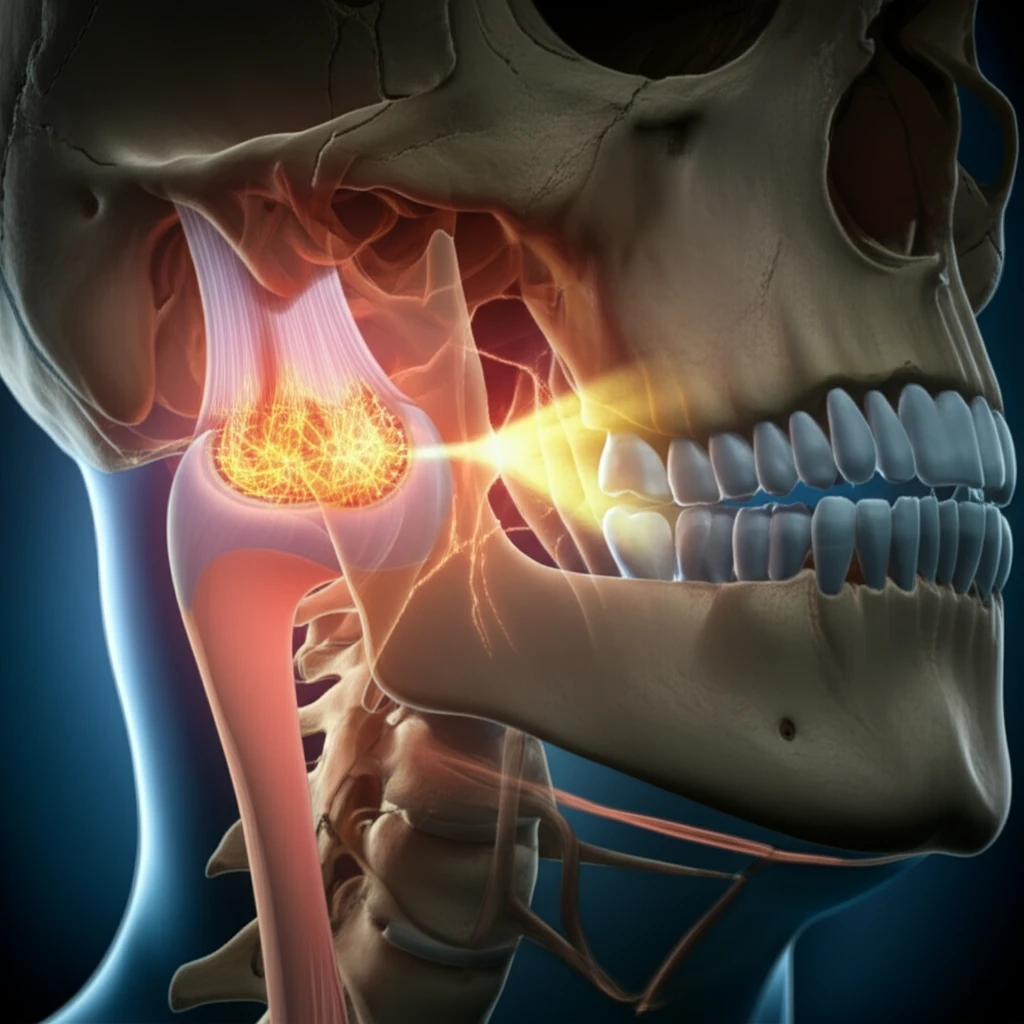
Illustration of stressed jaw joint cartilage leading to bone destruction.

Jaw Osteoarthritis: Can Mechanical Stress Cause Bone Loss?

"New research reveals how mechanical stress on jaw cartilage can trigger bone loss, offering insights into TMJ disorders and potential treatments."


Temporomandibular joint osteoarthritis (TMJ-OA) stands out as a particularly challenging subtype of temporomandibular disorders (TMD). It's characterized by the breakdown of cartilage and changes in the underlying bone. While both cartilage degeneration and bone remodeling are hallmarks of TMJ-OA, the exact sequence of these events has been a subject of debate among researchers.

During skeletal development, chondrocytes—the cells found in cartilage—secrete various cytokines that influence bone formation and remodeling. However, the mechanisms through which chondrocyte signals prompt bone resorption (the breakdown of bone tissue) remain unclear. Understanding this process could unlock new therapeutic strategies for managing TMJ-OA.

Recent research has explored whether biomechanical stimulation of chondrocytes can promote osteoclastic bone resorption in the mandibular condyle, a key area affected by TMJ-OA. By understanding how mechanical forces influence these cells, we can pave the way for more targeted interventions.

The Link Between Mechanical Stress and Bone Resorption

Illustration of stressed jaw joint cartilage leading to bone destruction.

A new study published in the Archives of Oral Biology (Kuang, Zeng, & Qin, 2019) aimed to determine whether biomechanically stimulated chondrocytes promote osteoclastic bone resorption in the mandibular condyle. The researchers subjected primary chondrocytes isolated from rat condylar cartilage to fluid flow shear stress (FSS) at varying intensities and durations. They then assessed the levels of pro-osteoclastic factors and the overall osteoclastic function.

The study also examined rats with abnormal molar occlusion to assess the relationship between cartilage degeneration and osteoclastogenesis (the formation of osteoclasts, which are responsible for bone resorption) in the subchondral bone of the mandibular condyle. Additionally, they evaluated the expression of pro-osteoclastic factors in condylar cartilage.

  • Increased Pro-Osteoclastic Factors: The study found that the mRNA and protein levels of SDF-1 and TGFβ-1 significantly increased in all FSS-treated groups. RANKL levels and the RANKL:OPG ratio also increased across all intensities and in longer durations of FSS (60 and 120 minutes). Wnt5A levels increased at all time points and in groups treated with higher FSS intensities (20 and 30 dynes/cm²).
  • Correlation with Cartilage Degeneration: The percent area of degenerative cartilage changes was positively correlated with osteoclast number and osteoclast surface/bone surface in the mandibular condyles of rats with abnormal occlusion.
  • Increased Expression in Abnormal Occlusion: Abnormal occlusion led to increased immune-positive areas and elevated mRNA expression levels of Sdf1, Tgfb1, Rankl, Wnt5a, and the RANKL:OPG ratio in rat condylar cartilage.
These results indicate that chondrocytes under mechanical stimulation can express higher levels of pro-osteoclastic factors, inducing condylar subchondral bone resorption by promoting osteoclastogenesis.

Implications and Future Directions

This research highlights the critical role of chondrocyte signaling in osteoclastic bone resorption within the mandibular condyle. The finding that mechanical stimulation can induce the expression of pro-osteoclastic factors by chondrocytes opens new avenues for therapeutic intervention in TMJ-OA. Future studies could focus on developing targeted therapies to modulate chondrocyte activity and prevent excessive bone resorption, ultimately improving outcomes for individuals suffering from this debilitating condition.

About this Article -

This article was crafted using a human-AI hybrid and collaborative approach. AI assisted our team with initial drafting, research insights, identifying key questions, and image generation. Our human editors guided topic selection, defined the angle, structured the content, ensured factual accuracy and relevance, refined the tone, and conducted thorough editing to deliver helpful, high-quality information.See our About page for more information.

This article is based on research published under:

DOI-LINK: 10.1016/j.archoralbio.2018.12.002, Alternate LINK

Title: Biomechanically Stimulated Chondrocytes Promote Osteoclastic Bone Resorption In The Mandibular Condyle

Subject: Cell Biology

Journal: Archives of Oral Biology

Publisher: Elsevier BV

Authors: Bin Kuang, Zhaobin Zeng, Qing Qin

Published: 2019-02-01

Everything You Need To Know

1

What is Temporomandibular joint osteoarthritis (TMJ-OA)?

Temporomandibular joint osteoarthritis (TMJ-OA) is a specific type of temporomandibular disorder (TMD) that involves the deterioration of cartilage and changes in the underlying bone structure within the temporomandibular joint. This condition is particularly challenging because the exact sequence of events leading to cartilage degeneration and bone remodeling has been a subject of debate. The condition is significant because it can cause pain and affect jaw function. Understanding this process can help develop new therapeutic strategies for managing TMJ-OA.

2

What role does mechanical stress play in jaw osteoarthritis?

Mechanical stress refers to the forces and pressures exerted on the cells and tissues within the jaw joint, specifically the chondrocytes in the cartilage. The research shows that biomechanical stimulation of chondrocytes, such as that caused by fluid flow shear stress (FSS), can lead to increased expression of pro-osteoclastic factors. This is important because it initiates the process of osteoclastic bone resorption, which contributes to bone loss in the mandibular condyle, a key area affected by TMJ-OA. The implications of this are that mechanical stress can directly contribute to the progression of TMJ-OA by stimulating processes that degrade bone.

3

What are chondrocytes, and how do they contribute to bone loss?

Chondrocytes are the cells found in cartilage, which secrete various cytokines that influence bone formation and remodeling. The recent research suggests that when chondrocytes are exposed to mechanical stress, they release pro-osteoclastic factors, which then promote osteoclastogenesis. These factors include SDF-1, TGFβ-1, RANKL, and Wnt5A. The significance here is that these chondrocyte signals prompt bone resorption, thus causing the bone breakdown that is a hallmark of TMJ-OA. This understanding is crucial as it shows how these cells can be targeted in future therapies to prevent bone loss.

4

What are osteoclasts, and how does osteoclastogenesis relate to jaw osteoarthritis?

Osteoclasts are cells responsible for breaking down and resorbing bone tissue. Osteoclastogenesis is the formation of these osteoclasts. The research indicates that mechanical stimulation of chondrocytes promotes osteoclastogenesis in the subchondral bone of the mandibular condyle, contributing to bone loss. The implications of this process is that bone resorption and remodeling is directly influenced by mechanical forces. This means that factors affecting chondrocytes can have a profound effect on bone health within the jaw joint, making this process a key target for therapeutic intervention.

5

What are the key findings and implications of this research?

The findings of the study are that mechanical stimulation of chondrocytes, such as via fluid flow shear stress (FSS), leads to increased expression of pro-osteoclastic factors, which then promote bone resorption in the mandibular condyle. This means that mechanical stress on the cartilage cells directly impacts the underlying bone. Future directions include developing therapies to modulate chondrocyte activity. The implications of this research are that mechanical forces play a critical role in TMJ-OA. Thus, new therapies that address chondrocyte activity could prevent bone loss and improve outcomes for individuals suffering from this debilitating condition.

Newsletter Subscribe

Subscribe to get the latest articles and insights directly in your inbox.