
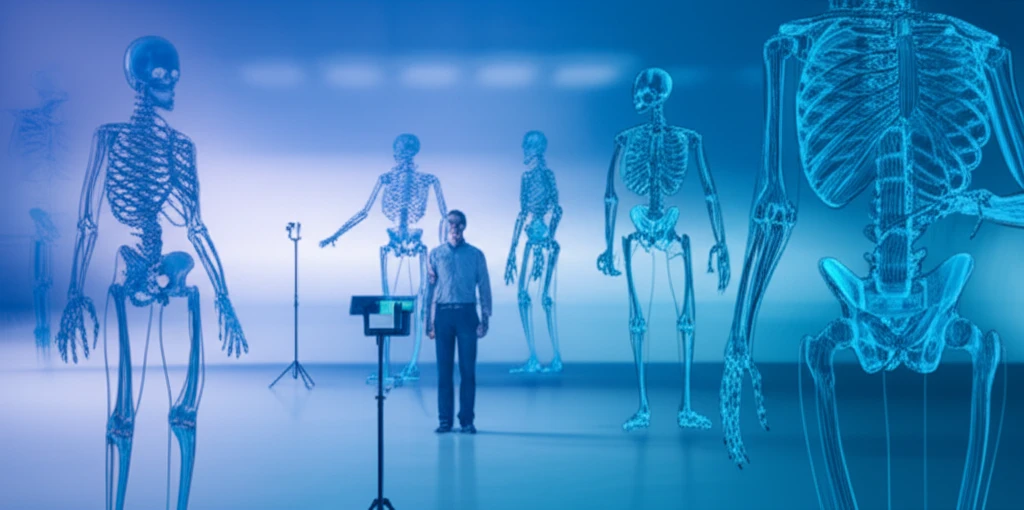
Digital illustration representing ergonomic analysis using Microsoft Kinect.

Is Your Workstation a Pain? How Tech Can Help Prevent Musculoskeletal Disorders

"Discover how low-cost 3D cameras like Microsoft Kinect are revolutionizing ergonomic risk assessment and helping to protect workers from developing musculoskeletal disorders."


In today's work environment, where repetitive motions and awkward postures are increasingly common, ensuring proper ergonomics is critical. Traditional methods of ergonomic assessment often rely on visual observations, which can be subjective and time-consuming. However, advancements in technology offer new possibilities for more accurate and efficient evaluations.

The Microsoft Kinect, originally designed for gaming, has emerged as a powerful tool for analyzing human movement. Its ability to capture three-dimensional data at a relatively low cost makes it an attractive option for workplace ergonomic assessments. This technology allows for the objective measurement of postures and gestures, providing valuable insights into potential risk factors for musculoskeletal disorders.

This article delves into a research project that explores the use of Microsoft Kinect in ergonomic risk assessment. By examining how this technology can quantify movements and identify potential hazards, we can gain a better understanding of how to create safer and more comfortable work environments, ultimately reducing the risk of musculoskeletal disorders among workers.

Kinect in Action: Analyzing Violinists' Movements

Digital illustration representing ergonomic analysis using Microsoft Kinect.

To test the capabilities of the Microsoft Kinect in a real-world scenario, researchers studied the movements of professional violinists. Violin playing involves repetitive gestures and sustained postures that can be physically demanding, making it an ideal case study for ergonomic assessment.

Using the Kinect, the researchers captured the three-dimensional coordinates of the violinists' body points during their performance. This data allowed them to analyze various aspects of their movements, including:

  • The range of motion of the wrists and arms
  • The frequency of repetitive movements
  • The duration of sustained postures
  • The overall fluidity and efficiency of their technique
The study revealed that the Kinect was able to effectively quantify the violinists' movements and even detect subtle differences in playing strategies. This demonstrates the potential of the technology to identify ergonomic risk factors in various work settings, even those involving complex and dynamic movements. This proves that movement strategies can be efficiently and accurately quantified using Microsoft Kinect.

Improving Ergonomics: The Future of Workplace Safety

The research highlights the potential of low-cost 3D cameras like the Microsoft Kinect to revolutionize ergonomic risk assessment. By providing objective and accurate data on workers' movements and postures, this technology can help identify and mitigate potential hazards before they lead to musculoskeletal disorders.

The implementation of Kinect-based ergonomic assessments can lead to several benefits, including: Reduced risk of injuries, Increased worker comfort and productivity, Lower healthcare costs for employers, Improved compliance with safety regulations

As technology continues to advance, we can expect to see even more sophisticated tools for ergonomic assessment emerge. By embracing these innovations, we can create safer, healthier, and more productive work environments for everyone.

About this Article -

This article was crafted using a human-AI hybrid and collaborative approach. AI assisted our team with initial drafting, research insights, identifying key questions, and image generation. Our human editors guided topic selection, defined the angle, structured the content, ensured factual accuracy and relevance, refined the tone, and conducted thorough editing to deliver helpful, high-quality information.See our About page for more information.

This article is based on research published under:

DOI-LINK: 10.1016/j.irbm.2018.10.003, Alternate LINK

Title: Ergonomic Risk Assessment Of Developing Musculoskeletal Disorders In Workers With The Microsoft Kinect: Track Tms

Subject: Biomedical Engineering

Journal: IRBM

Publisher: Elsevier BV

Authors: F. Buisseret, F. Dierick, O. Hamzaoui, L. Jojczyk

Published: 2018-12-01

Everything You Need To Know

1

How can technology help prevent musculoskeletal disorders in the workplace?

Musculoskeletal disorders can be prevented in the workplace by using technology like the Microsoft Kinect to assess ergonomic risks. The Microsoft Kinect captures three-dimensional data, allowing for objective measurement of postures and gestures. This helps in identifying potential risk factors associated with repetitive motions and awkward postures, common contributors to musculoskeletal disorders.

2

What makes the Microsoft Kinect a valuable tool for ergonomic assessment?

The Microsoft Kinect offers an efficient and objective method for ergonomic assessment. Traditional methods often rely on visual observations, which can be subjective and time-consuming. The Microsoft Kinect captures three-dimensional data to quantify movements and identify potential hazards, leading to a better understanding of how to create safer and more comfortable work environments. By understanding inefficiencies companies can reduce the risk of musculoskeletal disorders among workers.

3

How was the Microsoft Kinect used to analyze the movements of professional violinists?

Researchers tested the Microsoft Kinect by studying professional violinists, whose playing involves repetitive gestures and sustained postures. The Kinect captured the three-dimensional coordinates of the violinists' body points during their performance, enabling analysis of the range of motion, frequency of movements, duration of postures, and overall technique. This demonstrated the technology's ability to quantify movements and detect subtle differences in playing strategies.

4

In what specific ways can the Microsoft Kinect provide insights into ergonomic risk factors?

The Microsoft Kinect offers insights into ergonomic risk factors by providing objective data on movements and postures. For example, in the study of violinists, the Kinect identified the range of motion of wrists and arms, the frequency of repetitive movements, and the duration of sustained postures. Analyzing this data helps in identifying and mitigating potential hazards before they lead to musculoskeletal disorders. However, it's worth noting that the Kinect's ability to measure force or muscle exertion is limited, which could be relevant in a comprehensive ergonomic assessment.

5

What is the future of workplace safety with tools like the Microsoft Kinect, and what are the implications?

Using low-cost 3D cameras like the Microsoft Kinect can revolutionize workplace safety by enabling proactive ergonomic risk assessment. These tools accurately measure movements and postures, helping to identify and mitigate potential hazards before they lead to musculoskeletal disorders. The future of workplace safety involves integrating such technologies to create a healthier, more comfortable environment, reducing risks and improving overall well-being. However, widespread adoption requires addressing factors like data privacy concerns and the need for trained personnel to interpret the data effectively. Further research and development are also needed to enhance the accuracy and usability of these systems.

Newsletter Subscribe

Subscribe to get the latest articles and insights directly in your inbox.