
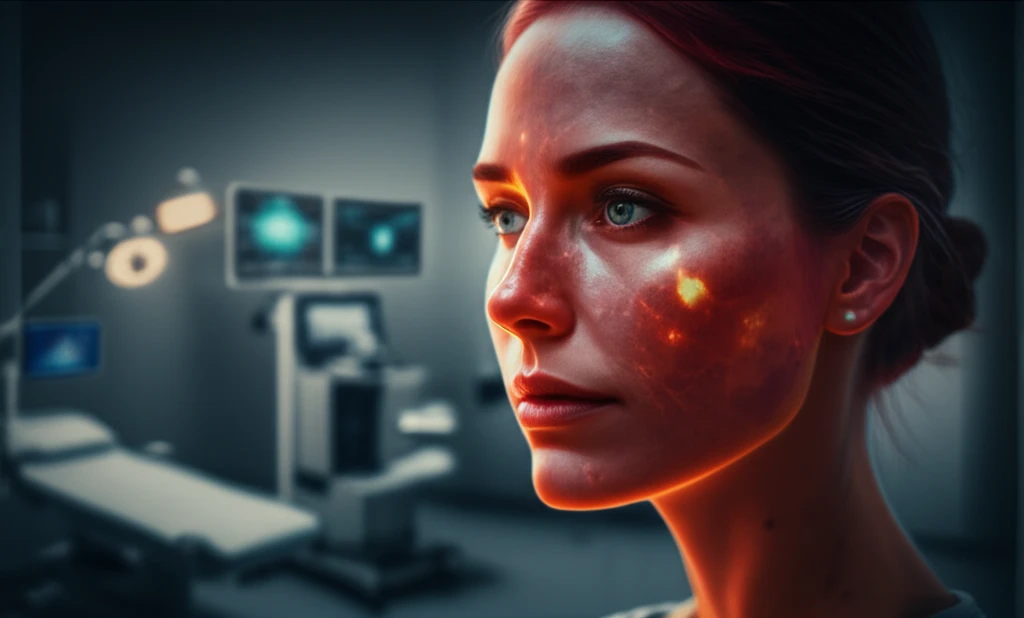
Glowing port-wine stain indicating local heat, with medical examination backdrop.

Is Your 'Never Warm' Port-Wine Stain Actually Something Else?

"A new case study suggests that the traditional diagnostic feature of Port-Wine Stains might not be as reliable as we thought, especially when heat is involved."


Port-wine stains (PWSs) are commonly known as congenital vascular malformations, characterized by dilated capillaries in the skin. These typically appear as pink or purple marks at birth, often on the face or neck, and are notably considered 'never warm' to the touch. But what happens when a PWS isn't congenital, and—more surprisingly—is warm?

A recent case study sheds light on acquired PWS, a rare condition that mirrors the appearance and microscopic features of congenital PWS but develops later in life. This study highlights a unique instance where an acquired PWS presented with local heat, challenging the traditional diagnostic criteria.

This article delves into the specifics of this intriguing case, exploring the methods used to diagnose it and discussing the implications for how we identify and understand PWS. It also addresses the questions of what to do if the temperature reading differs and how it could refine diagnostic process.

The Curious Case of the Warm Port-Wine Stain

Glowing port-wine stain indicating local heat, with medical examination backdrop.

A 46-year-old woman presented with slowly enlarging reddish-purple patches on her left cheek and neck that had developed over the course of a year. Unlike typical PWS, these lesions felt mildly warm and slightly swollen during examination. The woman had been previously misdiagnosed with rosacea. She confirmed that she had no history of such marks, trauma, or family history of PWS, and took no medications.

To accurately assess the condition, doctors employed a series of diagnostic techniques:

  • Skin Biopsy: Microscopic examination revealed dilated blood vessels in the dermis, consistent with PWS.
  • Laser Doppler Perfusion Imaging (LDPI): This non-invasive imaging technique mapped blood flow, revealing increased blood flow in the affected area, even in regions without visible symptoms.
  • Laser Doppler Perfusion Measurement (LDPM): This test quantified skin temperature and microcirculatory blood perfusion, confirming elevated temperature and blood flow on the left side of her face and neck compared to the right.
  • Immunohistochemical Staining: Testing ruled out arteriovenous malformation (AVM), another vascular condition that can cause similar symptoms.
These tests confirmed the diagnosis of acquired PWS, highlighting the unusual presence of local heat. This challenges the conventional understanding of PWS as 'never warm,' suggesting that skin temperature may not be a reliable diagnostic criterion.

Rethinking PWS Diagnosis: What Does This Mean for You?

This case not only highlights the rarity of acquired PWS but also challenges a long-standing diagnostic assumption. The presence of local heat in this case suggests that PWS can manifest differently than traditionally described.

For individuals with vascular lesions, it’s crucial to seek comprehensive evaluation that includes advanced imaging techniques like LDPI and LDPM. These tools can provide detailed information about blood flow and temperature, aiding in accurate diagnosis and treatment planning.

While pulsed dye laser therapy was considered for this patient, she opted to defer treatment. This decision underscores the importance of personalized care and informed decision-making in managing PWS and other vascular conditions. Further research and longer follow-up studies are needed to fully understand the implications of these findings and refine diagnostic approaches.

About this Article -

This article was crafted using a human-AI hybrid and collaborative approach. AI assisted our team with initial drafting, research insights, identifying key questions, and image generation. Our human editors guided topic selection, defined the angle, structured the content, ensured factual accuracy and relevance, refined the tone, and conducted thorough editing to deliver helpful, high-quality information.See our About page for more information.

This article is based on research published under:

DOI-LINK: 10.2340/00015555-2193, Alternate LINK

Title: Acquired Port-Wine Stain With Local Heat

Subject: Dermatology

Journal: Acta Dermato Venereologica

Publisher: Medical Journals Sweden AB

Authors: S Yang, C Lan

Published: 2016-01-01

Everything You Need To Know

1

What exactly is a Port-Wine Stain (PWS), and what's the standard understanding of its temperature?

Port-Wine Stains (PWSs) are congenital vascular malformations characterized by dilated capillaries in the skin, typically appearing at birth as pink or purple marks. A key diagnostic feature has been that they are 'never warm' to the touch. However, this case study demonstrates that acquired PWS, which develops later in life, can present with local heat, challenging this traditional diagnostic criterion.

2

What methods were used to diagnose the 'warm' Port-Wine Stain (PWS) in the case study?

Doctors used a combination of techniques including skin biopsy to examine dilated blood vessels, Laser Doppler Perfusion Imaging (LDPI) to map blood flow, Laser Doppler Perfusion Measurement (LDPM) to quantify skin temperature and blood flow, and Immunohistochemical Staining to rule out other conditions like arteriovenous malformation (AVM).

3

If a Port-Wine Stain (PWS) feels warm, does that automatically mean it's not a PWS?

This case suggests that the absence of heat should not be the sole determining factor in diagnosing Port-Wine Stains (PWS). The presence of local heat doesn't automatically rule out PWS, particularly acquired PWS. Doctors may need to use additional diagnostic tools like Laser Doppler Perfusion Imaging (LDPI) and Laser Doppler Perfusion Measurement (LDPM) to confirm their diagnosis.

4

What are acquired Port-Wine Stains (PWS), and how do they differ from the more commonly known congenital PWS?

Acquired Port-Wine Stains (PWS) are rare vascular malformations that develop later in life, mimicking the appearance and microscopic features of congenital PWS. Unlike the traditional understanding, acquired PWS can present with local heat. The case study involved a 46-year-old woman who developed reddish-purple patches on her face and neck, which were warm to the touch.

5

What are the broader implications of this 'warm' Port-Wine Stain (PWS) case for how doctors diagnose vascular conditions in the future?

This case challenges the conventional wisdom about Port-Wine Stains (PWS) diagnosis and may prompt a re-evaluation of diagnostic criteria. It emphasizes the need for a more comprehensive approach, potentially including Laser Doppler Perfusion Imaging (LDPI) and Laser Doppler Perfusion Measurement (LDPM), especially in cases where the PWS presents atypically, such as with local heat. Further research may be needed to understand the underlying mechanisms and refine diagnostic processes for vascular skin conditions.

Newsletter Subscribe

Subscribe to get the latest articles and insights directly in your inbox.