
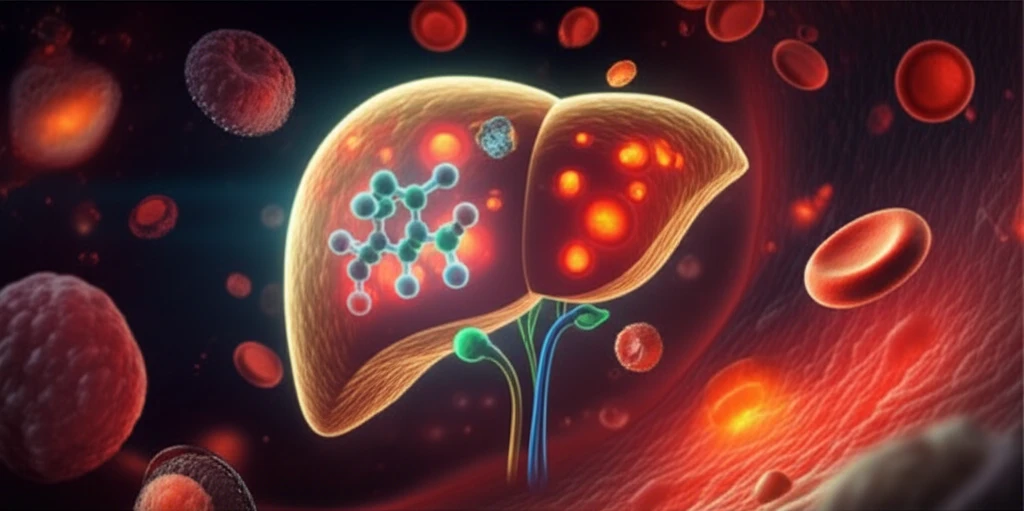
Inflamed liver cells with floating L-FABP molecule

Is Your Liver Sending Inflammation Signals? The Role of L-FABP

"Unlocking the link between a liver protein and inflammation, especially in kidney disease."


Fatty acid-binding proteins (FABPs) are typically known for their role inside cells, specifically how they manage and transport fats. However, recent research is uncovering that these proteins, particularly Liver-type FABP (L-FABP), also have important functions outside of cells. This is prompting scientists to rethink their understanding of how inflammation starts and what role different molecules play.

A new study digs into the activity of L-FABP outside the cell, investigating whether it directly contributes to inflammation by triggering the release of interleukin-6 (IL-6), a key inflammatory signal. The research also explores L-FABP levels in patients with end-stage renal disease (ESRD), a condition known to disrupt fat metabolism, to see if there's a connection.

By understanding how L-FABP behaves outside cells and how its levels change in conditions like kidney disease, researchers hope to find new ways to monitor, prevent, and treat inflammation.

L-FABP: More Than Just a Fat Transporter?

Inflamed liver cells with floating L-FABP molecule

L-FABP is abundant in the liver, making up a significant portion of the proteins within liver cells. It’s also found in other organs such as the kidney, lung, and intestine, where it plays a crucial role in processing fats. It regulates how cells take up, transport, break down, and store fatty acids.

While FABPs are not typically found circulating in the blood under normal conditions, they can be released when tissues are damaged. This has led to their use as markers for injury:

  • L-FABP for liver damage
  • I-FABP for intestinal injury
  • H-FABP for heart damage
  • B-FABP for brain injury
However, recent studies show that FABPs can be secreted from cells even without cell damage, suggesting they may have other functions. This study investigates whether L-FABP directly influences inflammation.

The Inflammatory Potential of L-FABP

The study reveals that L-FABP can indeed stimulate the production of IL-6, a key inflammatory molecule, in various cell types, including lung cells, immune cells, and whole blood samples. This suggests that L-FABP is not just a marker of tissue damage but may actively contribute to inflammation.

Interestingly, the research also found that patients with end-stage renal disease (ESRD) undergoing hemodialysis had lower levels of L-FABP in their blood compared to healthy individuals. This unexpected finding suggests that kidney dysfunction might affect L-FABP production or clearance.

While more research is needed to fully understand the mechanisms involved, this study highlights the potential of L-FABP as a key player in inflammatory processes and opens new avenues for exploring its role in diseases like kidney disease.

About this Article -

This article was crafted using a human-AI hybrid and collaborative approach. AI assisted our team with initial drafting, research insights, identifying key questions, and image generation. Our human editors guided topic selection, defined the angle, structured the content, ensured factual accuracy and relevance, refined the tone, and conducted thorough editing to deliver helpful, high-quality information.See our About page for more information.

This article is based on research published under:

DOI-LINK: 10.4110/in.2016.16.5.296, Alternate LINK

Title: Cytokine-Like Activity Of Liver Type Fatty Acid Binding Protein (L-Fabp) Inducing Inflammatory Cytokine Interleukin-6

Subject: Infectious Diseases

Journal: Immune Network

Publisher: The Korean Association of Immunobiologists

Authors: Hyunwoo Kim, Gaae Gil, Siyoung Lee, Areum Kwak, Seunghyun Jo, Ensom Kim, Tam T. Nguyen, Sinae Kim, Hyunjhung Jhun, Somi Kim, Miyeon Kim, Youngmin Lee, Soohyun Kim

Published: 2016-01-01

Everything You Need To Know

1

What is L-FABP, and what does it do?

L-FABP, or Liver-type Fatty Acid Binding Protein, is a protein primarily found in the liver, but also present in other organs such as the kidney. Its main function is to manage and transport fats within cells, specifically regulating how cells take up, transport, break down, and store fatty acids. The significance here is that beyond its role in fat metabolism, L-FABP is also being recognized for its potential role in triggering inflammation.

2

How does L-FABP influence inflammation?

The study indicates that L-FABP can stimulate the production of IL-6, a key inflammatory molecule, in various cell types. This means that L-FABP is not just a marker of tissue damage but actively contributes to inflammation. IL-6 is an inflammatory signal, and increased levels can lead to various health problems. This suggests that L-FABP's presence outside cells can have direct implications for inflammation, potentially worsening conditions, especially in diseases like kidney disease.

3

What are FABPs, and why are they important as markers?

FABPs, including L-FABP, are typically found inside cells. However, they can be released into the bloodstream when tissues are damaged. In the context of this information, L-FABP serves as a marker for liver damage, I-FABP for intestinal injury, H-FABP for heart damage, and B-FABP for brain injury. Recent studies indicate that FABPs can be secreted from cells even without cell damage, suggesting they might have additional roles. These additional roles include direct contribution to inflammation.

4

Why is L-FABP important in relation to kidney health?

The significance of L-FABP in the context of kidney health lies in its connection to inflammation and fat metabolism, both of which are disrupted in end-stage renal disease (ESRD). L-FABP's ability to trigger inflammation by releasing IL-6 is important because chronic inflammation is a major issue in kidney disease. Therefore, elevated L-FABP levels could potentially worsen kidney damage and overall health in patients with ESRD. Understanding this link could help in developing strategies to monitor, prevent, and treat inflammation associated with kidney disease.

5

What are the goals of the research on L-FABP?

Research in this area aims to uncover new ways to monitor, prevent, and treat inflammation related to conditions such as kidney disease. Scientists hope to understand the behavior of L-FABP outside cells, its levels in diseases, and its direct contribution to inflammation. This understanding could lead to early detection methods, targeted therapies to reduce inflammation, and strategies to improve outcomes for patients with kidney disease and other conditions where inflammation plays a key role.

Newsletter Subscribe

Subscribe to get the latest articles and insights directly in your inbox.