
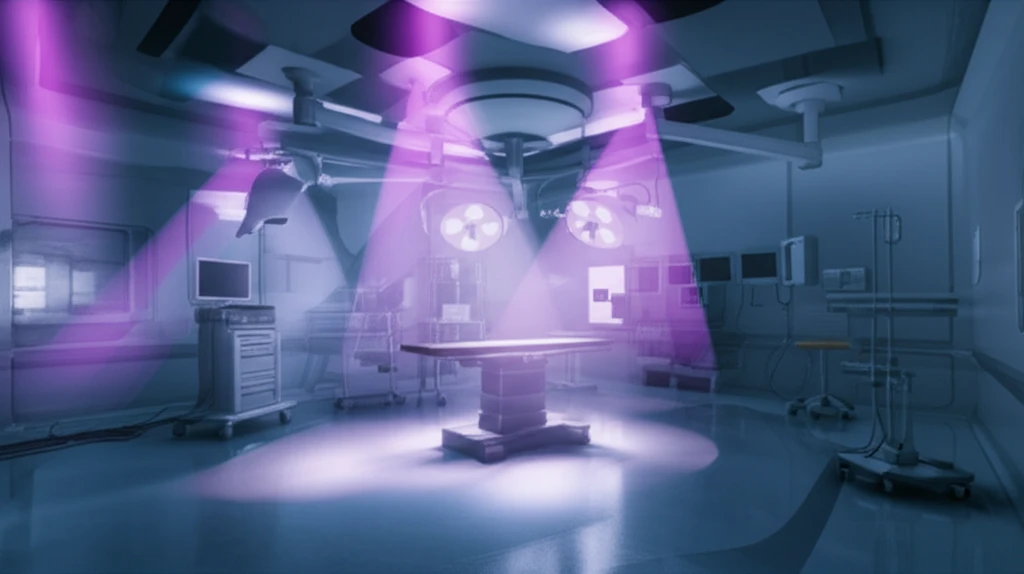
Futuristic operating room with shadowless UV disinfection

Is Your Hospital Really Clean? The Shadowless UV Solution

"New tech tackles hidden germs, promising safer patient environments without harsh chemicals."


Hospitals, despite diligent cleaning efforts, often harbor hidden reservoirs of germs that can lead to healthcare-acquired infections (HAIs). Traditional cleaning methods, while necessary, frequently leave behind residual contamination due to human error, shadowing effects, and the increasing resistance of pathogens. This leaves patients vulnerable and underscores the urgent need for more effective disinfection strategies.

In response to these challenges, innovative technologies like ultraviolet (UV) disinfection have emerged as promising adjuncts to standard cleaning protocols. Among these, Focused Multivector Ultraviolet (FMUV) disinfection with shadowless delivery stands out. Unlike conventional UV systems that emit light from a single source, FMUV employs multiple lamps strategically positioned to eliminate shadows and ensure comprehensive surface coverage. This approach promises to deliver more consistent and thorough disinfection, reducing the risk of HAIs and improving patient outcomes.

This article delves into the science behind FMUV disinfection, exploring its effectiveness in real-world hospital settings. We'll examine a recent study published in the American Journal of Infection Control that assessed the performance of an FMUV system in disinfecting patient care equipment, both inside and outside the operating room (OR). The findings reveal the potential of this technology to revolutionize hospital disinfection practices, offering a safer and more efficient alternative to traditional methods.

How Does Shadowless UV Disinfection Work?

Futuristic operating room with shadowless UV disinfection

The key to FMUV's superior performance lies in its shadowless delivery system. Traditional UV disinfection units typically feature a central lamp source, which can create shadows and leave some surfaces underexposed. FMUV, on the other hand, utilizes modular panels of lamps and reflectors that surround the target area, ensuring that UV rays converge on surfaces from multiple directions. This multi-directional approach minimizes shadowing and delivers a more uniform dose of UV light to all exposed surfaces.

Here's how FMUV works:

  • Multiple UV Sources: Modular panels with strategically placed lamps ensure comprehensive coverage.
  • Shadowless Delivery: UV rays converge from multiple angles, eliminating shadowed areas.
  • Rapid Disinfection: A high UV intensity and short disinfection cycle (e.g., 90 seconds) facilitate quick turnover.
  • Safe Operation: Modular panels block UV, allowing staff to remain in the room during disinfection.
A study published in the American Journal of Infection Control, researchers conducted a three-phase observational study to evaluate the effectiveness of an FMUV system in a hospital setting. The study focused on patient care equipment both inside and outside the OR, comparing FMUV disinfection to manual chemical disinfection.

The Future of Hospital Cleaning: A Paradigm Shift?

The findings of the study suggest that FMUV disinfection holds significant promise as an adjunct to traditional cleaning methods in hospitals. By delivering consistent and thorough disinfection without the need for harsh chemicals, FMUV can help reduce the risk of HAIs and improve patient safety. Moreover, the system's rapid disinfection cycle and safe operation make it a practical solution for busy hospital environments.

While further research is needed to fully understand the long-term impact of FMUV disinfection on HAI rates, the initial results are encouraging. As hospitals continue to grapple with the challenge of infection control, innovative technologies like FMUV may play an increasingly important role in creating safer and healthier environments for patients and healthcare workers alike.

The shadowless delivery technology and performance of the FMUV system offer a paradigm shift in hospital disinfection. By overcoming the limitations of traditional UV systems and manual cleaning methods, FMUV has the potential to revolutionize infection control practices and pave the way for a future where hospitals are truly clean.

About this Article -

This article was crafted using a human-AI hybrid and collaborative approach. AI assisted our team with initial drafting, research insights, identifying key questions, and image generation. Our human editors guided topic selection, defined the angle, structured the content, ensured factual accuracy and relevance, refined the tone, and conducted thorough editing to deliver helpful, high-quality information.See our About page for more information.

This article is based on research published under:

DOI-LINK: 10.1016/j.ajic.2018.09.019, Alternate LINK

Title: Assessment Of Focused Multivector Ultraviolet Disinfection Withshadowless Delivery Using 5-Point Multisided Sampling Ofpatientcare Equipment Without Manual-Chemical Disinfection

Subject: Infectious Diseases

Journal: American Journal of Infection Control

Publisher: Elsevier BV

Authors: Donna Armellino, Thomas J. Walsh, Vidmantas Petraitis, Wladyslaw Kowalski

Published: 2019-04-01

Everything You Need To Know

1

What are Healthcare-Acquired Infections (HAIs), and why are they a concern in hospitals?

Healthcare-acquired infections (HAIs) are infections patients get while receiving medical treatment. The presence of these infections highlights the need for effective disinfection strategies. The article explains that traditional cleaning methods sometimes fail due to human error, shadowing, and pathogen resistance. This is where technologies like Focused Multivector Ultraviolet (FMUV) disinfection become important.

2

How does Focused Multivector Ultraviolet (FMUV) disinfection work?

Focused Multivector Ultraviolet (FMUV) disinfection is a method that uses multiple lamps to emit ultraviolet (UV) light from different angles. Unlike conventional UV systems, FMUV's design minimizes shadows, ensuring surfaces are thoroughly disinfected. This is achieved through modular panels with strategically placed lamps and reflectors that converge UV rays on surfaces from multiple directions. This shadowless delivery ensures uniform disinfection across all exposed surfaces.

3

Why is Focused Multivector Ultraviolet (FMUV) disinfection important in hospitals?

The significance of FMUV in hospital settings lies in its potential to reduce Healthcare-Acquired Infections (HAIs). By providing more thorough disinfection than traditional methods, it decreases the risk of patients contracting infections during their stay. The technology's efficiency and safety features, like rapid disinfection cycles and safe operation, make it suitable for busy hospital environments, contributing to improved patient safety and outcomes.

4

What makes the FMUV system efficient and safe for hospital use?

The FMUV system is designed to operate quickly and safely. It utilizes multiple UV sources arranged in modular panels. These panels direct the UV rays from several angles to eliminate shadowed areas. The process involves a high UV intensity with a short cycle. For example, a 90-second cycle is mentioned, and it allows for quick turnaround of equipment and spaces. The design incorporates safety features such as modular panels that block the UV light, enabling staff to remain in the room during the process.

5

What do the studies say about the effectiveness of Focused Multivector Ultraviolet (FMUV) disinfection?

Studies, such as the one in the American Journal of Infection Control, indicate that FMUV disinfection is effective. The research compared FMUV to traditional manual chemical disinfection. The study focused on patient care equipment both inside and outside the operating room (OR). The results suggest that FMUV could revolutionize hospital disinfection, offering a safer and more efficient alternative. This indicates a potential paradigm shift in hospital cleaning practices.

Newsletter Subscribe

Subscribe to get the latest articles and insights directly in your inbox.