
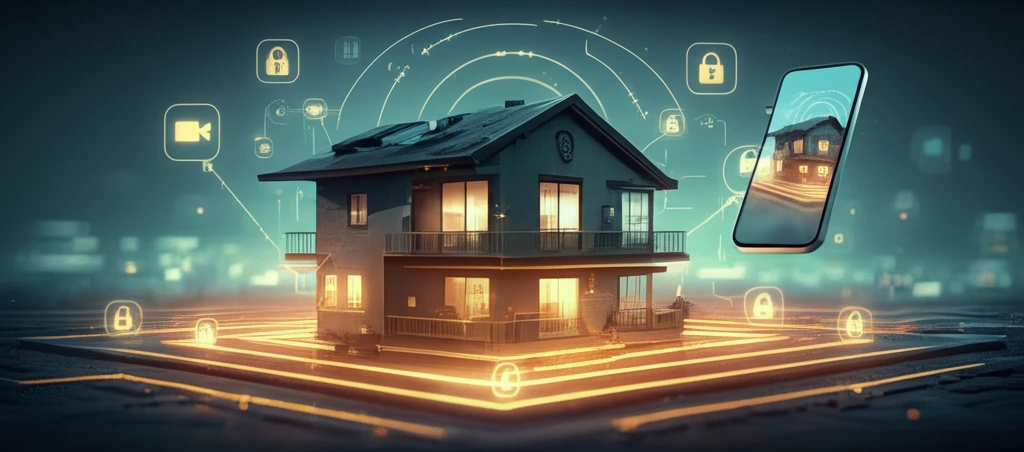
Smart home security system with Zigbee network and smartphone control.

Is Your Home Safe? How Smart Security Systems are Changing the Game

"Discover how Zigbee and embedded technology can bring peace of mind with advanced, user-friendly home security solutions."


As technology advances, so do our security needs. Traditional security systems are evolving to incorporate wireless technologies, offering more comprehensive and user-friendly solutions. This article explores how a smart security system, integrating Zigbee, GSM, sensors, and smartphones, can provide remote monitoring and control, ensuring your home's safety no matter where you are.

Imagine receiving an alert on your phone the moment a potential security breach occurs. With the system described here, sensors installed at windows and doors immediately send signals to a central microcontroller upon detecting a threat. This microcontroller then uses Zigbee technology to communicate with a control console, which in turn activates a GSM module to send an SMS alert to your mobile phone.

But it doesn't stop there. Upon receiving the alert, you can initiate a live video call to your home via a smartphone installed as a security camera, allowing you to visually assess the situation. If an intrusion is confirmed, you can remotely control gas valves and door locks, effectively managing the situation from afar. This level of control and monitoring represents a significant leap forward in home security technology.

How Does a Zigbee-Based Smart Security System Work?

Smart home security system with Zigbee network and smartphone control.

At the heart of this system are several key components working in harmony to provide robust security:

The system leverages multiple components:

  • Sensors: Typically include PIR (Passive Infrared) sensors to detect motion, vibration sensors for windows, and magnetic door contact sensors.
  • Microcontroller (MCU): Acts as the central processing unit, receiving signals from sensors and controlling other modules.
  • Zigbee Module: Provides wireless communication between sensors and the control console using a low-power, efficient protocol.
  • GSM Module: Enables communication with the homeowner via SMS, utilizing cellular networks.
  • Smartphone Integration: Allows remote viewing via video call and control of home appliances.
The process begins with the sensors. When a sensor detects a potential threat—motion, vibration, or a door opening—it sends a signal to the microcontroller. The microcontroller processes this signal and uses the Zigbee module to transmit the alert wirelessly to a central control console. This console, also equipped with a Zigbee module, receives the alert and activates the GSM module. The GSM module then sends an SMS message to the homeowner's mobile phone, notifying them of the security breach.

The Future of Home Security is Here

This smart security system represents a significant advancement in protecting homes and families. By integrating wireless communication technologies with remote monitoring and control capabilities, it offers a comprehensive and user-friendly solution that empowers homeowners to safeguard their property from anywhere in the world. As technology continues to evolve, expect even more sophisticated and integrated security solutions to emerge, further enhancing our ability to protect what matters most.

About this Article -

This article was crafted using a human-AI hybrid and collaborative approach. AI assisted our team with initial drafting, research insights, identifying key questions, and image generation. Our human editors guided topic selection, defined the angle, structured the content, ensured factual accuracy and relevance, refined the tone, and conducted thorough editing to deliver helpful, high-quality information.See our About page for more information.

Everything You Need To Know

1

How does a smart security system using Zigbee, GSM, and smartphone integration actually work to protect my home?

A smart security system uses several components working together. Sensors, such as PIR (Passive Infrared) sensors, vibration sensors, and magnetic door contact sensors, detect threats and send signals to a central Microcontroller (MCU). The MCU then uses a Zigbee Module to wirelessly transmit the alert to a control console. This console activates the GSM Module, sending an SMS to your smartphone. You can then use smartphone integration for live video and remote control.

2

What role does Zigbee technology play in a smart home security system, and why is it important?

Zigbee technology provides wireless communication between sensors and the control console in a smart home security system. It's important because it's a low-power, efficient protocol, allowing for reliable communication without draining batteries quickly. However, it's important to note that Zigbee's range can be limited compared to other wireless technologies like Wi-Fi, which might require additional Zigbee repeaters for larger homes.

3

If I receive an SMS alert from my smart security system, what immediate actions can I take to assess and manage the situation remotely?

Upon receiving an SMS alert triggered by the GSM Module, you can initiate a live video call to your home via a smartphone set up as a security camera. This allows you to visually assess the situation in real-time. If you confirm an intrusion, you can remotely control gas valves and door locks to manage the situation from afar. However, the effectiveness of these actions depends on the reliability of your internet connection and the responsiveness of the connected devices.

4

What kind of sensors are typically included in a Zigbee-based smart security system, and what specific threats do they detect?

Typical sensors include PIR (Passive Infrared) sensors to detect motion, vibration sensors for windows, and magnetic door contact sensors. PIR sensors detect movement by sensing changes in infrared radiation caused by a moving heat source. Vibration sensors detect disturbances on windows or other surfaces, indicating a potential break-in. Magnetic door contact sensors trigger when a door or window is opened, breaking the magnetic connection between two components. These sensors working together can cover various potential entry points and threat scenarios.

5

Beyond SMS alerts, live video, and remote control of locks, what are some potential future advancements or integrations we might see in smart security systems utilizing Zigbee and related technologies?

Future advancements might include more sophisticated AI-driven threat analysis, integrating data from multiple sensors to reduce false alarms. We might also see integration with other smart home devices, such as smart lighting and automated shades, to create a more comprehensive security response. For example, lights could automatically turn on and shades could lower upon detecting an intrusion. Furthermore, enhanced encryption and security protocols for Zigbee and GSM communication would be crucial to protect against hacking and unauthorized access. The evolution of sensor technology, like more accurate and energy-efficient sensors, will also play a significant role.

Newsletter Subscribe

Subscribe to get the latest articles and insights directly in your inbox.