
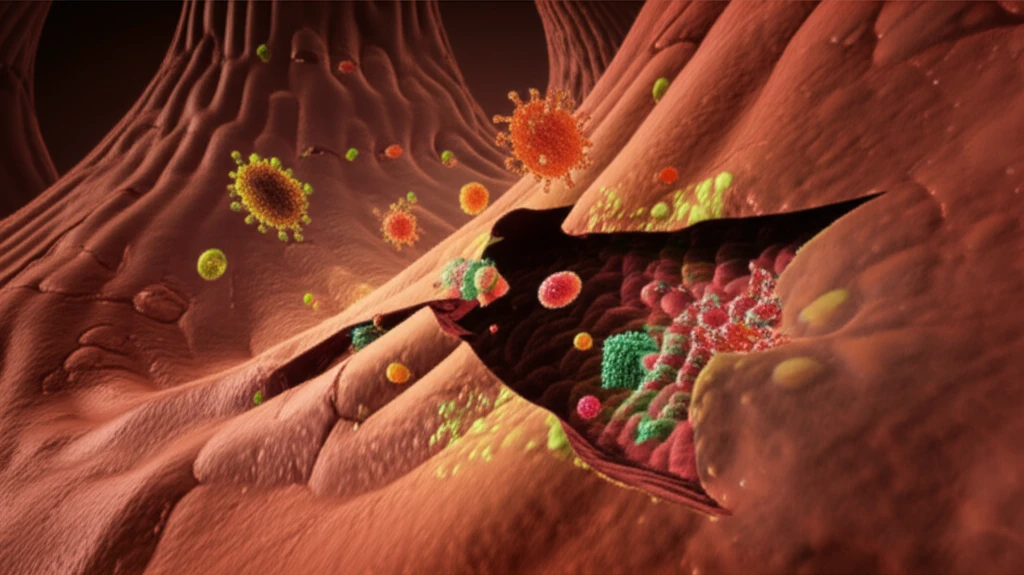
Damaged Intestinal Villi

Is Your Gut Under Attack? The Hidden Dangers of Zearalenone

"Unmasking the toxic effects of a common food contaminant and its impact on your intestinal health."


In today's world, environmental pollutants pose a significant threat to our health, silently compromising our immune systems and paving the way for various ailments. Among these hidden dangers is Zearalenone (ZEA), a mycotoxin produced by Fusarium fungi, commonly found in grains worldwide. While its estrogenic effects are well-documented, the impact of ZEA on our intestinal health often goes unnoticed.

Your gut is the frontline defender of your overall well-being. It plays a crucial role in nutrient absorption and immune function. This article delves into the groundbreaking research that uncovers the toxic effects of ZEA on the intestinal microflora and mucosal immunity in mice, shedding light on the potential risks to human health.

We'll explore how ZEA exposure disrupts the delicate balance of the gut microbiome, triggers inflammation, and compromises the intestinal barrier. Understanding these effects is the first step in protecting ourselves from the harmful consequences of this pervasive toxin.

ZEA's Assault on Your Gut: A Microscopic Look

Damaged Intestinal Villi

The study revealed a disturbing trend: ZEA inflicts significant damage on the intestinal lining. Microscopic analysis of mice intestines exposed to ZEA showed severe disruption of the intestinal villi, the finger-like projections responsible for nutrient absorption. This damage can impair the gut's ability to function correctly, potentially leading to malabsorption and other digestive issues.

Beyond the physical damage, ZEA triggers a cascade of immune responses within the gut. The researchers observed a significant increase in the expression of key genes involved in mucosal immunity, including:

  • β-defensin: An antimicrobial peptide that protects the gut from harmful bacteria.
  • Mucin-1 and Mucin-2: Proteins that form a protective mucus layer, shielding the intestinal lining.
  • Interleukin-1β (IL-1β) and Tumor Necrosis Factor-α (TNF-α): Inflammatory cytokines that signal the immune system to respond to threats.
  • Secretory Immunoglobulin A (sIgA): An antibody that neutralizes pathogens in the gut.
While the increased expression of these immune factors might seem beneficial, it indicates that the gut is under attack and mounting a defense against ZEA's toxic effects. Ironically, the prolonged activation of the immune system can lead to chronic inflammation, further damaging the gut and contributing to various health problems.

Protecting Your Gut: Practical Steps You Can Take

While the research highlights the dangers of ZEA, it also empowers us to take proactive steps to protect our gut health. Here are some strategies to consider:

Choose wisely: Opt for grains and cereals from reputable sources with strict quality control measures to minimize mycotoxin contamination. Read labels carefully and be aware of potential risks associated with certain products.

The key takeaway is that awareness and informed choices can significantly reduce your exposure to ZEA and safeguard your gut health. Stay informed, prioritize gut-friendly foods, and consult with healthcare professionals to address any concerns about mycotoxin exposure and its potential impact on your well-being.

About this Article -

This article was crafted using a human-AI hybrid and collaborative approach. AI assisted our team with initial drafting, research insights, identifying key questions, and image generation. Our human editors guided topic selection, defined the angle, structured the content, ensured factual accuracy and relevance, refined the tone, and conducted thorough editing to deliver helpful, high-quality information.See our About page for more information.

This article is based on research published under:

DOI-LINK: 10.1080/09540105.2018.1503233, Alternate LINK

Title: Toxic Effects Of Zearalenone On Intestinal Microflora And Intestinal Mucosal Immunity In Mice

Subject: Agronomy and Crop Science

Journal: Food and Agricultural Immunology

Publisher: Informa UK Limited

Authors: Xin Wang, Hao Yu, Anshan Shan, Yongcheng Jin, Hengtong Fang, Yun Zhao, Jinglin Shen, Changhai Zhou, Yongfeng Zhou, Yurong Fu, Junmei Wang, Jing Zhang

Published: 2018-01-01

Everything You Need To Know

1

What is Zearalenone (ZEA), and why is it significant?

Zearalenone (ZEA) is a mycotoxin produced by Fusarium fungi, commonly found in grains. Its significance lies in its detrimental effects on intestinal health, which often go unnoticed. The implications of ZEA exposure include disruption of the gut microbiome, inflammation, and compromise of the intestinal barrier, potentially leading to malabsorption and other digestive issues.

2

What is the significance of the gut microbiome in relation to this topic?

The gut microbiome is the community of microorganisms residing in your intestines. In the context of this information, Zearalenone (ZEA) disrupts this delicate balance. This disruption can lead to an imbalance in gut flora, which is crucial for nutrient absorption and immune function. The implications of this disruption are a weakened immune system and a compromised ability to absorb nutrients effectively, potentially leading to various health problems.

3

What are intestinal villi, and how does Zearalenone (ZEA) affect them?

Intestinal villi are finger-like projections in the intestinal lining responsible for nutrient absorption. Zearalenone (ZEA) exposure inflicts significant damage on these structures. The implications of this damage include impaired nutrient absorption, potentially leading to malabsorption issues and overall digestive problems.

4

What is mucosal immunity, and how does Zearalenone (ZEA) impact it?

Mucosal immunity refers to the immune defenses within the mucosal linings of the body, including the gut. In the context of this information, Zearalenone (ZEA) triggers immune responses within the gut, including an increase in the expression of key genes involved in mucosal immunity. This prolonged activation of the immune system can lead to chronic inflammation, which further damages the gut and contributes to various health problems. The body releases things like β-defensin, Mucin-1, Mucin-2, Interleukin-1β (IL-1β), Tumor Necrosis Factor-α (TNF-α), and Secretory Immunoglobulin A (sIgA) in response to the threat.

5

What are β-defensin, Mucin-1, Mucin-2, Interleukin-1β (IL-1β), Tumor Necrosis Factor-α (TNF-α), and Secretory Immunoglobulin A (sIgA) and what is their role in response to this problem?

β-defensin, Mucin-1, Mucin-2, Interleukin-1β (IL-1β), Tumor Necrosis Factor-α (TNF-α), and Secretory Immunoglobulin A (sIgA) are immune factors triggered by Zearalenone (ZEA) exposure in the gut. The increased expression of these factors indicates that the gut is under attack and mounting a defense against ZEA's toxic effects. While this response is initially protective, prolonged activation can lead to chronic inflammation and further damage to the gut.

Newsletter Subscribe

Subscribe to get the latest articles and insights directly in your inbox.