
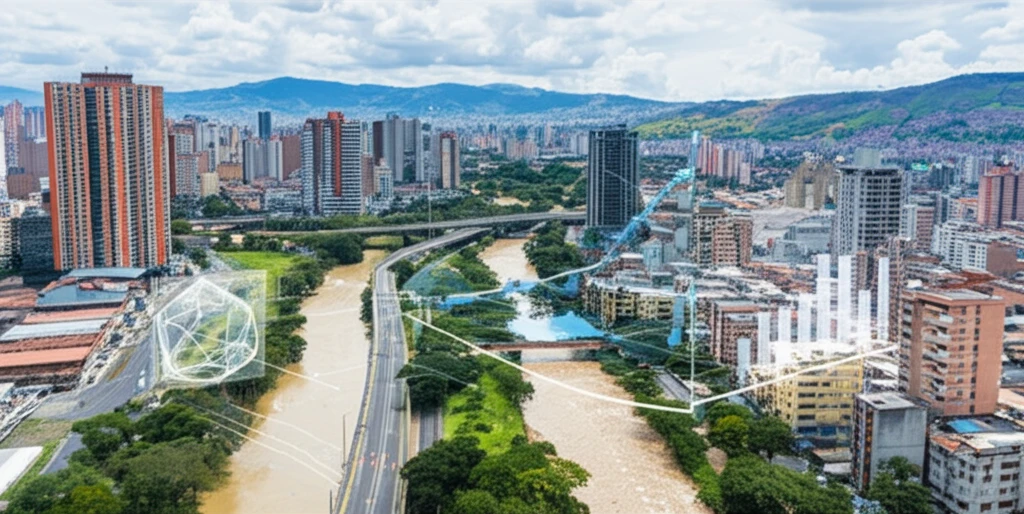
Is Your City's Water Safe? Unveiling Medellin's River Recovery Plan

"A Deep Dive into Water Quality Modeling and Urban River Restoration"
For cities worldwide, maintaining clean and safe water sources is a critical challenge, particularly for rivers that flow through urban areas. These rivers often suffer from pollution due to industrial discharge, residential runoff, and inadequate waste management. The consequences can be dire, impacting public health, ecosystems, and the overall quality of life for city residents.
Medellin, Colombia, a city nestled in the Aburrá Valley, has been grappling with these issues concerning the Aburrá-Medellín River. Recognizing the importance of this vital resource, Medellin has embarked on an ambitious journey to restore its river using advanced water quality modeling techniques. This initiative aims to assess the river's health, project the impact of various interventions, and guide the city towards sustainable water management.
This article dives deep into Medellin's water quality modeling project, exploring the strategies, challenges, and successes of this endeavor. We'll uncover how innovative technologies and community engagement are driving the transformation of a polluted urban river into a source of pride and well-being for the city.
Modeling the Medellín River's Water Quality Crisis
Researchers applied the Qual2kw model to assess water quality in the first 50 kilometers of the Aburrá-Medellín River during its most critical conditions, which correspond to low flow periods. The study evaluated three recovery scenarios—short-term, medium-term, and long-term—after calibrating the model to local conditions. These modeling efforts aim to project the effects of different protective measures on the river's water quality. The findings provide a foundation for understanding the severity of contamination in this urban waterway.
QUAL2K: The Workhorse of River Quality Modeling
QUAL2K and its derivative QUAL2Kw are widely used one-dimensional water quality models designed for rivers and streams under steady-state flow conditions. These models can simulate river pollution scenarios, identify pollution sources, and evaluate the effectiveness of various mitigation strategies. A comprehensive review published in 2025 examined the input data requirements, applications, recent advancements, strengths, and limitations of the QUAL2K framework. While these tools are valuable for point and non-point pollution modeling, their reliance on steady-state assumptions represents a known constraint when applied to dynamic river systems.
From Sacred Waterway to Contaminated Channel
Long before Medellín existed, the indigenous Aburrá people who inhabited the valley called the river Aná, which means 'water' or 'river' in their language. This sacred waterway eventually degraded into what many described as an open-air sewer as urbanization transformed the valley. The ecological history of the Medellín River reflects a broader pattern seen in rivers worldwide—from revered natural resource to neglected dumping ground. Understanding this historical arc is essential context for current restoration efforts.
Decoding Medellin's Water Quality Model: How Does It Work?
Medellin's approach revolves around a sophisticated water quality model called Qual2Kw. This model serves as a virtual representation of the Aburrá-Medellín River, allowing scientists and city planners to simulate different scenarios and predict the outcomes of various interventions. Here’s a breakdown of how it works:
- Water Transportation: Advection and dispersion, which determine how pollutants spread throughout the river.
- External Sources: Water intakes and wastewater discharges that add or remove water and pollutants.
- Internal Sources: Benthic oxygen demand (the consumption of oxygen by sediment at the river bottom) and biochemical transformations that affect water quality.
Advances in Urban River Restoration Science
Recent years have seen growing interest in applying water quality models to support urban river restoration projects. Researchers continue to refine modeling approaches to better capture the complexities of heavily urbanized watersheds. While specific large-scale reviews of Medellín River restoration outcomes remain limited, the broader field of urban river ecology is evolving rapidly. Cities around the world are increasingly turning to data-driven approaches to guide their waterway recovery strategies.
Challenges in Modeling Under Stress Conditions
The Qual2kw model applied to the Medellín River was specifically tested under the most critical water quality conditions, corresponding to low flow rates—a scenario where pollution concentrations peak. While the model calibration enabled evaluation of recovery scenarios, low-flow conditions inherently stress any modeling framework. The reliance on steady-state assumptions during these critical periods may limit the model's ability to capture transient pollution events. These constraints suggest that model outputs should be interpreted as indicative rather than definitive projections of river recovery.
QUAL2K Among Water Quality Modeling Tools
A 2025 comparative review examined the QUAL2K model alongside other water quality modeling approaches. The review analyzed how QUAL2K utilizes river and point-source flow rates and water quality parameters to simulate river conditions. As a one-dimensional model, QUAL2K offers computational efficiency but may not capture spatial heterogeneity in wider or more complex river systems. The comparative analysis highlights that model selection should match the specific characteristics of the waterbody being studied.
The Ripple Effect: How Medellin's River Restoration Impacts the Community
Medellin's commitment to restoring the Aburrá-Medellín River demonstrates how innovative water quality modeling and strategic interventions can revitalize urban waterways. By continuing these efforts, Medellin is paving the way for a cleaner, healthier, and more sustainable future for its residents. The city’s success serves as an inspiration for other urban centers facing similar challenges, proving that even the most polluted rivers can be brought back to life with the right tools and dedication.
Integrating Modeling with Long-Term Monitoring
Research on the Aburrá-Medellín River combines water quality modeling with long-term monitoring data. A 2022 study analyzed electrical conductivity readings from the river's monitoring network spanning 2006 to 2020, using conductivity as an indicator of water quality variation. This space-time analysis complements the Qual2kw modeling scenarios by providing empirical evidence of actual water quality trends. Together, these approaches offer a more complete picture of river conditions than either method alone.
The Path Forward for Urban River Restoration
Medellín's river recovery efforts represent an ongoing experiment in urban environmental restoration. As modeling tools become more sophisticated and monitoring networks expand, cities will gain better insights into what works and what doesn't in river rehabilitation. The integration of real-time monitoring with predictive modeling holds promise for adaptive management approaches. However, significant uncertainties remain about long-term outcomes, particularly as climate change alters precipitation patterns and river flows.
Global Patterns of River Degradation and Recovery
The Medellín River's challenges mirror those faced by rivers worldwide, where water quality impairment and scarcity events stem from deforestation, urban expansion, and agricultural activities. Research on integrated river-reservoir systems shows that while models can reproduce expected variability, calibration challenges arise in multiscale modeling efforts. These systemic challenges are not unique to Medellín—they reflect the broader difficulty of managing water resources in rapidly urbanizing landscapes. Medellín's approach to using innovative water quality modeling offers lessons that may apply to other cities confronting similar challenges.
Communities and Rivers: An Intertwined Fate
The fate of urban rivers is inseparable from the communities that live alongside them. When rivers degrade, public health, recreation, and quality of life all suffer. Conversely, river restoration can transform neighborhood identities and create new opportunities for outdoor activity and community gathering. The human dimension of river recovery reminds us that environmental restoration is not just about water chemistry—it is about restoring the relationship between people and their waterways.