
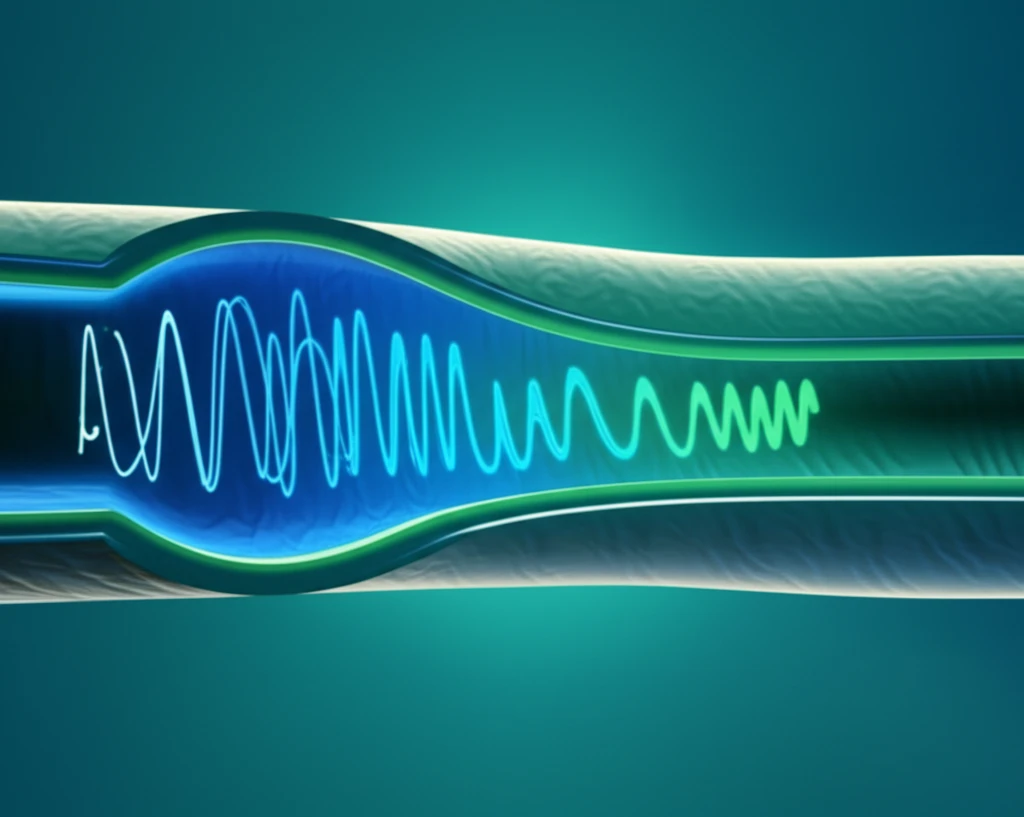
Illustration of a slowing pulse wave in the brachial artery, representing flow-mediated slowing.

Is There a Better Way to Measure Heart Health? Flow-Mediated Slowing Explored

"New research suggests a promising alternative to traditional methods for evaluating endothelial function, offering a potentially easier and more reproducible approach."


Cardiovascular disease remains a leading cause of health concerns, making early detection of risk factors crucial. Endothelial dysfunction (ED), an early indicator of potential heart problems, is often assessed using flow-mediated dilation (FMD). However, FMD has limitations, including its reliance on skilled technicians and specialized equipment.

A recent study published in Mayo Clinic Proceedings: Innovations, Quality & Outcomes explores an alternative method called flow-mediated slowing (FMS). This technique measures the change in pulse wave velocity (PWV) in the brachial artery after a period of increased blood flow, offering a potentially easier and more consistent way to evaluate endothelial function.

This article will delve into the details of FMS, comparing it to the traditional FMD method. We'll explore how it works, its potential advantages, and what the research suggests about its accuracy and reliability for assessing heart health.

Flow-Mediated Slowing: A Simpler Approach to Heart Health Assessment

Illustration of a slowing pulse wave in the brachial artery, representing flow-mediated slowing.

The core concept behind FMS lies in the relationship between arterial radius and pulse wave velocity (PWV). The Moens-Korteweg equation predicts that when arterial radius increases (as it does during reactive hyperemia, a period of increased blood flow), PWV should slow down in that arterial segment. FMS measures this deceleration of PWV in the brachial artery.

Researchers compared FMS with FMD in 25 healthy participants. They measured both FMS (assessing changes in PWV) and FMD (measuring the dilation of the brachial artery) simultaneously. The results revealed a significant correlation between the two methods, suggesting that FMS could be a reliable indicator of endothelial function.

  • Simpler and more reproducible: FMS offers a less operator-dependent method, potentially leading to more consistent results.
  • Cost-effective: FMS could reduce the need for expensive equipment and highly specialized technicians.
  • Promising alternative: The study suggests FMS holds promise as a non-invasive tool for evaluating endothelial function.
While the initial results are encouraging, researchers also found that FMS measurements can be influenced by the baseline diameter of the brachial artery. This means that individuals with smaller arteries may show smaller variations in PWV. Further studies are needed to fully understand this relationship and how it affects the accuracy of FMS in different individuals.

The Future of Endothelial Function Assessment

The study indicates that flow-mediated slowing has potential as a valuable tool for assessing endothelial function. Its simplicity and reproducibility could address some of the limitations associated with the traditional flow-mediated dilation technique.

However, it’s important to acknowledge that this is a preliminary study with a limited sample size. More extensive research is necessary to validate these findings across diverse populations, including individuals with existing cardiovascular risk factors.

Further studies are needed to fully determine how FMS correlates with actual cardiovascular events and whether it can effectively identify individuals at risk. While FMS shows promise, ongoing research is critical to fully establish its role in cardiovascular risk assessment and management.

About this Article -

This article was crafted using a human-AI hybrid and collaborative approach. AI assisted our team with initial drafting, research insights, identifying key questions, and image generation. Our human editors guided topic selection, defined the angle, structured the content, ensured factual accuracy and relevance, refined the tone, and conducted thorough editing to deliver helpful, high-quality information.See our About page for more information.

This article is based on research published under:

DOI-LINK: 10.1016/j.mayocpiqo.2018.02.002, Alternate LINK

Title: Flow-Mediated Slowing As A Methodological Alternative To The Conventional Echo-Tracking Flow-Mediated Dilation Technique For The Evaluation Of Endothelial Function: A Preliminary Report

Subject: General Medicine

Journal: Mayo Clinic Proceedings: Innovations, Quality & Outcomes

Publisher: Elsevier BV

Authors: Telmo Pereira, Armindo Almeida, Jorge Conde

Published: 2018-06-01

Everything You Need To Know

1

What exactly is flow-mediated slowing, FMS, and how does it assess heart health?

Flow-mediated slowing, or FMS, assesses heart health by measuring the change in pulse wave velocity (PWV) in the brachial artery following a period of increased blood flow. The Moens-Korteweg equation predicts that as the arterial radius increases during reactive hyperemia, the PWV will decrease in that segment. It's a simpler and potentially more reproducible way to evaluate endothelial function compared to traditional methods. However, FMS measurements can be influenced by the baseline diameter of the brachial artery, which requires further investigation.

2

How does flow-mediated slowing, FMS, compare to traditional flow-mediated dilation, FMD, techniques?

Traditional flow-mediated dilation, known as FMD, measures the dilation of the brachial artery to assess endothelial function. FMD relies on skilled technicians and specialized equipment. Flow-mediated slowing, FMS, offers a potential advantage because it is less dependent on the operator, potentially leading to more consistent results and is measured by assessing changes in pulse wave velocity. FMS also has the potential to be more cost-effective, reducing the need for expensive equipment and specialized technicians.

3

How can flow-mediated slowing, FMS, contribute to early detection of heart problems?

Endothelial dysfunction, or ED, is an early indicator of potential heart problems. Flow-mediated slowing, or FMS, could play a role in early detection. By providing a simpler and more reproducible assessment of endothelial function, FMS may help identify individuals at risk earlier in the disease process, allowing for timely interventions. However, it's important to note that while the initial research is promising, more studies are needed to fully understand how baseline diameter of the brachial artery may affect FMS accuracy.

4

What did the study in *Mayo Clinic Proceedings* reveal about flow-mediated slowing, FMS?

The study published in *Mayo Clinic Proceedings: Innovations, Quality & Outcomes* compared flow-mediated slowing, FMS, with flow-mediated dilation, FMD, in 25 healthy participants. The results indicated a significant correlation between FMS (assessing changes in PWV) and FMD (measuring the dilation of the brachial artery). This suggests that FMS could be a reliable indicator of endothelial function. Further studies are needed to validate these findings in larger and more diverse populations.

5

Are there any factors that can affect the accuracy of flow-mediated slowing, FMS, measurements?

While flow-mediated slowing, FMS, offers a promising avenue for heart health assessment, there are also factors that can affect the accuracy of FMS measurements. One is the baseline diameter of the brachial artery. Individuals with smaller arteries may show smaller variations in pulse wave velocity, PWV, which can affect FMS accuracy. Understanding this is crucial for correctly interpreting the results and tailoring interventions to each individual's specific needs. Further research is needed to fully understand these nuances.

Newsletter Subscribe

Subscribe to get the latest articles and insights directly in your inbox.