
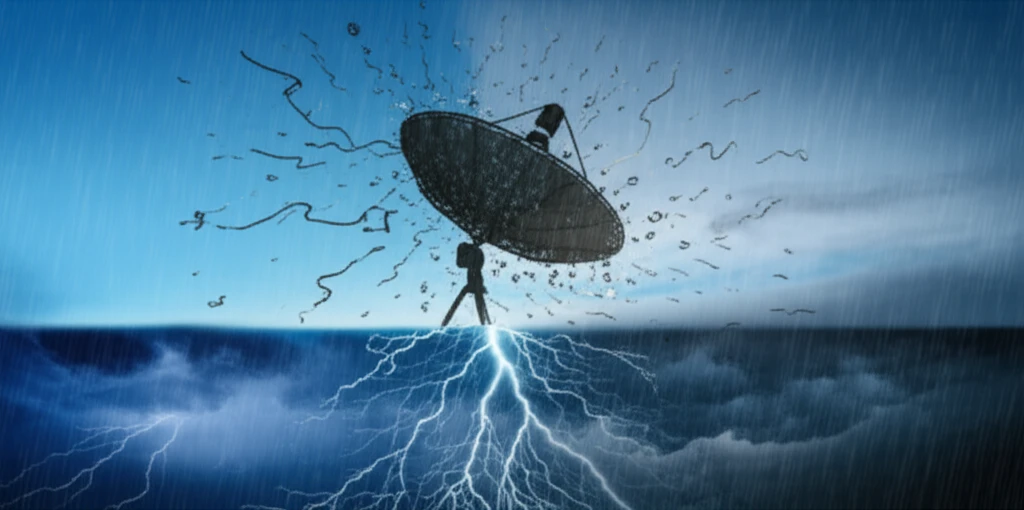
Is Rain Ruining Your Signal? Understanding and Overcoming Radio Wave Attenuation

"Explore how rainfall impacts earth-space communication links and discover strategies to maintain optimal connectivity in challenging weather."
In our increasingly connected world, reliable communication is paramount. From streaming your favorite shows to conducting critical business operations, we depend on stable connections. But what happens when the weather turns? Rain, seemingly harmless, can significantly impact the quality of microwave and satellite communication links. This phenomenon, known as rain attenuation, occurs when raindrops absorb and scatter radio waves, weakening the signal and potentially disrupting service.
Rain attenuation is a significant factor in designing microwave satellite and terrestrial communication systems, especially in the Ku and Ka bands, which are commonly used for satellite internet and broadcasting. Predicting the effects of rain is essential for ensuring reliable connectivity. This article delves into the complexities of rain attenuation, exploring recent research and modeling techniques aimed at mitigating its impact. We'll focus on a case study from Uyo, Akwa Ibom State, Nigeria, a region known for its heavy rainfall, to illustrate the real-world implications of this phenomenon.
Whether you're a telecommunications professional, a weather enthusiast, or simply someone who relies on a stable internet connection, understanding rain attenuation can help you appreciate the challenges of maintaining seamless communication in the face of adverse weather conditions. By exploring the science behind rain attenuation and the strategies for overcoming it, we can better prepare for and adapt to the impact of rain on our connected lives.
Why Does Rain Attenuate Radio Waves?
Rain attenuation happens because raindrops can both absorb and scatter radio waves, especially at frequencies above 10 GHz. Think of it like this: radio waves are a form of energy, and when they encounter raindrops, some of that energy is absorbed by the water molecules. Additionally, raindrops act like tiny obstacles, scattering the radio waves in different directions, reducing the strength of the signal reaching its destination. This effect becomes more pronounced as the frequency of the radio waves increases and when rainfall is intense.
- Frequency: Higher frequency signals are more susceptible to rain attenuation. Ku and Ka bands, commonly used for satellite communications, are particularly affected.
- Rain Intensity: The heavier the rainfall, the greater the attenuation. High-intensity, short-duration rain events can cause significant signal disruptions.
- Path Length: The longer the distance a radio wave travels through rain, the more it is attenuated. Earth-space paths are particularly vulnerable.
- Climate: Tropical regions, characterized by heavy rainfall, experience more severe rain attenuation than temperate zones.
Looking Ahead: Ensuring Reliable Communication in a Changing Climate
As climate patterns shift and extreme weather events become more frequent, understanding and mitigating rain attenuation will become increasingly critical for maintaining reliable communication networks. Continued research and development in modeling techniques, adaptive technologies, and network design will be essential to ensure that our connected world remains robust in the face of adverse weather conditions. By staying informed and proactive, we can minimize the impact of rain on our signals and keep the world connected, no matter the weather.