
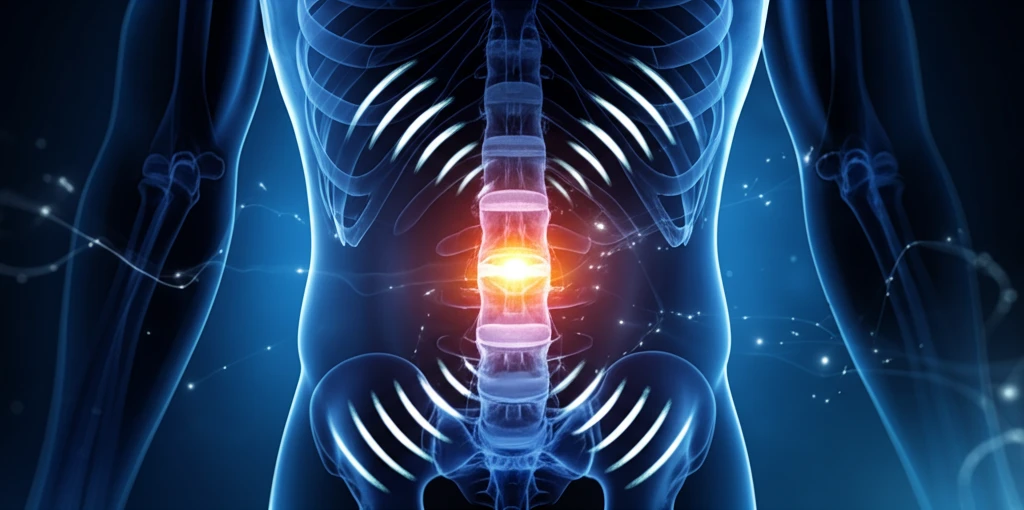
Is Radiofrequency Denervation the Key to Long-Term Lower Back Pain Relief?

"A look at a randomized study on radiofrequency lumbar facet denervation and its potential to reduce pain and serum beta-endorphin levels."
Chronic lower back pain (LBP) is a widespread problem, affecting approximately 80% of adults at some point in their lives. The facet joints in the spine are often implicated as a significant source of this pain, accounting for 15% to 40% of chronic LBP cases. Lumbar Facet Syndrome (LFS) can significantly impact an individual's quality of life, leading to decreased mobility and persistent discomfort.
Traditional treatments for LFS often involve pain management with medications like NSAIDs. However, a technique called radiofrequency (RF) lumbar facet denervation has emerged as a promising alternative. This procedure involves using radiofrequency energy to disrupt the nerves transmitting pain signals from the facet joints. While prior research indicates the potential of RF denervation, a direct comparison with NSAIDs has been lacking.
A randomized controlled study explored and directly compared RF denervation to NSAID treatment, focusing on changes in serum beta-endorphin levels, which are natural pain-relieving substances in the body. This study aimed to shed light on the effectiveness of RF denervation and its possible mechanisms for providing pain relief in individuals with LFS.
Numbers Behind the Procedure
Radiofrequency (RF) denervation is a widely used interventional treatment for chronic low back pain, and its evidence base is now being consolidated through large-scale systematic reviews. As of searches run through 18 February 2025, a systematic review and meta-analysis of randomized controlled trials has assessed the effects of RF denervation for chronic low back pain arising from facet joints, sacroiliac joints, discs, and non-specific sources, reflecting the breadth of pain sources the procedure is used to treat. In parallel, published analyses of three randomized clinical trials comparing a standardized exercise program with and without radiofrequency denervation have contributed real-world context on the procedure's added value within broader rehabilitation. For lumbar facet pain specifically, commonly cited statistics report success rates in the range of 70–85%, though results vary with patient selection and technique.
How RF Denervation Is Performed
Radiofrequency (RF) denervation is typically reserved for adults with chronic low back pain whose pain source has been narrowed to reproducible structures such as the facet joints, sacroiliac joints, or intervertebral discs, often following diagnostic blocks. The procedure disrupts the small sensory nerves believed to carry pain signals from the affected joint to the central nervous system, with the goal of providing relief that outlasts the immediate post-procedure period. Accepted methods vary in lesion size, temperature, needle placement, and imaging guidance, and outcomes appear to depend heavily on how carefully patients are selected. Because no single approach has been shown to be uniformly superior, clinicians often weigh factors such as anatomy, coexisting spinal conditions, and response to prior interventions when deciding whether and how to proceed.
Five Decades of Evolution
Radiofrequency neurotomy (RFN) of the lumbar medial branch has been an established treatment for facet-joint-proven low back pain since the technique was invented in the early 1970s. The development of the procedure unfolded over a diverse timeline involving multiple medical specialists, and for years relatively little collated history of the technique was published. A key milestone came roughly two decades later, when the first sham-controlled randomized trial of facet joint denervation using radiofrequency ablation technology was conducted, demonstrating both efficacy and exceptional long-term clinical outcomes in individuals with chronic neck pain due to whiplash injury. Together, these developments trace a trajectory from early clinical adoption to controlled validation.
Radiofrequency Denervation vs. NSAIDs: Which Offers Better Pain Relief?
The study, published in the Journal of Spine in 2016, enrolled twenty-five participants diagnosed with LFS. Participants were randomly assigned to either the treatment arm, receiving percutaneous RF denervation, or the control arm, receiving medical treatment with NSAIDs. The participants were evaluated at baseline, 7 days post-intervention, and 28 days post-intervention. The primary endpoint was the pain visual analogue scale (VAS) score on day 28.
- Pain Intensity: Measured using a visual analogue scale (VAS) at days 0, 7, and 28.
- Quality of Life: Assessed using the Short Form-36 (SF-36) questionnaire.
- Serum Beta-Endorphin Levels: Measured at days 0, 7, and 28 to evaluate changes in natural pain relief.
An Active Evidence Base
Recent and ongoing research continues to interrogate whether radiofrequency (RF) denervation reliably outperforms non-invasive and placebo-controlled alternatives for chronic low back pain. Current studies are broadly focused on improving patient selection — refining diagnostic criteria so the procedure is offered mainly to those whose pain genuinely arises from targetable structures — and on standardizing technique, outcome measures, and follow-up periods so results can be compared across trials. While some reviews report meaningful pain relief for carefully selected patients, the broader literature remains mixed, and the field is likely to continue evolving as longer-term randomized data accumulate.
Why Treatment Can Fail
Despite decades of use, radiofrequency denervation for chronic low back pain carries a notable evidence controversy. The Cochrane review of the procedure reports substantial variation in its use between countries and continued uncertainty about its effectiveness, with many uncontrolled studies contributing to the mixed picture. A well-known clinical puzzle is the patient who gets excellent short-term relief from diagnostic medial branch blocks but fails to see comparable improvement after lumbar facet radiofrequency denervation — a phenomenon that can stem from technical, anatomical, and selection-related factors. Related systematic reviews have likewise compared radiofrequency denervation of intervertebral discs against control conditions, reporting mixed short-term pain outcomes at one to three months of follow-up.
Weighing the Options
Direct comparisons between radiofrequency denervation and other interventional and non-interventional treatments for chronic low back pain remain relatively limited, and much of the existing comparative evidence is heterogeneous in design, patient selection, and outcome definition. Some comparisons focus on variant techniques — such as different levels of lesioning, alternate imaging modalities, or denervation at different anatomical targets — rather than head-to-head trials against a single standard comparator. Conclusions are complicated by the fact that the efficacy of radiofrequency denervation appears highly sensitive to patient selection, so results from one population may not generalize cleanly to another.
The Future of Lower Back Pain Treatment
Radiofrequency lumbar facet denervation shows promise as a treatment for individuals with lumbar facet syndrome. While further research is needed to fully understand its long-term effects and the role of beta-endorphins, this study offers hope for those seeking alternatives to traditional pain management approaches.
What the Experts Say
Expert assessments of radiofrequency denervation for chronic low back pain are not unanimous. A systematic review and network meta-analysis describes RF denervation as an effective treatment option for facet joint pain and was designed to compare the efficacy of different RF denervation techniques against one another. Broader systematic reviews continue to assess the effects of RF denervation across facet joint, sacroiliac joint, discogenic, and non-specific pain. At the same time, published commentary on the randomized trials that tested RF denervation plus exercise versus exercise alone has pointed to design flaws, cautioning that apparent null results should be interpreted with care.
Refining Selection, Not Just Technique
The future direction of radiofrequency denervation for low back pain likely hinges less on the technology itself and more on refining who receives it and how outcomes are measured. Ongoing work is expected to sharpen diagnostic selection criteria, improve the reproducibility of lesion placement, and standardize outcome reporting so that trials can be compared meaningfully. Whether newer variants of the technique will deliver more durable relief — and whether they prove cost-effective relative to other interventional and conservative care — remains to be established by well-designed prospective studies.
Selection Is Everything
Radiofrequency denervation works on a simple underlying premise: the procedure aims to generate small lesions in the nerves responsible for transmitting pain impulses from the site where low back pain originates to the central nervous system. Success, however, is heavily dependent on identifying the correct anatomical source of the pain before treatment, since denervation only makes sense if the targeted nerve is genuinely driving the patient's symptoms. Studies by MacVicar and colleagues and Dreyfuss and colleagues have demonstrated excellent clinical outcomes when rigorous selection criteria are applied, underscoring that the procedure's results are tied to diagnostic rigor rather than to the technique alone.
Life Beyond the Pain Score
For patients, chronic low back pain is not simply a clinical diagnosis but a daily burden that affects mobility, sleep, work, and emotional well-being, and the prospect of an intervention that could reduce pain is often met with genuine hope. In practice, the real-world impact of radiofrequency denervation depends on factors that extend beyond the procedure itself — including how carefully the diagnostic workup is performed, how outcomes are managed over time, and how realistic patient expectations are set beforehand. Because results vary substantially between individuals, many patients experience meaningful relief while others see little change, which makes shared decision-making and honest discussion of uncertainty especially important.