
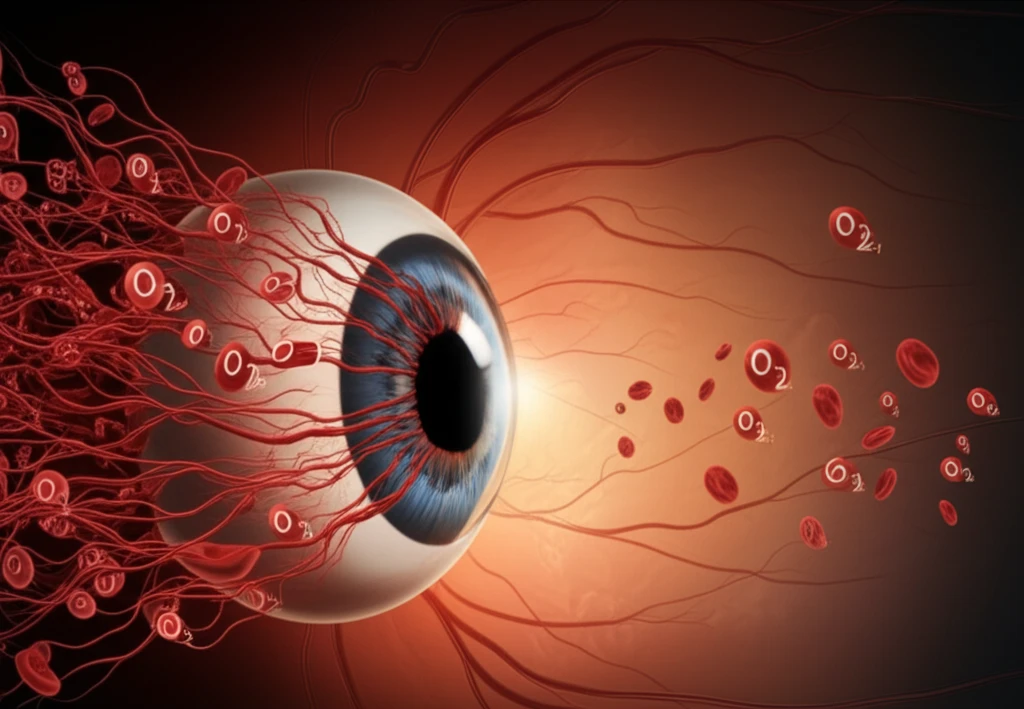
Surreal illustration of retinal oxygenation and blood vessels.

Is Oxygen the Key? Unlocking the Mysteries of Retinal Ischemia

"A deeper look at how oxygen levels affect vision in retinal vein occlusion and other ischemic conditions."


Recent studies using en face optical coherence tomography (OCT) have highlighted the variable nature of macular middle-retinal infarction (MMRI) in eyes experiencing retinal vein or arterial occlusion. This variability reflects differing levels of circulatory failure during the evolution of an infarct, challenging existing models.

Researchers have proposed that MMRI stems from "misery perfusion," where the inner retina suffers from disproportionate oxygen extraction, leading to ischemic hypoxia and anoxia. This challenges the traditional understanding of tissue oxygenation, suggesting that the anatomic structure of macular arterioles and venules plays a critical role.

This article delves into the concept of oxygenation-based hypoperfusion maculopathy (OHM) to provide a broader perspective on ischemic dysfunction in the retina, moving beyond the limitations of terms like "perivenular PAMM" and addressing the role of oxygen levels in different retinal layers.

Beyond PAMM: Understanding Oxygenation-Based Hypoperfusion Maculopathy (OHM)

Surreal illustration of retinal oxygenation and blood vessels.

The term PAMM (“paracentral acute middle maculopathy”) has been used to describe specific lesions in CRVO and CRAO. However, this term may be limiting because OCT cannot directly identify hypoxic tissue. This means it might underestimate the full impact of inner retinal hypoperfusion. Furthermore, the expression "perivenular PAMM" is inherently contradictory.

Instead, considering the broader spectrum of ischemic dysfunction through the lens of oxygenation-based hypoperfusion maculopathy (OHM) offers a more comprehensive understanding. OHM recognizes that changes in oxygen levels can affect both the superficial inner retina (SIR) and the middle retina (MR).

  • OHM Grade 1 (OHM1): Corresponds to the "fern-like" perivenular opacification seen in CRVO. The SIR is typically normoxic, while MMRI may show asymmetry.
  • OHM Grade 2 (OHM2): Similar to "partial" CRAO, the SIR becomes predominantly hypoxic, and the MR is diffusely affected. Cotton-wool spots may appear.
  • OHM Grade 3 (OHM3): Represents "complete" CRAO, where both the MR and SIR are anoxic, although some areas around third-order arterioles might be spared due to residual blood flow.
Understanding these grades helps to appreciate how different levels of oxygen deprivation impact retinal structures, leading to a more nuanced approach to diagnosis and potential treatment strategies. It's crucial to move beyond simplified terms and consider the complex interplay of oxygen supply and demand in the retina.

The Future of Retinal Ischemia Research

Moving forward, a deeper understanding of oxygen dynamics within the retina is crucial for developing targeted treatments for ischemic conditions. By recognizing the limitations of previous classifications and embracing the OHM framework, researchers and clinicians can better address the complexities of retinal vascular diseases.

Further research is needed to refine the OHM classification and explore potential therapeutic interventions that can improve oxygen delivery and reduce ischemic damage in the retina. This includes investigating strategies to enhance blood flow, reduce inflammation, and protect retinal cells from oxidative stress.

Ultimately, a comprehensive approach that considers the multifaceted nature of retinal ischemia, including oxygenation levels, vascular structure, and cellular responses, will lead to more effective treatments and improved outcomes for patients at risk of vision loss.

About this Article -

This article was crafted using a human-AI hybrid and collaborative approach. AI assisted our team with initial drafting, research insights, identifying key questions, and image generation. Our human editors guided topic selection, defined the angle, structured the content, ensured factual accuracy and relevance, refined the tone, and conducted thorough editing to deliver helpful, high-quality information.See our About page for more information.

This article is based on research published under:

DOI-LINK: 10.1016/j.ajo.2017.06.037, Alternate LINK

Title: En Face Optical Coherence Tomography Analysis To Assess The Spectrum Of Perivenular Ischemia And Paracentral Acute Middle Maculopathy In Retinal Vein Occlusion

Subject: Ophthalmology

Journal: American Journal of Ophthalmology

Publisher: Elsevier BV

Authors: David Mcleod

Published: 2017-10-01

Everything You Need To Know

1

What is oxygenation-based hypoperfusion maculopathy (OHM), and why is it important?

Oxygenation-based hypoperfusion maculopathy (OHM) is a framework that classifies retinal ischemia based on the levels of oxygen deprivation affecting the retina. It moves beyond traditional classifications, like PAMM, to provide a more comprehensive understanding of how oxygen levels influence vision loss. This is important because understanding oxygen dynamics is crucial for developing targeted treatments for ischemic conditions. The implications of OHM include a more nuanced approach to diagnosis and the potential for more effective treatment strategies, as it considers the complex interplay of oxygen supply and demand in different retinal layers.

2

What is macular middle-retinal infarction (MMRI), and why is understanding it significant?

Macular middle-retinal infarction (MMRI) refers to damage in the middle retinal layers due to circulatory failure and oxygen deprivation. It is a key component in understanding retinal ischemia. Variability in MMRI, as seen in eyes with retinal vein or arterial occlusion, challenges previous models of ischemia. This variability is important because it reflects differing levels of circulatory failure, leading to a more detailed understanding of the condition. Implications of MMRI understanding include the recognition that the anatomic structure of macular arterioles and venules plays a critical role in the progression of the disease, potentially influencing treatment approaches.

3

What are the different grades of oxygenation-based hypoperfusion maculopathy (OHM), and what do they signify?

The grades of Oxygenation-based hypoperfusion maculopathy (OHM) are OHM1, OHM2, and OHM3, which classify retinal ischemia based on the severity of oxygen deprivation. OHM1 corresponds to the 'fern-like' perivenular opacification, OHM2 resembles 'partial' CRAO, and OHM3 represents 'complete' CRAO. Understanding these grades helps appreciate how different levels of oxygen deprivation impact retinal structures. The implications include a more nuanced approach to diagnosing and treating retinal vascular diseases by considering the specific oxygenation state of different retinal layers. This framework facilitates the development of targeted treatments based on the severity of ischemia.

4

What are the limitations of the term PAMM (paracentral acute middle maculopathy), and how does OHM address these limitations?

PAMM (paracentral acute middle maculopathy) is a term that has been used to describe specific retinal lesions in conditions like CRVO and CRAO. The limitations of PAMM stem from its inability to directly identify hypoxic tissue using OCT. This term may underestimate the full impact of inner retinal hypoperfusion. Considering the broader spectrum of ischemic dysfunction through the lens of oxygenation-based hypoperfusion maculopathy (OHM) offers a more comprehensive understanding. The implication is that by moving beyond the limitations of terms like 'perivenular PAMM' and embracing OHM, researchers and clinicians can better address the complexities of retinal vascular diseases, leading to improved diagnostic accuracy and potential therapeutic interventions.

5

What is the role of oxygen in retinal ischemia, and why is it so important?

The role of oxygen in retinal ischemia is central to understanding the disease. Oxygen dynamics affect the retina's function. The inner retina suffers disproportionate oxygen extraction, leading to ischemic hypoxia and anoxia, challenging the traditional understanding of tissue oxygenation. The significance lies in the fact that oxygen levels impact the function of the superficial inner retina (SIR) and the middle retina (MR). The implications of oxygen deprivation are reflected in different grades of OHM, impacting retinal structures. This allows for a more nuanced approach to diagnosing and treating these conditions. A deeper understanding of oxygen dynamics is crucial for developing targeted treatments for ischemic conditions.

Newsletter Subscribe

Subscribe to get the latest articles and insights directly in your inbox.