
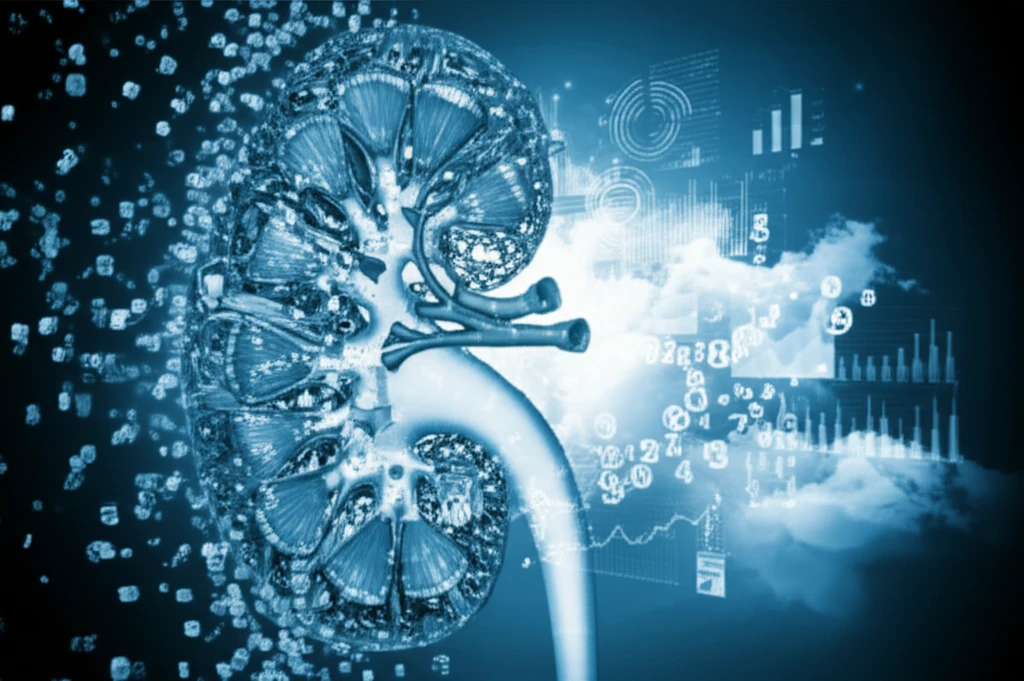
Surreal image of a kidney dissolving into statistical graphs, representing kidney disease prediction.

Is Methylglyoxal the Key to Predicting Kidney Disease?

"New research suggests a link between methylglyoxal levels and the progression of chronic kidney disease, offering potential for earlier intervention."


Chronic Kidney Disease (CKD) is a major global health issue, affecting a significant portion of the population and leading to various complications, including cardiovascular events and end-stage renal disease. Early detection and prevention are crucial for managing CKD and improving patient outcomes.

Advanced glycation end products (AGEs) are compounds formed in the body when sugars react with proteins or fats. These AGEs and their precursors can cause vascular damage through oxidative stress. Researchers are investigating specific AGE precursors, like methylglyoxal (MG), 3-deoxyglucosone (3-DG), and pentosidine, to understand their impact on CKD progression.

A new study investigates the hypothesis that methylglyoxal (MG), 3-deoxyglucosone (3-DG), and pentosidine influence outcomes of chronic kidney disease (CKD) patients. The research focuses on whether measuring these substances can help predict the course of the disease and identify patients at higher risk.

How Was the Methylglyoxal Study Conducted?

Surreal image of a kidney dissolving into statistical graphs, representing kidney disease prediction.

Researchers conducted a three-year prospective observational study involving 150 outpatients with CKD stages 3–5. At the beginning of the study, the researchers measured the plasma concentrations of MG, 3-DG, and pentosidine. The patients were then divided into three groups (tertiles) based on the concentration of each substance in their blood. The study tracked several key outcomes:

The primary endpoint was defined as any of the following:

  • Death (all causes)
  • A cardiovascular event (like a heart attack or stroke)
  • Progression to end-stage renal disease (ESRD) requiring dialysis or kidney transplant
The researchers used a statistical method called Cox regression analysis to determine how these substances were associated with the time it took for patients to reach the primary endpoint. This analysis helped them understand if higher or lower levels of MG, 3-DG, and pentosidine could predict how quickly the disease would progress.

What Can We Conclude from the Methylglyoxal Research?

This study highlights the potential of methylglyoxal as a marker for predicting outcomes in patients with chronic kidney disease, especially those with diabetic nephropathy. Monitoring MG levels may help identify high-risk individuals and guide more aggressive interventions to slow disease progression and improve patient outcomes. Further research is needed to fully understand the role of MG and other AGEs in CKD and to develop targeted therapies.

About this Article -

This article was crafted using a human-AI hybrid and collaborative approach. AI assisted our team with initial drafting, research insights, identifying key questions, and image generation. Our human editors guided topic selection, defined the angle, structured the content, ensured factual accuracy and relevance, refined the tone, and conducted thorough editing to deliver helpful, high-quality information.See our About page for more information.

Everything You Need To Know

1

What is the significance of Methylglyoxal (MG) in the context of Chronic Kidney Disease (CKD)?

Methylglyoxal (MG) is a focus of research because it is believed to be a key indicator in predicting the progression of Chronic Kidney Disease (CKD). The study suggests that measuring MG levels in the blood can help identify individuals at higher risk of adverse outcomes, such as death, cardiovascular events, or end-stage renal disease (ESRD). This is crucial because early detection enables proactive management strategies to slow disease progression and improve patient outcomes. The study also investigated the role of 3-deoxyglucosone (3-DG) and pentosidine, however, MG has gained prominence because of its predictive abilities for high-risk individuals, specifically those with diabetic nephropathy.

2

How does the study relate Methylglyoxal (MG) levels to patient outcomes in Chronic Kidney Disease (CKD)?

The study followed 150 outpatients with CKD (stages 3-5) for three years, measuring their plasma concentrations of Methylglyoxal (MG), 3-deoxyglucosone (3-DG), and pentosidine. Patients were divided into groups based on their levels of these substances. The primary outcomes tracked included death (all causes), cardiovascular events, and progression to end-stage renal disease (ESRD). Using Cox regression analysis, researchers determined how the levels of MG, 3-DG and pentosidine related to the time it took patients to reach the primary endpoint. This analysis helped to determine the ability of MG to predict the rate of CKD progression. The study's findings suggest that higher MG levels may be associated with a faster progression of CKD and a higher risk of adverse events.

3

What are Advanced Glycation End products (AGEs) and why are they relevant to Chronic Kidney Disease (CKD)?

Advanced Glycation End products (AGEs) are compounds formed when sugars react with proteins or fats in the body. This process of glycation contributes to vascular damage, primarily through oxidative stress. In the context of Chronic Kidney Disease (CKD), the buildup of AGEs is thought to contribute to the progression of the disease and the complications associated with it. Researchers are investigating specific AGE precursors, such as Methylglyoxal (MG), 3-deoxyglucosone (3-DG), and pentosidine, to understand their role in CKD and how they can be used to predict disease progression and guide interventions.

4

What were the key findings regarding Methylglyoxal (MG) in this research?

The research highlighted the potential of Methylglyoxal (MG) as a biomarker for predicting outcomes in patients with Chronic Kidney Disease (CKD), especially those with diabetic nephropathy. The study suggests that monitoring MG levels may help identify high-risk individuals, allowing for more aggressive interventions aimed at slowing disease progression and improving patient outcomes. The findings emphasize the importance of MG in predicting the progression of CKD, providing a basis for future research and targeted therapies. Although the study also looked at 3-deoxyglucosone (3-DG) and pentosidine, Methylglyoxal (MG) proved a useful marker for risk assessment.

5

Beyond Methylglyoxal, what other substances were investigated in the study, and how do they relate to kidney disease?

Besides Methylglyoxal (MG), the study also investigated 3-deoxyglucosone (3-DG) and pentosidine. These substances are precursors to Advanced Glycation End products (AGEs), which are formed when sugars react with proteins or fats in the body. The researchers measured the levels of MG, 3-DG, and pentosidine in the blood of CKD patients to understand how these AGE precursors might influence the progression of the disease. While the study explored all three, the focus was to evaluate the ability of each to predict adverse outcomes, like death, cardiovascular events, or progression to end-stage renal disease (ESRD). These precursors provide insight into the body's glycation processes and the resulting vascular damage, helping to understand the disease and to identify at-risk patients earlier.

Newsletter Subscribe

Subscribe to get the latest articles and insights directly in your inbox.