
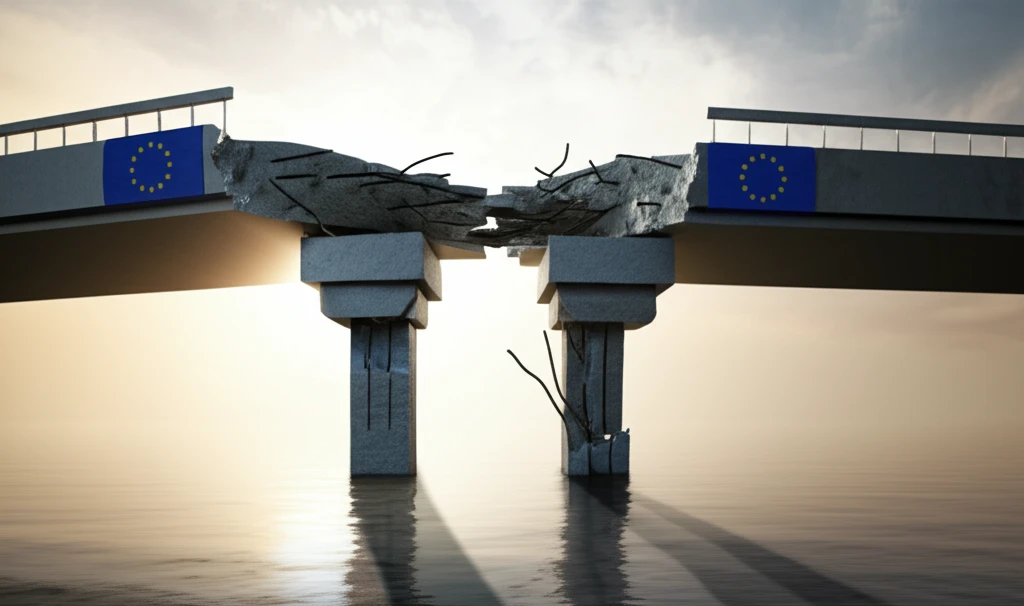
Is EU Enlargement Really Working? A Deep Dive into Bosnia, Herzegovina, and Kosovo

"Explore how EU influence and political promises impact democratization in the Balkans, revealing the complex realities beyond policy."
The fall of communism in Eastern Europe sparked hopes for widespread democratization. However, in the Western Balkans, this transition was complicated by the violent breakup of Yugoslavia, where state-building and national identity became intertwined with democratization. The European Union (EU) stepped in, aiming to foster economic prosperity and stable democracies across the region.
More than a decade into the EU enlargement process, significant challenges remain. One critical issue is the weak implementation of the rule of law, which directly impacts civil liberties. Bosnia and Herzegovina (BiH) and Kosovo are prime examples, with their progress stalled and EU expectations unmet. The core question is: How effective is the EU's enlargement process, particularly its political conditions, in boosting democracy in these complex post-conflict societies?
This article delves into the EU's role in the democratization of BiH and Kosovo. By comparing these two countries, we aim to understand how the EU's political conditions influence democratic development. Both nations share a legacy from Yugoslavia and have undergone peacebuilding with externally-driven state-building. This involves establishing state institutions acceptable to all domestic actors while aligning with the EU integration process.
Measuring Enlargement's Mixed Track Record
Hard, comparable statistics on what enlargement has delivered for Bosnia, Herzegovina, and Kosovo are thin, so any assessment of concrete impact must be treated cautiously. The most reliable quantitative signals come from the EU's own monitoring reports on candidate and potential candidate countries, which track rule-of-law reforms, economic convergence, and institutional progress over time. On these indicators, the record for the Western Balkans is decidedly mixed: some benchmarks improve slowly while others stagnate or regress. Given that official accession dates remain open and that negotiations for these countries sit at very different stages, figures on "impact" are best read as directional trends rather than settled outcomes.
The Fundamentals-First Enlargement Methodology
The EU's standard approach to enlargement rests on a merit-based, conditionality-driven model, in which candidate countries are integrated on the basis of fulfilled reforms rather than fixed timetables. That approach has shifted noticeably since 2022, when Ukraine, Moldova, and Georgia applied to join and fresh geopolitical challenges accelerated the case for reform, cementing a turn towards merit-based integration. The Commission's evolving accession methodology emphasises "the fundamentals," including functioning democratic institutions, which it assesses against explicit criteria for candidate countries. Yet analyses of the process point to its limits: enlargement policy has been questioned for its capacity to foster genuine democratic resilience and security in the neighbourhood, and some research argues the standard framework overstates EU hegemony and underplays the contested politics of Europeanisation.
Seven Waves of Enlargement and the Stability Dividend
Enlargement occurs when new countries join the EU, and it has done so seven times in the Union's history, each wave transforming both the EU and the acceding states. The policy is deliberately merit-based: candidate countries must fulfil the same conditions and complete the same steps to become members. Official EU accounts credit enlargement with having significantly spread stability, peace, and prosperity across the continent, and describe it as one of the most successful tools for promoting political, economic, and social reform. Framed this way, the historical record is offered as evidence that a similarly disciplined process could work for the Western Balkans — including Bosnia, Herzegovina, and Kosovo.
The EU's Carrot-and-Stick Approach: Does It Really Work?
The EU uses a strategy known as “conditionality,” often described as a carrot-and-stick approach. The “carrots” are incentives like economic aid and eventual membership, offered for good behavior. The “sticks” are punishments, such as withholding benefits, for failing to meet specific obligations. This strategy is rooted in the idea that external pressure can drive internal reforms. However, theories diverge on how this actually plays out.
- Rationalist Theory: EU conditionality alters the incentives for local actors, making reforms more attractive.
- Constructivist Theory: Domestic actors adopt EU norms because they view them as legitimate and beneficial for their society.
- Practical Implication: The success of EU influence hinges on both changing incentives and fostering a sense of shared values.
Strengthening Candidate Parliaments as the New Reform Frontier
Recent research focuses on building the capacity of parliaments in accession countries, positioning legislative strengthening as a key front in the evolving enlargement methodology. A 2025 European Parliament study examines democracy-support efforts by EU institutions and partners, and assesses the Commission's criteria for "functioning democratic institutions" in candidate countries. Based on desk research, mapping, and a large number of expert and stakeholder interviews, the study analyses EU support across a slate of enlargement countries, raising questions about the depth of coverage for Bosnia, Herzegovina, and Kosovo specifically. The study's central concern is how EU and member-state support can counter democratic backsliding in accession countries while the Union still has leverage.
Stalling Reforms and Rule-of-Law Backsliding
Evaluations of current candidates paint a pessimistic picture, especially on the rule of law and democracy: the Commission's enlargement reports show limited progress and several candidates are even backsliding on reform commitments. Analysts stress that while bold geopolitical decisions have brought enlargement back onto the EU's agenda, long-standing constraints remain, leaving EU and candidate-state leaders facing persistent dilemmas over how to reward progress without abandoning conditionality. Some ten-year reviews of EU policy reach a more balanced verdict, weighing genuine accomplishments in expansion and crisis management against recurring failures in governance and institutional quality. For candidate countries such as Bosnia, Herzegovina, and Kosovo, the implication is that headline progress can obscure much slower underlying reform.
Comparing Democratic Pull Within and Beyond the Union
Comparative analysis of enlargement and democratisation suggests the EU's policy remains a powerful tool, but one whose effects diverge sharply across regime types: in hybrid regimes, legal reforms alone are said to be insufficient, and enlargement risks reinforcing the very systems it seeks to transform unless trust is rebuilt and informal power structures are tackled. The comparison also runs in the other direction, since the EU itself faces democratic backsliding among existing members — with particular concern about illiberal and pro-Russian tendencies in Czechia, Hungary, and Slovakia — limiting Brussels' appetite to absorb more problems. Other analyses link enlargement to democratization, EU internal reform, and geostrategic interests, and propose differentiated approaches that calibrate integration against democratic performance. Applied to the Western Balkans, this points away from a one-size-fits-all accession path and towards more granular, country-specific benchmarks.
Reassessing EU's Role: A Path Forward
The EU's approach in the Balkans is complex and requires a nuanced understanding of local dynamics. While conditionality has had some positive effects, its success is not guaranteed. In Bosnia and Herzegovina, the EU's influence was initially effective but stalled due to internal political conflicts and a failure to fully embrace EU values. In Kosovo, a more tailored approach, focusing on gradual progress and normalization of relations with Serbia, has shown promise. Moving forward, the EU needs to adapt its strategies, focusing on building genuine commitment to democratic values and fostering inclusive political processes to achieve lasting democratization in the region.
Pulling the Threads Together
Bringing the strands together, the picture that emerges is one of an enlargement policy whose mechanisms are well understood but whose outcomes remain unsettled for the Western Balkans. The EU's credibility depends on holding candidates, including Bosnia, Herzegovina, and Kosovo, to the same fundamentals-first standards applied to earlier waves, even as geopolitical urgency pulls toward speed. The honest synthesis is that progress is real but uneven, and that the final verdict will depend on both sides keeping their commitments. Without more transparent benchmarks and consistent enforcement, confident claims that enlargement is "working" should be treated with caution.
An Open-Ended Accession Horizon
Near-term prospects for Bosnia, Herzegovina, and Kosovo's EU accession remain uncertain, with timelines depending on factors the candidates only partly control. Much will hinge on the pace of rule-of-law reform, the resolution of outstanding political disputes, and the EU's internal willingness to accept new members while managing its own institutional adjustments. Analysts broadly agree that a faster process is unlikely without clear, sustained progress in each country, and that public support on both sides will matter. In short, observers should expect incremental steps rather than dramatic breakthroughs in the coming years.
Systemic Dilemmas: Pace, Credibility, and Geopolitics
Placed in broader context, EU enlargement is caught between competing systemic pressures: the Union must sustain a predictable and credible pace of accession even as uneven reform performance, stalled negotiations, and prolonged timelines breed fatigue among both candidates and member states. Analyses of expansion point to shifting strategic logics behind membership — classically described as a movement through transformation, stabilisation, and demarcation — that have redefined what enlargement is for in a contested neighbourhood. Comparisons between the Western Balkans and the Eastern Partnership highlight structural differences in both the challenges and the opportunities facing each group of countries, with geopolitical rivalry reshaping the strategic calculus. In this reading, enlargement is elevated from technical diplomacy to a matter of fundamental EU security and identity.
People, Not Just Benchmarks
Behind the technical benchmarks, enlargement is ultimately experienced by citizens — candidates weighing whether reforms will change daily life, and EU publics deciding whether further expansion is worth its costs. For people in Bosnia, Herzegovina, and Kosovo, expectations of easier travel, trade, and stability are real even when political processes stall. Public frustration can grow when promised progress fails to arrive, making the credibility gap a human as well as a policy problem. No reliable data is available here, so the human dimension should be treated as an impressionistic but important part of the story.