
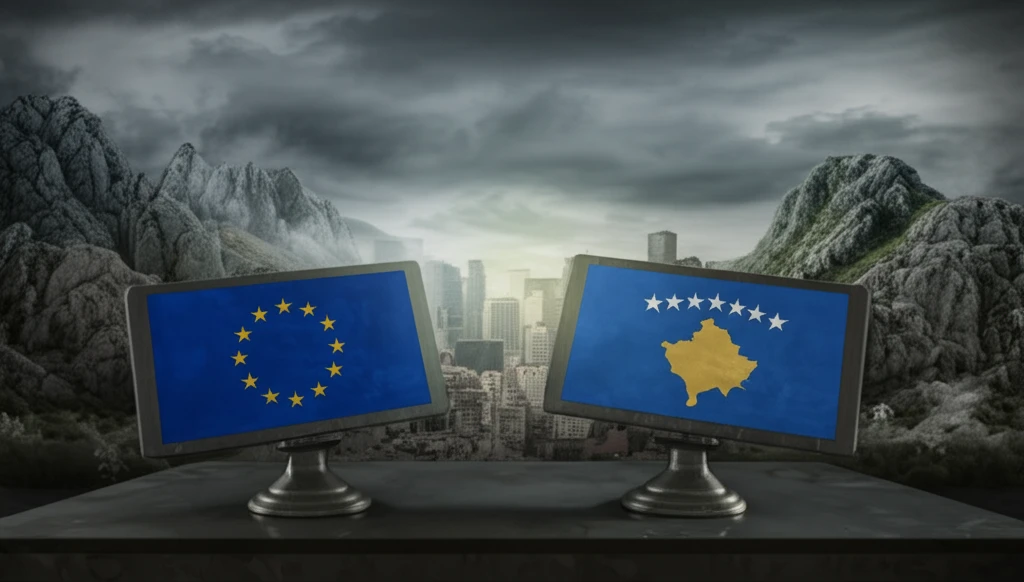
EU Enlargement: Can Political Pressure Truly Democratize the Balkans?

"A deep dive into the effectiveness of EU conditionality in fostering democracy in Bosnia and Herzegovina and Kosovo."
The fall of communism in Eastern Europe sparked hopes for widespread democratization. However, in the Western Balkans, this transition was intertwined with the violent breakup of Yugoslavia, adding layers of complexity to the state-building process. The European Union (EU) stepped in, aiming to guide the region towards economic prosperity and stable democracy. Yet, more than a decade into the enlargement process, democratization faces significant hurdles, especially in strengthening the rule of law and enhancing civil liberties.
Bosnia and Herzegovina (BiH) and Kosovo exemplify these challenges. Their paths to democratization have stagnated, falling short of EU expectations. This raises a crucial question: How effective is the EU's enlargement strategy, particularly its use of political conditionality, in promoting democratization in these countries?
This article examines the EU's engagement in BiH and Kosovo, analyzing how the enlargement process influences democratization through political pressure. By comparing these two cases, we can understand the limitations and potential of the EU's approach in transforming post-conflict societies.
What the EU Is Today
The European Union is a union of 27 member states whose official portal positions itself as a gateway to understanding how the bloc functions, including its principles, priorities, history, legal basis, and citizens' rights. Individual country profiles detail each member's government, economy, role within the EU, use of the euro, and participation in the Schengen area. The bloc's geography also carries notable exceptions: Greenland is the largest territory by area but sits outside the EU while its citizens retain EU citizenship, whereas the Canary Islands are the most populous EU territory and belong to both the Union and the Schengen area. This layered structure of membership, currency, and border arrangements is directly relevant to debates about what full accession would mean for prospective Balkan candidates.
The Mechanics of Enlargement
The European Union's standard path to membership is generally understood as a staged process in which candidate countries must align domestic laws and institutions with the bloc's rules before accession is finalized. Formal negotiations, progress reports, and agreement among existing members are widely described as core elements of this framework. In practice, progress is often portrayed as slow and politically driven rather than purely technical or merit-based. Observers commonly argue that, for Western Balkan candidates, accession benchmarks can function as a lever of political pressure as much as a measure of genuine reform.
A Long Road of Widening
The EU's enlargement history is generally described as a series of successive waves in which groups of countries joined at different moments. The core formed in the 1950s was later joined by additional Western European states, and then by post-communist countries from Central and Eastern Europe after the Cold War ended. More recently, a first Western Balkan state acceded, an event that is often cited as a milestone for the region. Each wave is thought to have carried both political symbolism and concrete institutional and economic consequences for the candidates involved.
The EU's Democratization Toolkit: Carrots, Sticks, and Conditionality
The EU's enlargement policy operates on a system of rewards and penalties, often described as "carrots and sticks." Accession to the EU, with its economic and political benefits, serves as a major incentive for countries to align with EU standards. Conversely, failure to comply with EU conditions can lead to withheld benefits, such as financial assistance or visa-free travel.
- Rationalist Theory: EU pressure changes incentives for domestic actors.
- Constructivist Theory: Domestic actors internalize EU norms and values.
Evidence on Democratization
Research on whether enlargement pressure genuinely democratizes candidate countries is ongoing, and findings are not yet settled. Scholarship generally acknowledges that EU conditionality has helped shape legal and institutional reforms in candidate states. However, researchers remain divided on whether those reforms reflect durable democratic consolidation or tactical compliance driven by external incentives. The most cautious conclusion is that evidence on the Western Balkans remains mixed and highly context-dependent.
The Record of Enlargement
According to World Population Review, the European Union was formed in the aftermath of World War II and today encompasses 27 nations. Its first batch of countries joined in 1957 and included Germany, France, Italy, Belgium, Luxembourg, and the Netherlands. A second wave followed in 1973 with the accession of Denmark, Ireland, and the United Kingdom. The EU subsequently grew through multiple later rounds of enlargement. In the context of the Balkan question, this record suggests that membership has historically proceeded in distinct waves separated by long intervals, rather than through rapid or politically expedient expansions.
Contrasting Accession Paths
Broader comparisons between past enlargements and the current Western Balkan process point to meaningful differences in circumstances. Earlier waves are commonly seen as having admitted relatively stable democracies, whereas many Balkan candidates continue to face rule-of-law deficits and unresolved regional tensions. Analysts also note that each enlargement has been shaped by the geopolitical climate of its era. Any such comparison depends heavily on interpretation and should be treated with caution.
Lessons Learned: Reforming the EU's Approach to Democratization
The EU's conditionality approach has had mixed results in the Western Balkans. While it has provided incentives for reform, its effectiveness is limited by domestic political dynamics and the varying capacity of countries to implement EU standards. A more tailored and nuanced approach, focusing on long-term institution-building and genuine local ownership, is needed to achieve sustainable democratization in the region. The EU must adapt its strategies to ensure that political pressure translates into tangible improvements in the lives of citizens, fostering a true commitment to democratic values.
Weighing Pressure Against Progress
A balanced assessment sits between two poles: pressure can accelerate institutional reform, but critics warn that formal alignment with EU rules does not automatically amount to democratic consolidation. Expert commentary commonly distinguishes between compliance with accession criteria and the deeper political change those criteria are meant to encourage. On the Balkans, informed observers tend to describe the outcome as genuinely mixed rather than a clear success or failure. The ultimate judgment likely depends on which measure of democratization one chooses to emphasize.
Prospects Ahead
The future of Balkan enlargement remains difficult to predict, hinging on political will among both candidates and existing member states. Momentum is widely expected to be gradual, with progress tied as much to regional stability as to domestic reforms. Some scenarios envision step-by-step integration short of full membership as a pragmatic intermediate. Whatever path unfolds, the coming years are likely to test whether political pressure can convert stated commitments into lasting institutional change.
Systemic Strains
Enlargement touches on deeper structural questions about how the European Union absorbs new members and reaches decisions. A larger union can complicate the consensus-based dynamics that shape its governance and raise tensions between newer and older members over resources and influence. These systemic considerations may prove as consequential as conditions inside the candidate countries themselves. Any assessment of Balkan prospects therefore needs to look beyond national reform efforts to the union's own institutional constraints.
From Policy to People
Behind the accession negotiations are citizens and communities whose daily lives would be reshaped by membership. Freedom of movement, trade access, and legal protections are among the practical benefits often associated with joining the bloc. At the same time, reform processes can impose short-term costs on ordinary people even as they promise longer-term gains. The human stakes of enlargement are, in the end, inseparable from the political and institutional questions that dominate the debate.