
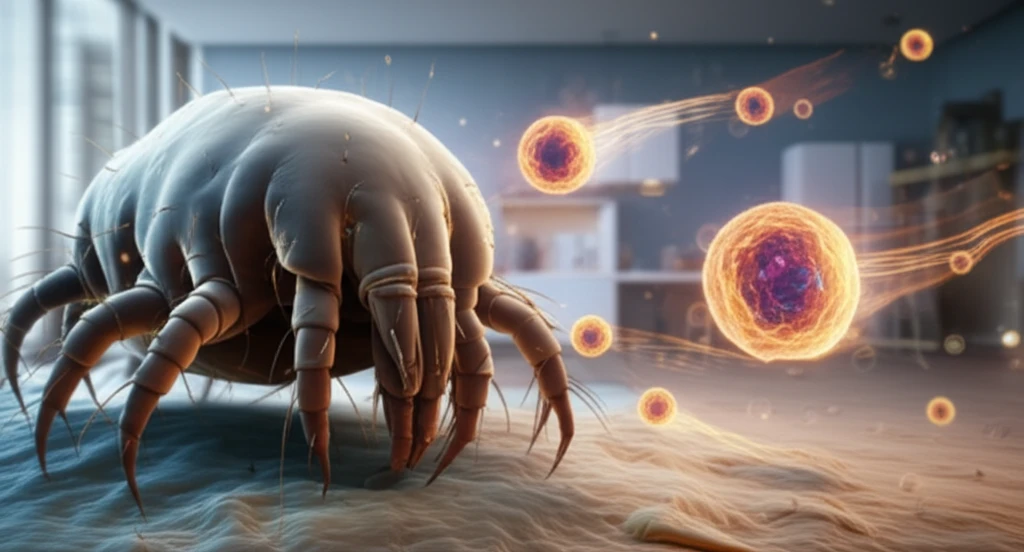
Microscopic dust mites with Der p 18 molecules in a home environment, symbolizing allergic reactions.

Is Dust Mite Allergy More Than Just Sneezing? Unveiling the Secrets of Der p 18

"A deep dive into the molecular structure and allergenic activity of Der p 18, a chitinase-like protein found in house dust mites."


House dust mites (HDMs) are a major source of allergens, affecting millions worldwide. Among the various allergens produced by these microscopic creatures, Dermatophagoides pteronyssinus and D. farinae are the most notorious culprits. Up to 50% of allergic individuals exhibit sensitivity to HDM allergens, which can trigger a range of allergic responses.

While many HDM allergens have been extensively studied, a group of chitin-associated allergens, including Der p 18, remains relatively mysterious. Der p 18 belongs to the glycoside hydrolase family 18 chitinases, but its specific role in dust mite allergy has only been partially understood. This article delves into the recent research uncovering the molecular, structural, and immunological properties of Der p 18, shedding light on its contribution to allergic reactions.

Recent research is re-evaluating the frequency of IgE recognition of Der p 18 and exploring its allergenic activity and localization within dust mites. By expressing Der p 18 as a folded recombinant protein, scientists have been able to study its interactions with IgE antibodies and its impact on basophil activation. Furthermore, the development of allergen-specific antibody probes has enabled the examination of cross-reactivity with other allergens and the visualization of Der p 18 within the HDM environment.

Unlocking the Secrets of Der p 18: Molecular and Structural Insights

Microscopic dust mites with Der p 18 molecules in a home environment, symbolizing allergic reactions.

The study successfully produced recombinant Der p 18 in E. coli, confirming its folded structure and biological activity. Testing revealed that Der p 18 exhibits weak chitin-binding activity and partial cross-reactivity with Der f 18 from D. farinae, a closely related dust mite species. However, it did not show cross-reactivity with proteins from other tested allergen sources.

To understand Der p 18's role, researchers examined its location within the HDM. Immunogold electron microscopy revealed that the allergen is primarily located in the peritrophic matrix of the HDM gut, with a lesser presence in fecal pellets. This suggests Der p 18 is involved in digestive processes within the mite.

  • Chitin-Binding Activity: Der p 18 shows a weak ability to bind chitin, a component of fungal cell walls and insect exoskeletons.
  • Cross-Reactivity: It cross-reacts partially with Der f 18 from D. farinae but not with other allergens.
  • Localization: Found mainly in the peritrophic matrix of the HDM gut.
Further investigation into the allergic potential of Der p 18 revealed that it reacts with IgE from approximately 10% of mite-allergic patients in Austria. Additionally, Der p 18 demonstrated allergenic activity by triggering basophil activation in sensitized individuals. This indicates that Der p 18, despite being a minor allergen, can still contribute to allergic responses in some individuals.

Der p 18: A Key Piece in the Dust Mite Allergy Puzzle

This research highlights Der p 18 as a genus-specific minor allergen with weak chitin-binding activity but demonstrable allergenic activity. These findings suggest that Der p 18 should be considered for inclusion in diagnostic test panels for HDM allergy, especially for individuals who may not react to the major, more commonly tested allergens. Understanding the role of Der p 18 can lead to more comprehensive diagnostic approaches and potentially, more targeted treatment strategies for dust mite allergies.

About this Article -

This article was crafted using a human-AI hybrid and collaborative approach. AI assisted our team with initial drafting, research insights, identifying key questions, and image generation. Our human editors guided topic selection, defined the angle, structured the content, ensured factual accuracy and relevance, refined the tone, and conducted thorough editing to deliver helpful, high-quality information.See our About page for more information.

This article is based on research published under:

DOI-LINK: 10.1371/journal.pone.0160641, Alternate LINK

Title: Molecular, Structural And Immunological Characterization Of Der P 18, A Chitinase-Like House Dust Mite Allergen

Subject: Multidisciplinary

Journal: PLOS ONE

Publisher: Public Library of Science (PLoS)

Authors: Yvonne Resch, Katharina Blatt, Ursula Malkus, Christian Fercher, Ines Swoboda, Margit Focke-Tejkl, Kuan-Wei Chen, Susanne Seiberler, Irene Mittermann, Christian Lupinek, Azahara Rodriguez-Dominguez, Petra Zieglmayer, René Zieglmayer, Walter Keller, Vladislav Krzyzanek, Peter Valent, Rudolf Valenta, Susanne Vrtala

Published: 2016-08-22

Everything You Need To Know

1

What exactly is Der p 18?

Der p 18 is a chitinase-like protein found in house dust mites. More specifically, it belongs to the glycoside hydrolase family 18 chitinases. Its function is related to digestive processes within the mite, as it is primarily located in the peritrophic matrix of the HDM gut. While it exhibits weak chitin-binding activity, it also demonstrates allergenic activity, meaning it can trigger allergic responses in sensitized individuals.

2

Why is Der p 18 important when we talk about dust mite allergies?

Der p 18 is significant because, despite being a minor allergen, it can contribute to allergic reactions in some individuals. Research has shown that it reacts with IgE from approximately 10% of mite-allergic patients and can trigger basophil activation. This is important because individuals might not react to major, more commonly tested allergens.

3

What does it mean that Der p 18 is found in the gut of dust mites, and what are the implications?

The implications of finding Der p 18 primarily in the peritrophic matrix of the HDM gut suggest its involvement in digestive processes within the mite. Also, Der p 18 shows partial cross-reactivity with Der f 18 from D. farinae, a closely related dust mite species. However, it does not show cross-reactivity with proteins from other tested allergen sources. This specificity may have implications for diagnostics and treatment.

4

What are IgE antibodies, and what role do they play in dust mite allergies and Der p 18?

IgE antibodies are involved in allergic reactions. In the context of dust mite allergies, IgE antibodies recognize and bind to specific allergens, such as Der p 18. This binding triggers the release of inflammatory mediators from cells like basophils, leading to allergy symptoms. Recent research is re-evaluating the frequency of IgE recognition of Der p 18 and exploring its allergenic activity.

5

What is chitin, and how does it relate to Der p 18's function and allergenic properties?

Chitin is a component of fungal cell walls and insect exoskeletons. Der p 18 exhibits weak chitin-binding activity, which means it can interact with chitin to some extent, this activity may play a role in the mite's digestive processes or other biological functions. However, Der p 18 also has allergenic activity, triggering basophil activation in sensitized individuals.

Newsletter Subscribe

Subscribe to get the latest articles and insights directly in your inbox.