
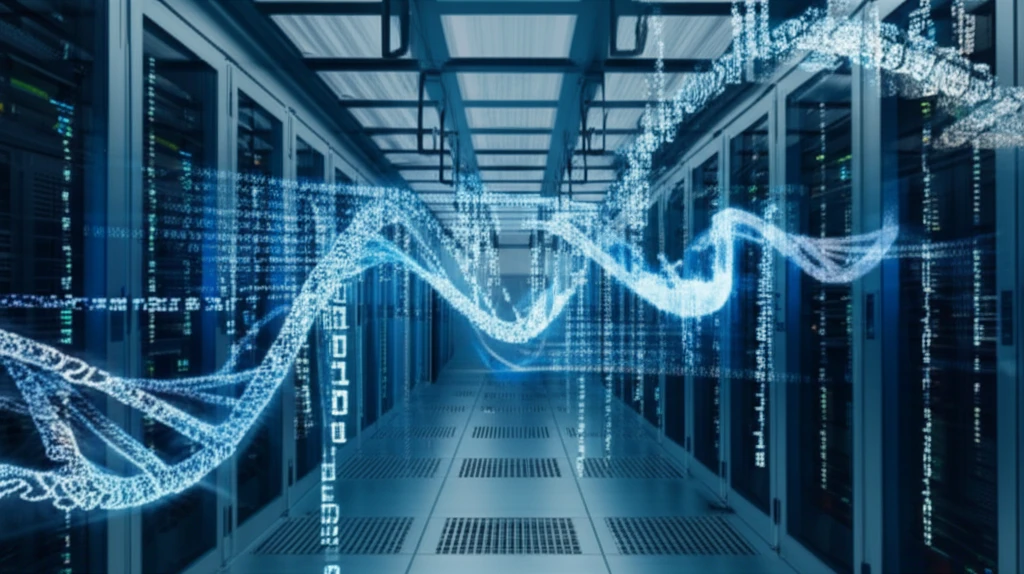
DNA strands intertwining with binary code in a futuristic data center, symbolizing the fusion of biology and information technology.

Is DNA the Next Hard Drive? The Promise and Pitfalls of DNA Data Storage

"Explore the potential of DNA as a future storage solution, examining recent breakthroughs and the remaining challenges in cost and accessibility."


Imagine a storage device that's incredibly compact and lasts for centuries. That's the promise of DNA data storage, an idea that's been captivating scientists for decades. The allure lies in DNA's natural efficiency: it can pack vast amounts of information into a microscopic space, far exceeding the capabilities of flash drives and hard disks.

The idea of using DNA to store information isn't new, but it's only recently that technological advancements have made it a tangible possibility. For years, the limitations of DNA synthesis and sequencing technologies made the concept more of a dream than a practical solution. However, significant strides in recent years are changing the landscape.

Where current storage solutions degrade within a decade or two, DNA boasts stability on a millennial scale. Its lasting form also removes the issue of obsolescence, making the future of archived data safer. Let's dive into the recent breakthroughs that are turning DNA data storage into a reality.

Encoding Data in DNA: A Feasibility Milestone

DNA strands intertwining with binary code in a futuristic data center, symbolizing the fusion of biology and information technology.

Traditional DNA sequencing has seen drastic improvements over the last decade, with the cost of sequencing a human genome dropping to around $1,000. However, synthesizing oligonucleotides—the building blocks for DNA data storage—hasn't seen the same cost reductions. Despite this, researchers are making progress.

One approach involves synthesizing oligonucleotides individually on microcolumns. While this method is useful for synthesizing yeast chromosomes, another format involves synthesizing a large number of different oligonucleotides (up to a million) on a solid support, similar to DNA microarrays. By detaching them from the support, researchers obtain a mixture of thousands of different oligonucleotides, each with a predefined sequence. This drastically reduces the cost per base.

  • Cost-Effective Synthesis: Array-based oligonucleotide synthesis significantly reduces the cost per base, making large-scale DNA data storage more feasible.
  • Error Correction: Sophisticated coding and error correction systems ensure the accurate encoding and retrieval of binary information from DNA.
  • High-Density Storage: DNA's ability to store vast amounts of information in a small volume is unparalleled by traditional storage media.
Recent research has demonstrated the possibility of encoding 200MB of data into DNA, marking a significant step forward. This collaborative effort between universities and Microsoft involved encoding 35 files into DNA, with the ability to directly access and retrieve each file without errors. The process involves encoding information into a large number of oligonucleotides, each containing an address indicating the file it belongs to and its position within the file.

The Road Ahead: Challenges and Future Directions

While the 200MB demonstration is a remarkable achievement, significant challenges remain. The cost of DNA synthesis needs to decrease by several orders of magnitude for this technology to become practically viable. The accessibility of this data may first be applicable for the most precious data needed for long term storage.

Despite these challenges, DNA data storage is moving closer to reality. A project called Memories in DNA encourages participation by allowing users to submit photos that will be encoded into DNA, contributing to research on classifying images directly from their nucleotide sequence.

DNA is entering an age of large-scale synthesis, opening the door to numerous applications beyond data storage. This marks a new era for synthetic biology and biotechnology.

About this Article -

This article was crafted using a human-AI hybrid and collaborative approach. AI assisted our team with initial drafting, research insights, identifying key questions, and image generation. Our human editors guided topic selection, defined the angle, structured the content, ensured factual accuracy and relevance, refined the tone, and conducted thorough editing to deliver helpful, high-quality information.See our About page for more information.

This article is based on research published under:

DOI-LINK: 10.1051/medsci/20183406025, Alternate LINK

Title: L’Adn Comme Mémoire Informatique ?

Subject: General Biochemistry, Genetics and Molecular Biology

Journal: médecine/sciences

Publisher: EDP Sciences

Authors: Bertrand Jordan

Published: 2018-06-01

Everything You Need To Know

1

What exactly is DNA data storage and why is it important?

DNA data storage is the process of encoding digital information into the structure of DNA molecules. The significance lies in its potential for unparalleled density and long-term stability. Unlike traditional storage methods like flash drives and hard disks, which degrade over time, data stored in DNA could last for centuries, making it ideal for archival purposes. The implications of DNA data storage include the ability to store massive amounts of information in a very small space, potentially revolutionizing data centers and archival practices. It's a solution to the limitations of current storage methods regarding lifespan and density.

2

What specific breakthroughs have made DNA data storage a viable option?

Several recent breakthroughs have made DNA data storage more feasible. Advances in technologies for synthesizing oligonucleotides, which are the building blocks of DNA data storage, have significantly reduced costs. Researchers are now able to synthesize a large number of oligonucleotides, each with a specific sequence, on a solid support, such as DNA microarrays. Sophisticated coding and error correction systems are also crucial, ensuring the accurate encoding and retrieval of binary information from DNA. These advancements have led to demonstrations of encoding and retrieving substantial amounts of data without errors.

3

What are the primary advantages of using DNA for data storage?

The primary advantage is its remarkable longevity. DNA boasts a lifespan that spans millennia, vastly outperforming existing storage solutions. This extended durability ensures that archived data remains accessible over extremely long periods, circumventing the issue of data obsolescence. In addition, DNA's high-density storage capabilities allow for storing vast amounts of data in a minuscule volume, making it a very efficient solution for long-term archival data storage.

4

Can you explain the general process of encoding and retrieving data using DNA?

The process involves several key steps. First, information is encoded into a sequence of DNA bases (A, T, C, G). This is typically done by converting the binary information into a corresponding DNA sequence. Next, this DNA sequence is synthesized, either individually or in large batches using methods like microcolumns or solid-support synthesis, creating the oligonucleotides. These oligonucleotides are then stored. To retrieve the data, the DNA is sequenced, and the original information is decoded from the DNA sequence. Error correction systems are incorporated to ensure data integrity throughout the process.

5

What are the remaining challenges in DNA data storage?

While the technology is promising, significant challenges remain. The cost of DNA synthesis needs to decrease dramatically to make this technology practically viable. The current cost of synthesizing DNA is still relatively high. Furthermore, the accessibility of this technology is another challenge, meaning it may be first applicable for archiving very precious data. Despite these obstacles, the 200MB demonstration showed that the concept of DNA data storage is possible and represents a remarkable achievement.

Newsletter Subscribe

Subscribe to get the latest articles and insights directly in your inbox.