
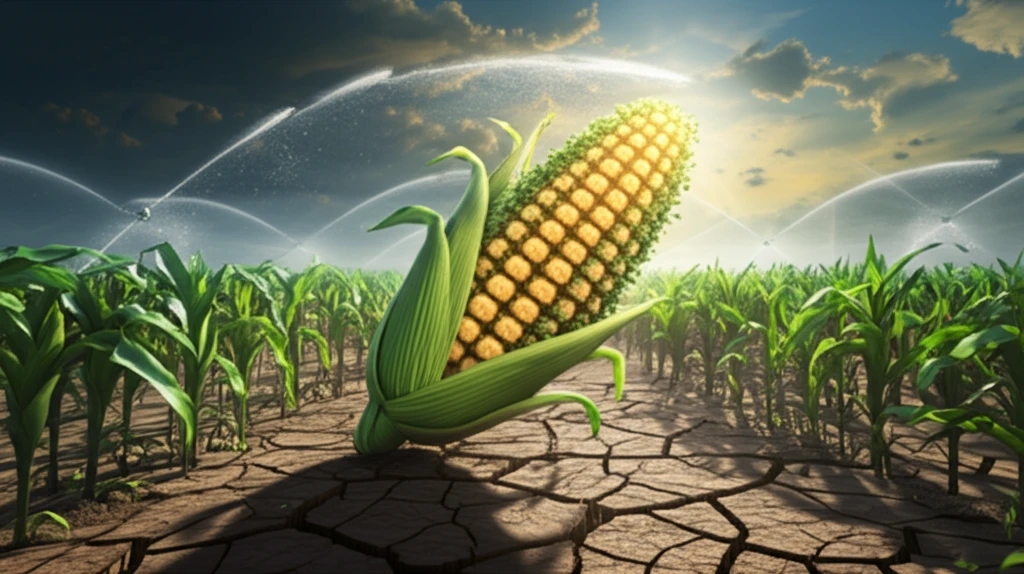
Is Deficit Irrigation the Future of Farming? How Strategic Water Management Can Save Crops and Resources

"Unlocking Sustainable Agriculture: Exploring Yield Response, Water Productivity, and Seasonal Water Production Functions for Maize Under Deficit Irrigation Management"
In an era where water resources are becoming increasingly strained, the agricultural sector faces immense pressure to optimize water usage while maintaining or even increasing crop yields. Traditional irrigation methods, often relying on flooding fields, are simply no longer sustainable in many regions. This necessitates a shift towards innovative strategies that prioritize efficiency and conservation. One such approach gaining considerable attention is deficit irrigation (DI).
Deficit irrigation involves deliberately applying less water than the crop would ideally require, particularly during specific growth stages that are less sensitive to water stress. The goal is to minimize water use while avoiding significant reductions in yield. This requires a delicate balance, a deep understanding of the crop's water requirements at each growth stage, and careful monitoring of soil moisture levels.
Maize, a staple crop worldwide, is often grown in regions prone to water scarcity. This makes it a prime candidate for DI strategies. Research has shown that, under certain conditions, maize can tolerate mild water stress without substantial yield losses, opening up opportunities for significant water savings.
Water Scarcity and Agricultural Pressure
Global freshwater availability continues to decline as agricultural demand rises, creating mounting pressure on farming systems worldwide. Water scarcity affects an estimated 40 percent of the global population, with agriculture accounting for approximately 70 percent of all freshwater withdrawals. Deficit irrigation strategies have emerged as one response to this growing imbalance, though adoption remains uneven across regions and crop types.
Understanding Deficit as a Concept
The term deficit generally refers to the amount by which something falls short of a reference or required amount. In agricultural water management, deficit irrigation applies this principle deliberately, providing crops with less water than their full requirement under controlled conditions. Merriam-Webster defines deficit as a deficiency in amount or quality, which aligns with how practitioners describe planned water reductions. This controlled approach differs fundamentally from drought-induced water shortages, as it is applied strategically rather than reactively.
Deficits in Practice: Scale and Context
Deficits occur across many systems, from government budgets to resource allocation. The concept of operating with planned shortfalls has historical precedent in economic policy, where deficit spending has been used to stimulate growth during downturns. In July 2026, the U.S. federal government posted a budget deficit of $432.3 billion for that month alone, illustrating how large-scale systems routinely manage planned shortfalls. The agricultural application of deficit principles follows a similar logic: accepting controlled shortfalls in one resource input to achieve broader sustainability or efficiency goals.
Understanding the Science: How Deficit Irrigation Impacts Maize Production
A recent study published in Plant Production Science investigated the effects of deficit irrigation on maize production in southern Taiwan. The researchers aimed to quantify maize yield response to soil moisture deficits and assess the impact of DI on water productivity. They examined five irrigation treatments, ranging from full irrigation to varying levels of deficit irrigation.
- Yield Reduction: Water deficits led to a significant reduction in grain yield, ranging from 6% to 33%, depending on the severity of the deficit.
- Component Decline: This yield reduction was correlated with a decline in grain number per ear, 1000-grain weight, ear number per plant, and number of grains per row.
- Water Productivity: Water use efficiency (WUE) and irrigation water use efficiency (IWUE) varied depending on the irrigation treatment.
- Viable Practices: High water productivity without significant yield reduction (<13%) was observed for specific water depths, indicating the potential for sustainable water development.
Emerging Findings and Evidence
Recent investigations into deficit irrigation continue to refine understanding of crop-specific responses to water stress at different growth stages. Researchers have noted that certain crops can tolerate moderate water reductions during vegetative or reproductive stages without significant yield loss, though the precise thresholds remain under study. The evidence base is still evolving, and findings from one climate zone or soil type may not transfer reliably to others. Continued research is needed to establish more universally applicable guidelines.
Risks and Limitations
Deficit irrigation carries inherent risks that have limited its widespread adoption. Underestimating crop water requirements or misapplying stress timing can lead to yield penalties, quality reductions, or crop failure. Critics note that local soil variability, weather unpredictability, and farmer expertise gaps create challenges that controlled experimental results may not capture. These uncertainties represent real barriers, particularly for smallholder farmers who cannot afford trial-and-error approaches.
Deficit Irrigation Versus Alternatives
When compared to conventional full irrigation, deficit irrigation offers potential water savings but requires more precise management knowledge. Alternative approaches such as rain-fed agriculture, mulching, and drip irrigation systems each address water scarcity from different angles. The most effective strategy often depends on local conditions, crop types, and available infrastructure. No single approach has emerged as universally superior, and integrated water management frameworks tend to perform best in practice.
The Future of Maize Farming: Balancing Yield and Sustainability
As water resources become increasingly scarce, deficit irrigation offers a promising strategy for maize farmers to optimize water use while maintaining productivity. By carefully understanding the science behind crop water requirements and implementing tailored irrigation strategies, farmers can contribute to a more sustainable and resilient agricultural sector. Further research and on-farm trials are essential to refine DI practices and ensure their widespread adoption.
Synthesizing the Evidence
Expert consensus suggests deficit irrigation holds genuine promise as one tool among several for managing agricultural water use more sustainably. However, it is not a silver bullet solution. Its effectiveness depends heavily on context, including crop selection, climate conditions, soil characteristics, and farmer skill. Successful implementation requires integrating deficit irrigation with other conservation practices and providing adequate technical support to farmers.
Looking Ahead
Advances in soil moisture monitoring, weather forecasting, and crop modeling are expected to make deficit irrigation more precise and accessible in coming years. Remote sensing technologies may help farmers make real-time decisions about water application. Integration with precision agriculture platforms could reduce the knowledge barriers that currently limit adoption. The technology trajectory points toward more data-driven, site-specific approaches rather than universal prescriptions.
Systemic Barriers to Adoption
Widespread implementation of deficit irrigation faces systemic challenges beyond individual farm decisions. Water pricing policies, infrastructure limitations, and institutional support structures vary enormously across regions. Farmers in many areas lack access to the technical training, monitoring equipment, and extension services that deficit irrigation requires. Addressing these structural barriers is as important as refining the science itself.
Farmers on the Ground
For individual farmers, adopting deficit irrigation represents a calculated risk that directly affects their livelihoods. The transition from conventional irrigation practices requires not only technical knowledge but also tolerance for uncertainty during the learning period. Communities in water-stressed regions often show greater willingness to experiment with these methods out of necessity. Real-world impact ultimately depends on bridging the gap between research findings and practical, on-farm application.