
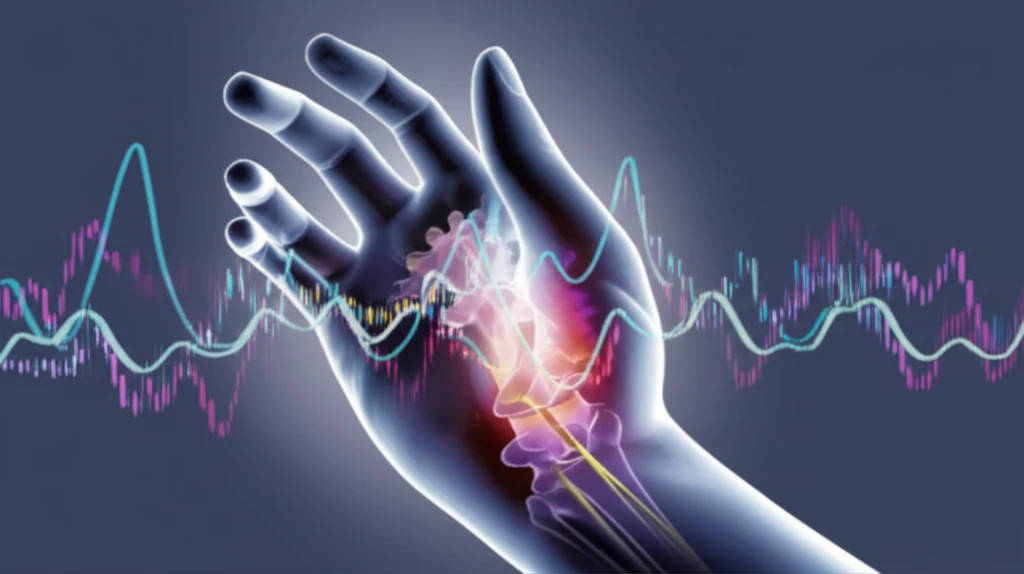
High-resolution ultrasound image of a hand with carpal tunnel syndrome.

Is Carpal Tunnel Syndrome Severity Overstated? The Role of Advanced Imaging

"Unveiling the Power of High-Resolution Ultrasonography in Carpal Tunnel Syndrome Diagnosis and Grading"


Carpal tunnel syndrome (CTS), a prevalent condition resulting from the compression of the median nerve in the wrist, has long posed diagnostic challenges. Traditional methods often rely on nerve conduction studies (NCS), but these can sometimes be inconclusive or fail to capture the full extent of the nerve's condition.

A recent study sheds light on the potential of high-resolution ultrasonography (HRUS) as a valuable tool in CTS diagnosis and grading. This non-invasive imaging technique offers a detailed view of the median nerve, allowing clinicians to assess its cross-sectional area (CSA) and identify subtle changes that may be missed by other methods.

This article explores the findings of this study, highlighting how HRUS can improve the accuracy of CTS diagnosis, provide a more nuanced understanding of disease severity, and ultimately lead to better patient management.

HRUS: A Clearer Picture of Carpal Tunnel Syndrome

High-resolution ultrasound image of a hand with carpal tunnel syndrome.

The study focused on evaluating the effectiveness of HRUS in grading the severity of carpal tunnel syndrome by measuring the median nerve's cross-sectional area (CSA) at the wrist and comparing it to the CSA in the forearm. Researchers analyzed 72 wrists diagnosed with CTS via NCS and 80 healthy wrists, dividing the CTS group into mild, moderate, and severe categories.

Key findings from the study underscore the potential of HRUS:

  • Accurate Detection: HRUS demonstrated a high degree of accuracy (96.1%) in detecting carpal tunnel syndrome when a wrist-to-forearm ratio (WFR) of 1.7 was used as a cutoff value.
  • Severity Assessment: The CSA of the median nerve in the wrist showed a significant increase as the severity of CTS increased, indicating that HRUS can effectively differentiate between mild, moderate, and severe cases.
  • Correlation with Nerve Conduction: Positive correlations were found between the CSA measurements obtained with HRUS and median nerve conduction latency, further validating the technique's reliability.
These findings suggest that HRUS can provide valuable information for diagnosing and grading CTS, potentially complementing or even augmenting traditional NCS methods.

The Future of CTS Diagnosis: A Shift Towards Advanced Imaging

The study's findings highlight the growing importance of advanced imaging techniques like HRUS in the diagnosis and management of carpal tunnel syndrome. By providing a more detailed and accurate assessment of the median nerve, HRUS can help clinicians make more informed decisions about treatment strategies.

While NCS remains a valuable tool, HRUS offers several advantages, including its non-invasive nature, ability to visualize the nerve directly, and potential to detect subtle changes that may be missed by electrodiagnostic testing. This is particularly relevant for younger patients, as they are more concerned about non-invasive diagnostic tests.

As research continues to explore the full potential of HRUS in CTS, it is likely to play an increasingly important role in improving diagnostic accuracy, guiding treatment decisions, and ultimately enhancing the quality of life for individuals affected by this common condition.

About this Article -

This article was crafted using a human-AI hybrid and collaborative approach. AI assisted our team with initial drafting, research insights, identifying key questions, and image generation. Our human editors guided topic selection, defined the angle, structured the content, ensured factual accuracy and relevance, refined the tone, and conducted thorough editing to deliver helpful, high-quality information.See our About page for more information.

Everything You Need To Know

1

What is Carpal Tunnel Syndrome (CTS), and why is it important?

Carpal Tunnel Syndrome (CTS) is a condition where the median nerve in the wrist gets compressed. This compression can cause pain, numbness, and tingling in the hand and arm. This is important because CTS is a prevalent condition and proper diagnosis is crucial for effective treatment and to prevent further nerve damage. The implications include potential limitations in daily activities and work, as well as the need for interventions like medication, therapy, or surgery.

2

What is high-resolution ultrasonography (HRUS), and why is it used in diagnosing CTS?

High-resolution ultrasonography (HRUS) is a non-invasive imaging technique that provides detailed images of the median nerve. In the context of Carpal Tunnel Syndrome, HRUS measures the cross-sectional area (CSA) of the median nerve. This helps in assessing the nerve's condition and the severity of the syndrome. It's significant because it offers a more accurate and detailed view compared to traditional methods like nerve conduction studies (NCS). Implications include earlier and more accurate diagnoses, leading to better patient management and potentially reducing unnecessary interventions.

3

What does the median nerve's cross-sectional area (CSA) mean, and why is it measured?

The median nerve's cross-sectional area (CSA) is a measurement taken using high-resolution ultrasonography (HRUS). It measures the size of the median nerve at the wrist. An increased CSA often indicates compression and swelling of the nerve, which is a key indicator of Carpal Tunnel Syndrome (CTS). This measurement is important because it allows clinicians to grade the severity of CTS and differentiate between mild, moderate, and severe cases. The implications are that it helps to tailor treatment plans based on the severity of the condition, providing more personalized care and better patient outcomes.

4

How does high-resolution ultrasonography (HRUS) relate to nerve conduction studies (NCS)?

Nerve conduction studies (NCS) are a traditional method used to diagnose Carpal Tunnel Syndrome (CTS). They assess the electrical activity of the median nerve to determine if there is any impairment. The study found that HRUS correlated with the results of NCS, which validates the reliability of HRUS. This is significant because it demonstrates that HRUS can provide similar diagnostic information and potentially complement or augment NCS. The implication is that HRUS may provide a more detailed and accurate assessment, potentially leading to earlier and more precise diagnoses.

5

What is the significance of a wrist-to-forearm ratio (WFR) of 1.7 in the context of CTS?

A wrist-to-forearm ratio (WFR) of 1.7 is a cutoff value used with HRUS to detect Carpal Tunnel Syndrome (CTS). It's calculated by comparing the cross-sectional area (CSA) of the median nerve at the wrist to the CSA in the forearm. If the ratio exceeds 1.7, it strongly suggests the presence of CTS. This is important because it offers a highly accurate method for diagnosing CTS. The implication is that it provides a reliable diagnostic tool, enabling clinicians to confidently identify cases of CTS and initiate appropriate treatment strategies.

Newsletter Subscribe

Subscribe to get the latest articles and insights directly in your inbox.