
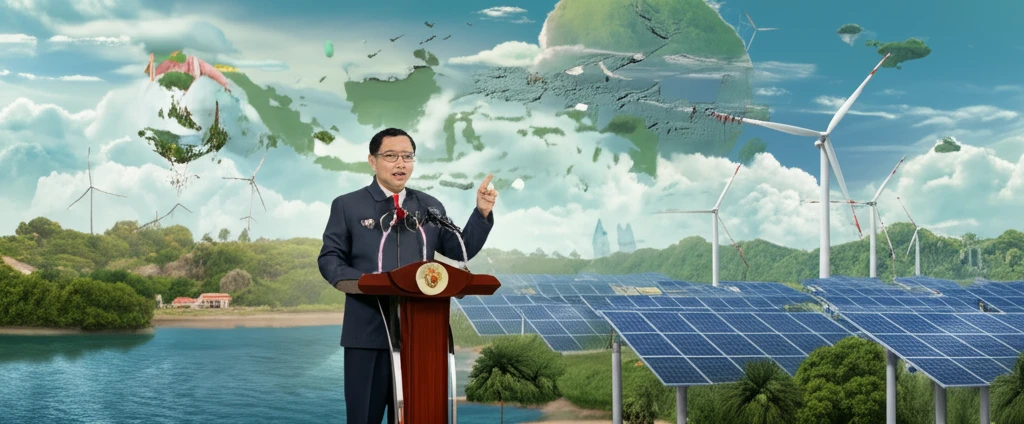
Indonesia's Climate Crossroads: Will New Governors Drive Green Policy?

"Analyzing the vision of Indonesia's elected governors to understand the future of climate change policy and sustainable development in the region."
The global fight against climate change increasingly hinges on local action. As highlighted by the Intergovernmental Panel on Climate Change (IPCC), local governments play a vital role in implementing adaptation strategies tailored to their specific regions. For Indonesia, a nation highly vulnerable to the impacts of climate change, the leadership and vision of its regional governors are critical in shaping effective environmental policy.
In Indonesia, the elected governors hold significant power in determining the direction of regional development. Their vision and mission statements, articulated during election campaigns, directly influence the five-year regional development plans that guide policy and resource allocation. This makes understanding their perspectives on climate change essential for gauging the nation's commitment to sustainability.
This article examines the vision and mission statements of governors elected in early 2017 across several Indonesian provinces. By analyzing these documents, we aim to assess the extent to which climate change and environmental sustainability are prioritized in their agendas, and what this could mean for the future of green policies in Indonesia.
Climate Exposure in a Vast Archipelago
Indonesia, as one of the world's most populous nations and largest archipelagic states, faces significant and growing exposure to climate change impacts including rising sea levels, extreme weather events, and biodiversity loss. Its vast coastline and low-lying urban areas, particularly around Jakarta, make it especially vulnerable to flooding and land subsidence. Agricultural livelihoods for tens of millions of Indonesians are threatened by shifting rainfall patterns and rising temperatures. The economic costs of inaction are projected to be substantial, though precise estimates remain debated across different modeling approaches.
Policy Frameworks and Their Constraints
Indonesia's climate policy framework typically relies on nationally determined contributions (NDCs), sectoral emission reduction targets, and the integration of climate considerations into national development planning. Key methodologies include greenhouse gas inventories, emissions modeling, and cost-benefit analyses of mitigation and adaptation measures. However, these standard approaches face limitations including data gaps at sub-national levels, difficulty in accounting for land-use change across the archipelago, and challenges in measuring the effectiveness of decentralized implementation across thousands of local jurisdictions. There is growing recognition that purely technical approaches may overlook the social and political dimensions critical to policy success.
A Decade-Long Policy Evolution
Indonesia's engagement with climate change policy has evolved significantly since the mid-2000s, with the country ratifying the Paris Agreement and embedding mitigation and adaptation strategies into successive national development plans. Both national and local governments have introduced climate-related milestones, though implementation has varied widely across jurisdictions. Due to its geographical and natural diversity, Indonesia is recognized as one of the countries most susceptible to climate change impacts, a factor that has shaped its policy trajectory. The World Bank's Country Climate and Development Report has modeled various land, energy, and fiscal pathways for Indonesia's transition to a low-carbon, climate-resilient economy, building on the country's ongoing commitments.
How Do Indonesian Governors View Climate Change?
To understand the potential for climate action, a study was conducted analyzing the vision and mission statements of governors elected in seven provinces during the early 2017 gubernatorial elections. The research employed a qualitative approach, scrutinizing the language used in these documents to identify any explicit or implicit references to climate change, environmental conservation, or sustainable development.
- Explicit Mentions: Only a small number of governors explicitly mentioned climate change or related terms in their vision and mission statements.
- Environmental Awareness: Some governors showed awareness of broader environmental issues, such as deforestation and pollution, but failed to connect these issues to the larger context of climate change.
- Sustainable Development: A few governors emphasized sustainable development in their platforms, suggesting a potential pathway for integrating climate considerations into regional planning.
- Inconsistent Priorities: Overall, the study revealed a lack of consistent prioritization of climate change across the different gubernatorial platforms.
Evolving Evidence and Knowledge Gaps
Recent research on Indonesia's climate trajectory suggests that the gap between stated policy ambitions and actual implementation remains significant. Academic and policy analyses continue to highlight the need for more rigorous monitoring and evaluation frameworks to track whether pledged measures translate into measurable emissions reductions. There is increasing scholarly attention to the intersection of climate policy with Indonesia's broader development objectives, including poverty reduction and energy access. However, comprehensive, independent review mechanisms for Indonesia's climate commitments are still developing, and the evidentiary base for evaluating policy effectiveness remains uneven across sectors.
Political Barriers and Policy Shortfalls
A key barrier to effective climate policy in Indonesia is political inaction, which research suggests is partly driven by politicians' misperceptions of voters' preferences on climate issues. While the country has pledged to reach net zero by 2060 and committed to restoring 3.3 million hectares of mangroves, it continues to rely heavily on coal and faces governance challenges that complicate progress. Multiple political forces — including leadership commitment, technical capacity, media attention, and popular opinion — interact to shape the trajectory of climate action. Furthermore, Indonesia's climate documents have been criticized for failing to adequately address the social and environmental dimensions essential to a just transition during the 2024–2029 government period.
International Assessments of Indonesia's Ambition
The Climate Action Tracker has issued notably different ratings for Indonesia's climate policies across assessment periods, ranging from "Highly Insufficient" to "Critically Insufficient" (as of December 2024), indicating that current policies are not consistent with the Paris Agreement's 1.5°C temperature limit and may lead to rising rather than falling emissions. Analysis of Indonesia's national climate governance explores how the country's response compares to global climate frameworks, examining the effectiveness and challenges of its approach. Despite ratifying the Paris Agreement and setting emission reduction targets, Indonesia's policy trajectory is viewed internationally as lagging behind what is required for its fair share contribution to global mitigation efforts.
The Path Forward: Integrating Climate Action into Regional Agendas
The study highlights the urgent need for greater awareness and prioritization of climate change at the regional level in Indonesia. To ensure effective climate action, it is crucial for stakeholders to actively engage in the regional development planning process, advocating for the integration of climate considerations into all relevant policies and programs. By working together, Indonesian provinces can pave the way for a more sustainable and resilient future.
Public Opinion, Policy Support, and Expert Insight
The Yale Program on Climate Change Communication published its first-ever report on Indonesian public beliefs, attitudes, and policy support regarding climate change, providing a foundational dataset for understanding domestic political will. Climate Policy Initiative's work in Indonesia supports both climate and sustainable development objectives, with its analyses evolving as the country's energy transition needs accelerate. A joint GIZ and Think Policy report offers a timely perspective on how Indonesia's climate commitments, particularly its NDCs, can be advanced within the context of the new government following the 2024 general election. Together, these efforts point to a growing ecosystem of expert analysis aimed at bridging the gap between climate ambition and implementation.
Navigating Political Transition and Dual Challenges
Indonesia's policy direction on climate change is entering a critical phase amid political transition, with key sectors including energy, forestry and land use, climate finance, and industry requiring coordinated action. The government faces dual challenges of achieving emissions reduction targets while maintaining economic growth, a tension that has historically favored extractive industries and fossil fuel use. Positive economic growth since the late 1990s has been closely tied to the central government's directive to capitalize on natural resources, making the transition to cleaner energy sources a politically complex undertaking. How the new administration navigates these competing priorities will largely determine whether Indonesia's climate pledges translate into transformative action.
Scale, Equity, and the Just Transition Imperative
Indonesia, an archipelagic nation of approximately 17,000 islands with a population of roughly 276 million people, faces the compounding challenge of addressing climate change while meeting the economic and development needs of its large and diverse population. Its vision for a just transition strives to balance climate ambition with social equity, ensuring that the shift to a net-zero and climate-resilient future supports workers, communities, and vulnerable populations. Aligning this transition with broader sustainable development goals adds further complexity, as policymakers must reconcile short-term economic pressures with long-term climate imperatives. The sheer scale and diversity of Indonesia's governance landscape — spanning thousands of local jurisdictions — presents systemic challenges that centralized climate targets alone cannot resolve.
Communities on the Frontlines
Behind policy frameworks and international assessments, Indonesia's climate challenge is fundamentally a human one — affecting farmers whose harvests are disrupted by erratic rainfall, coastal communities threatened by rising seas, and urban residents in rapidly growing cities vulnerable to flooding. The success or failure of climate policy will be measured not only in emissions data but in whether ordinary Indonesians experience tangible improvements in resilience and livelihood security. Ensuring that the benefits of a green transition reach marginalized and vulnerable populations remains a critical test of political commitment. Ultimately, the human dimension will determine whether climate action gains or loses public support in the world's fourth most populous nation.