
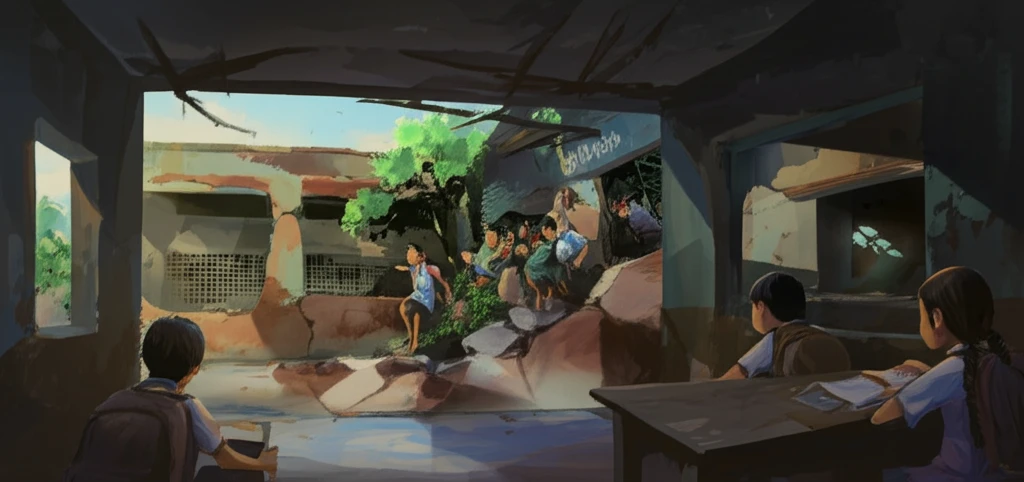
India's Education Crisis: How the Right to Education Act Went Wrong

"Examining the unintended consequences of India's Right to Education Act and its impact on school closures and quality of education."
In 2009, India introduced the Right to Education (RTE) Act, a landmark piece of legislation designed to provide free and compulsory education to all children on an equitable basis. This act aimed to transform the educational landscape by focusing on schooling inputs rather than just learning outcomes. However, the implementation of the RTE Act has led to several unintended consequences, particularly for private unrecognised schools, which play a significant role in providing basic education across the country.
These private schools now face the threat of closure as the RTE Act mandates compliance with various input-related requirements. These requirements often necessitate substantial additional capital investment, placing immense pressure on these institutions. This article delves into the complexities surrounding the RTE Act, examining its impact on the educational ecosystem and questioning whether it has truly achieved its intended goals.
One critical aspect of this analysis involves developing a compliance index. This index measures the extent to which government schools in various Indian states meet the RTE Act's input criteria. By comparing the compliance of government schools with the actions taken against private schools, we can uncover disparities and assess the fairness and effectiveness of the Act's implementation.
Measuring Impact When Data and Law Diverge
National statistics agencies such as the UK's Office for National Statistics and the Namibia Statistics Agency act as the official sources for statistics published across government. Assessment measures also shape how impact is judged: research associated with ACT Education Corp reports that the ACT test is an important indicator of students' college readiness and a key component of the postsecondary application process and of scholarship eligibility (Sanchez, 2024; Miranda & Sanchez, 2023). Yet commentary on higher-education policy contends that most legislation does not actually support higher education, pointing to measures such as FERPA (1974) and HIPAA (1996) alongside the proposed STATS and Earnings Accountability system. Such examples illustrate how the presence of law and official data does not by itself guarantee stronger educational outcomes.
Top-Down Standards Versus Ground-Level Practice
Standardized education models are typically imposed from the centre through uniform standards and oversight. The First Nations Education Act in Canada is reported to embody exactly this approach, with the federal government providing the standards, reporting and other oversight mechanisms to "ensure" First Nations meet "new" standards. The Montessori Method is offered as a contrasting, child-centred approach that respects the individuality of each child and encourages lifelong learning. Even grassroots implementation depends heavily on local actors, as illustrated by a classroom blog in which a teacher works with an eighth-grade student named Durgi to understand that education is a necessity that cannot be denied.
Rights History Is Built on Documented Milestones
Histories of rights are built on documented milestones. LegalClarity reports that many of the 100 milestone documents of American history are permanently housed in the National Archives Building in Washington, D.C., where some are available for public viewing. Long before modern rights legislation, the feminist movement's early voices — identified by one survey as Christine de Pizan, Marie de Gournay, and Mary Astell — pushed back against oppressive culture between the 15th and 17th centuries. Institutional milestones such as the Continental Congress (1774–1781) similarly anchor the official record of U.S. foreign relations. India's Right to Education Act belongs to this same genre of foundational, milestone-setting documents in the history of rights.
The Dismal State of Public Education and the Rise of Private Schools
Opinions regarding private sector involvement in India are sharply divided. Some advocate for private sector contributions to healthcare, education, public transport, and other social services, while others oppose it, fearing exploitation. The government's promotion of a Public-Private Partnership (PPP) model in education has created a policy paradox. This approach threatens private educational institutions while simultaneously relying on them to enhance educational opportunities.
- Flawed teaching methods contribute to ineffective learning.
- High pupil-teacher ratios strain resources and individual attention.
- Low teacher motivation impacts teaching quality.
- Teacher absenteeism reduces instructional time.
Field Research Finds an Awareness Gap
Recent field research has documented how the Right to Education Act is experienced on the ground. Human Rights Watch conducted research in Andhra Pradesh, Uttar Pradesh, Bihar, and Delhi, interviewing more than 160 people, including children, parents, teachers, education experts, rights activists, and local authorities. A separate study of parents of school-aged children in Telangana found an overall moderate level — 59.3 percent — of awareness of the Right to Education Act 2009. Journals such as the Review of Educational Research publish critical, integrative reviews of research literature bearing on education, providing a venue for synthesizing findings like these into broader lessons about policy implementation.
When Other Schemes Undermine the Education Right
Critics have argued that other government schemes undermine the education right in practice. The Guardian reports that India's controversial Aadhaar biometric scheme has been accused of restricting fundamental rights, including limiting access to free school meals and exposing roughly one billion people to privacy risks. In response to such schemes, advocates have insisted that "right to education is a fundamental right, and is protected by the core of the constitution," and it "cannot be challenged by any other document." Debate also continues over whether criticism of schools should be limited, with opponents of limits arguing that open dialogue is essential for improvement, empowerment, and accountability.
The Discipline of Side-by-Side Comparison
Side-by-side comparison is a disciplined way to judge whether an intervention works. A clinical comparison reported in The Lancet Haematology and echoed by the Russian health resource Ясность examined iron absorption from oral supplements given on consecutive versus alternate days and as single morning doses versus twice-daily schedules (Stoffel NU et al., 2017). Dedicated platforms apply the same logic to consumer choices, with Versus offering comparisons across more than 100 categories and Cars.com enabling users to compare up to four vehicles on features such as MSRP, fuel economy, and crash-test results. Extending this criteria-based approach to education policy would let reformers weigh systems against one another on measures of access, quality, and equity before legislating.
A Right Gone Wrong?
India's RTE Act sought to address critical issues of access, equity, and quality within its education system. While enrolment rates have increased, learning levels are declining, raising serious questions about the Act's effectiveness. The focus on input-based measures has not yielded the desired improvements in educational outcomes, and the closure of low-cost private schools exacerbates the problem.
A Right Made Intricate by Its Own Linkages
Expert commentary on the Right to Education Act stresses how tangled implementation has become. A critical analysis shared by a teacher on Brainly notes that linking the right to education to the right to a dignified life, equality, freedom, and cultural and minority rights has made the matter highly intricate, with regulations from different perspectives proving quite complex. Comparable challenges appear internationally: Minority Watch reports that Tanzania must explicitly guarantee the right to education for pregnant and parenting students, remove discriminatory provisions allowing the expulsion of girls based on wedlock, and prohibit mandatory pregnancy testing in schools. Related commentary frames the right broadly, insisting that everyone has the right to a basic education, including adult education. Together these assessments suggest that a right on paper only becomes meaningful when the rules around it are clear, coherent, and enforceable.
From Committee Rooms to Classroom Reality
The future of the Right to Education Act depends on how its terms are translated into rules. The Times of India reports that a special empowered committee in Bengaluru held a day-long meeting on the RTE Act, including the definition of the neighbourhood school. Optimistic observers predict the Act will have a strong impact, with civil-society groups such as Equalsign taking measures aimed at securing elementary education for poor children. Comparable legislation elsewhere shows how such rights can be reinforced: Kenya's Sexual Offences Act (Act No. 3 of 2006) and Basic Education Act (Act No. 14 of 2013) endorse policies against gender discrimination and corporal punishment in schools. Not every new education law expands rights, however — commentary warns the EDUCATE Act could undermine DEI recruitment and workforce diversity at HBCUs and other institutions.
Structural Fault Lines Rooted in History
India's education crisis is best understood against its historical and systemic backdrop. A Medium analysis of the evolution of the Indian educational system reports that the earlier Gurukul model gave academics, life skills, and ethics substantial weight, while the colonial-era system introduced during the British period was designed to train leaders and labourers for the empire. Under the 2009 Right to Education Act, schooling is free and compulsory for all children aged 6 to 14. With more than 260 million students, India has one of the largest education systems in the world. Courts have been drawn into the equity struggle, though judicial efforts for educational equity face current challenges and criticisms.
Closing the Distance Between Promise and Classroom
Education rights only have meaning when they reach real children and families. Experts led by the University of East London argue that early childhood care and education should be recognised as part of every child's right to education, with access to at least one year of free public pre-primary education. International human-rights frameworks make a similar point about duty: states cannot simply ratify a treaty guaranteeing human rights without taking the necessary administrative, legal, policy, and economic steps to make it a reality for their citizens, a gap that is especially consequential for women and girls. Narrowing the distance between the legal promise and everyday classroom experience is the core test of any education-rights law.