
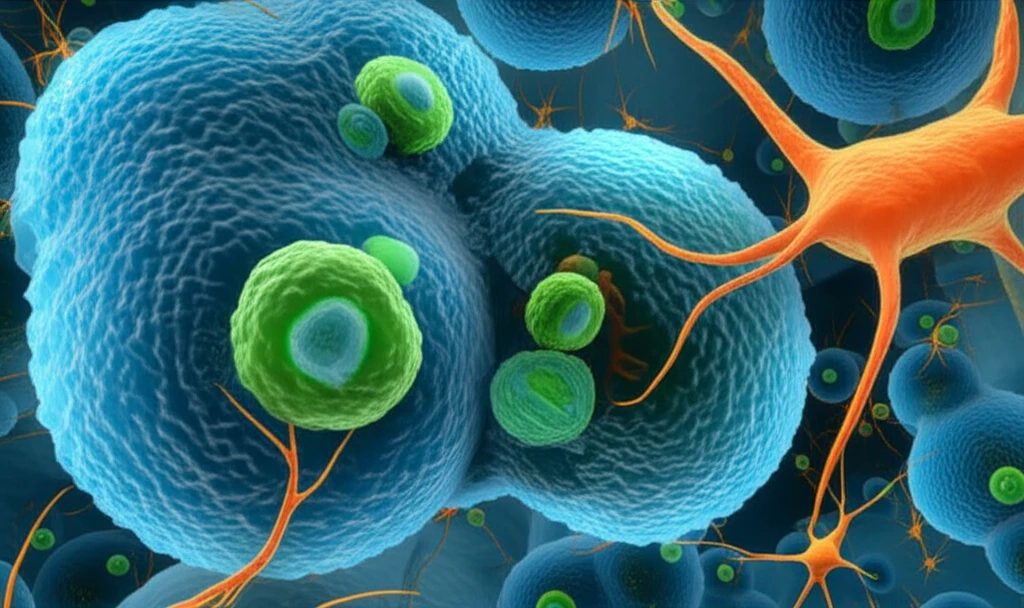
Immune cells interacting in a lymph node.

Immune Defenders: How Macrophages and Notch Signaling Shape the Body's Response

"Discover the hidden roles of macrophages in trapping immune cells and how Notch signaling fine-tunes the balance between immunity and tolerance."


The immune system is a complex network of cells and signals that protect the body from harm. Among these, macrophages and T cells play crucial roles, constantly interacting to maintain a delicate balance. Recent research sheds light on how these interactions shape our immune responses, offering potential new targets for therapies.

This article delves into two key areas of immunological research. First, we'll explore how macrophages, a type of immune cell known for engulfing pathogens and debris, can also act as gatekeepers in lymph nodes, trapping specific types of T cells. Second, we'll examine the role of Notch signaling, a communication pathway within dendritic cells, in controlling the differentiation of T helper cells, which are essential for coordinating immune responses.

By understanding these mechanisms, we can gain valuable insights into how the immune system works and potentially develop new strategies to treat immune-related diseases, from autoimmune disorders to infections.

Macrophages: Lymph Node Guardians Locking Up γδ T Cells

Immune cells interacting in a lymph node.

Gamma delta (γδ) T cells are a unique type of T cell that bridges the gap between the innate and adaptive immune systems. They can respond rapidly to threats, but their behavior in lymph nodes under normal conditions has remained somewhat mysterious. A study by Audemard-Verger et al. (2017) reveals that macrophages in lymph nodes actively retain a specific subset of γδ T cells, influencing their availability to respond to challenges.

The researchers discovered that a subset of γδ T cells, characterized by the markers Ly-6C-CD44hi, remains in the lymph nodes while other γδ T cells circulate freely. This retention is dependent on macrophages within the lymph nodes, which physically interact with these γδ T cells. These trapped γδ T cells also express macrophage markers, suggesting a transfer of surface molecules during their interaction.

  • Key Findings:Macrophage-dependent retention of Ly-6C-CD44hi γδ T cells in lymph nodes.
  • Mechanism: Direct interaction and potential transfer of surface markers between macrophages and γδ T cells.
  • Functional Significance: Trapped γδ T cells are poised to rapidly secrete IL-17 upon stimulation, suggesting a role in local immune responses.
This research highlights the importance of macrophages in regulating the distribution and function of γδ T cells. By trapping these cells in lymph nodes, macrophages may be creating a local reserve of immune cells ready to respond to infection or tissue damage.

Decoding Immunity: Future Directions

These studies offer valuable insights into the complex interplay of immune cells and signaling pathways that govern immune responses. By understanding how macrophages regulate T cell trafficking and how Notch signaling influences T helper cell differentiation, we can potentially develop more targeted and effective therapies for a range of immune-related disorders.

Further research is needed to fully elucidate the mechanisms underlying these interactions and to explore the therapeutic potential of manipulating these pathways. For example, targeting macrophage-γδ T cell interactions could be a strategy to modulate local immune responses in lymph nodes, while modulating Notch signaling in dendritic cells could help restore immune balance in autoimmune diseases.

Ultimately, a deeper understanding of these fundamental immunological processes will pave the way for new and innovative approaches to prevent and treat diseases that affect millions worldwide.

About this Article -

This article was crafted using a human-AI hybrid and collaborative approach. AI assisted our team with initial drafting, research insights, identifying key questions, and image generation. Our human editors guided topic selection, defined the angle, structured the content, ensured factual accuracy and relevance, refined the tone, and conducted thorough editing to deliver helpful, high-quality information.See our About page for more information.

Everything You Need To Know

1

What are Macrophages and how do they affect the immune response?

Macrophages are a type of immune cell, known for engulfing pathogens and debris. They also act as gatekeepers in lymph nodes, trapping specific types of T cells. This retention influences the availability of these γδ T cells to respond to challenges. Their interaction with γδ T cells is significant because it regulates the distribution and function of these cells, creating a local reserve for immune responses.

2

What are γδ T cells, and how do macrophages interact with them?

γδ T cells are a unique type of T cell that bridges the innate and adaptive immune systems. Macrophages actively retain a specific subset of γδ T cells, characterized by the markers Ly-6C-CD44hi, within lymph nodes. This retention is dependent on direct interactions between the macrophages and the γδ T cells. The trapped γδ T cells, poised to secrete IL-17 upon stimulation, highlight their role in local immune responses.

3

What is Notch signaling and why is it important?

Notch signaling is a communication pathway within dendritic cells. It is involved in controlling the differentiation of T helper cells, essential for coordinating immune responses. When Notch signaling influences T helper cell differentiation, it impacts the balance between immunity and tolerance. This can be significant in developing targeted therapies for immune-related disorders by manipulating this pathway.

4

Why are lymph nodes important in the context of immune responses?

Lymph nodes are crucial sites for immune cell interaction and response coordination. Macrophages in lymph nodes act as gatekeepers, trapping a specific subset of γδ T cells. This macrophage-dependent retention of Ly-6C-CD44hi γδ T cells in lymph nodes ensures that these cells are readily available for rapid response to infection or tissue damage. The environment within the lymph node is finely tuned to regulate and orchestrate immune responses.

5

What are the potential implications of this research for treating diseases?

The research on macrophages and Notch signaling offers new avenues for treating immune-related diseases by understanding how the immune system functions. By understanding how macrophages regulate T cell trafficking and how Notch signaling influences T helper cell differentiation, more targeted and effective therapies can be developed. This includes potential treatments for autoimmune disorders and infections, as it enables manipulation of immune responses.

Newsletter Subscribe

Subscribe to get the latest articles and insights directly in your inbox.