
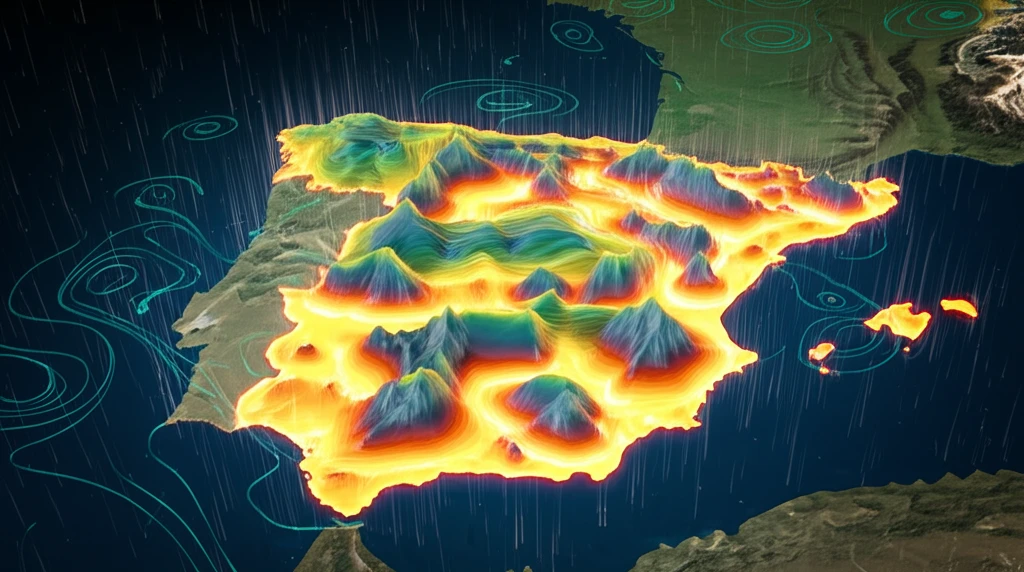
Stylized map of Iberian Peninsula illustrating temperature changes.

Iberian Peninsula Heats Up: Unpacking Temperature Trends & Climate Change Impacts

"A Deep Dive into Shifting Temperature Patterns, Seasonal Changes, and Regional Differences Across Spain and Portugal"


Climate change isn't a distant threat—it's reshaping our world right now. One of the most visible signs is the shift in temperature patterns, impacting everything from agriculture to daily life. Understanding these changes requires a deep dive into regional trends, especially in areas like the Iberian Peninsula, which includes Spain and Portugal.

Recent studies highlight significant temperature variations across the Iberian Peninsula, marked by rising averages, altered seasonal cycles, and increased occurrences of extreme weather events. But how do we make sense of these complex changes? Econometric models, which blend statistical analysis with economic principles, offer a powerful way to dissect these trends and uncover underlying patterns. This analysis moves beyond simple averages to explore the variability and range of temperatures, providing a more nuanced view of climate change impacts.

By examining detailed temperature data from numerous locations within the Iberian Peninsula, it’s possible to reveal common trends and regional differences. This approach helps in understanding how climate change manifests uniquely in different areas and why some regions are more vulnerable than others. Such detailed analysis is invaluable for informed policy-making and targeted adaptation strategies.

Decoding Iberian Temperatures: What Do the Trends Reveal?

Stylized map of Iberian Peninsula illustrating temperature changes.

To truly grasp the scope of climate change in the Iberian Peninsula, one must first understand the methodology used to dissect temperature data. Researchers often employ unobserved component models, a statistical tool that helps break down complex time series data into several underlying components such as trends, seasonal variations, and irregular fluctuations. This method is particularly useful for teasing out the signal of long-term climate change from the noise of daily weather patterns.

This approach isn't about simply looking at average temperatures. Instead, it focuses on both the 'center' (average temperature) and the 'log-range' (variability between minimum and maximum temperatures). The log-range provides critical insights into extreme temperatures, which are often more indicative of climate change's disruptive effects than averages alone. By studying both measures, a comprehensive understanding of how temperature dynamics are evolving is gained.

  • Stochastic Trends: Whether temperature trends are predictable or random.
  • Seasonal Components: How seasonal temperature patterns change over time.
  • Heterogeneity: Regional variations in temperature trends.
Advanced models, such as Dynamic Factor Models (DFM), can then be employed to analyze multiple locations simultaneously. DFM helps identify common trends across a region while still allowing for local variations. In the context of the Iberian Peninsula, this means understanding whether temperature changes in Barcelona mirror those in Madrid, or whether regional factors lead to divergent patterns. The goal is to separate the common climate signal from the unique regional responses.

The Path Forward: Using Data to Prepare for Change

Understanding the nuances of climate change in the Iberian Peninsula is more than an academic exercise—it’s a call to action. The insights gained from detailed temperature analysis can inform a range of adaptation and mitigation strategies, from optimizing agricultural practices to managing water resources and planning for extreme weather events. By leveraging data-driven insights, communities and policymakers can make informed decisions to safeguard the region's future.

About this Article -

This article was crafted using a human-AI hybrid and collaborative approach. AI assisted our team with initial drafting, research insights, identifying key questions, and image generation. Our human editors guided topic selection, defined the angle, structured the content, ensured factual accuracy and relevance, refined the tone, and conducted thorough editing to deliver helpful, high-quality information.See our About page for more information.

This article is based on research published under:

DOI-LINK: https://doi.org/10.48550/arXiv.2406.14145,

Title: Temperature In The Iberian Peninsula: Trend, Seasonality, And Heterogeneity

Subject: stat.ap econ.em

Authors: C. Vladimir Rodríguez-Caballero, Esther Ruiz

Published: 20-06-2024

Everything You Need To Know

1

What are the primary impacts of climate change on the Iberian Peninsula, as highlighted by recent studies?

Recent studies underscore significant temperature variations across the Iberian Peninsula, which includes Spain and Portugal. These variations are marked by rising average temperatures, shifts in seasonal cycles, and a notable increase in extreme weather events. These changes directly impact agriculture, daily life, and the overall environmental landscape of the region. The studies employ detailed temperature data analysis to reveal these trends and their implications, informing the need for targeted adaptation strategies.

2

How do researchers analyze temperature data to understand climate change in the Iberian Peninsula, and what methodologies are employed?

Researchers utilize a variety of statistical methods, primarily focusing on econometric models and unobserved component models. Econometric models blend statistical analysis with economic principles to dissect temperature trends. Unobserved component models are employed to break down complex time series data into underlying components such as 'stochastic trends,' 'seasonal components,' and 'heterogeneity'. This allows for the separation of long-term climate change signals from daily weather fluctuations. Furthermore, the analysis considers not only average temperatures but also the 'log-range' to understand the variability and presence of extreme temperatures, providing a comprehensive view of climate change impacts in the region.

3

What is the significance of understanding both the average temperature and the 'log-range' when analyzing climate change impacts in the Iberian Peninsula?

The study of both the average temperature and the 'log-range', which represents the variability between minimum and maximum temperatures, is crucial for a complete understanding of climate change impacts. While average temperatures offer a general overview, the 'log-range' provides critical insights into extreme temperatures. These extremes are often more indicative of the disruptive effects of climate change, such as heat waves or cold snaps. Analyzing the 'log-range' helps in identifying the frequency and intensity of extreme events, which is essential for developing effective adaptation and mitigation strategies for the Iberian Peninsula.

4

How do Dynamic Factor Models (DFM) contribute to understanding regional variations in temperature trends across the Iberian Peninsula?

Dynamic Factor Models (DFM) are advanced statistical tools used to analyze multiple locations simultaneously. In the context of the Iberian Peninsula, the DFM helps identify common temperature trends across the region while still allowing for local variations. This means researchers can discern whether temperature changes in Barcelona mirror those in Madrid, or if regional factors lead to different patterns. By separating the common climate signal from unique regional responses, policymakers and researchers can gain a more nuanced understanding of the impacts of climate change and develop tailored strategies for different areas. The goal is to separate the common climate signal from the unique regional responses.

5

What are the practical implications of using detailed temperature analysis for the future of the Iberian Peninsula, and what actions can be informed by this research?

The detailed temperature analysis in the Iberian Peninsula has significant implications for adaptation and mitigation strategies. The insights gained can inform various actions, including optimizing agricultural practices, managing water resources, and planning for extreme weather events. By leveraging data-driven insights, communities and policymakers can make informed decisions to safeguard the region's future. Understanding the nuances of climate change through tools like unobserved component models and DFM is crucial for creating effective policies and strategies to address the challenges posed by changing temperature patterns and extreme events. This knowledge helps in developing targeted interventions to mitigate risks and build resilience in the face of climate change.

Newsletter Subscribe

Subscribe to get the latest articles and insights directly in your inbox.