
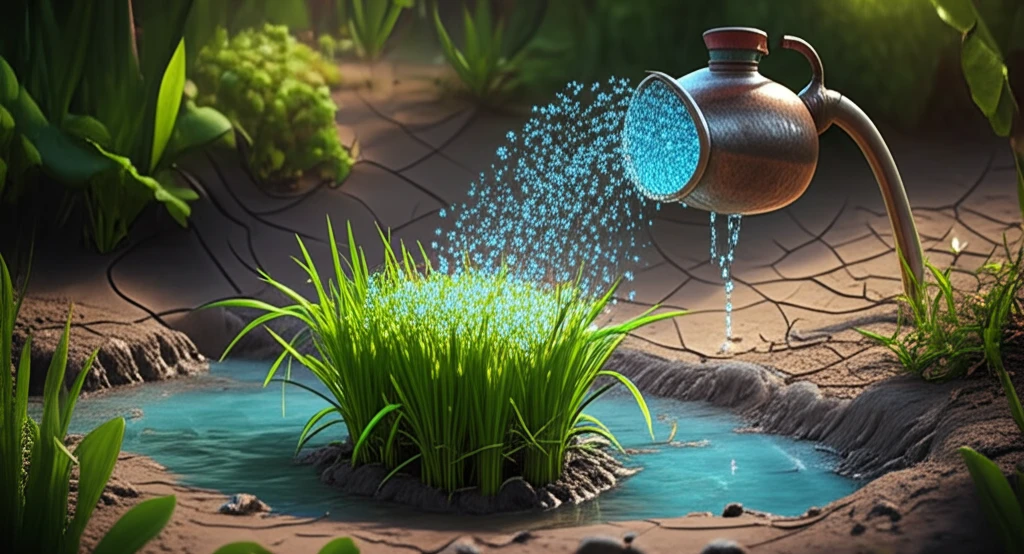
Hydrogen-Rich Water: The Unexpected Key to Healthier Plants?

"Discover how this simple innovation could revolutionize agriculture and home gardening, influencing everything from rice crops to your backyard plants."
In a world increasingly focused on sustainable solutions, the potential of hydrogen-rich water (HW) in agriculture is garnering attention. While hydrogen gas (H₂) is known for its role in helping plants withstand stress, its broader impact on plant development and reproduction has remained somewhat of a mystery. Recent research is shedding light on this intriguing area, suggesting HW could be a game-changer for both crop production and home gardening.
The latest research dives deep into how HW affects various types of rice, from conventional and genetically modified varieties to wild species. By exploring its effects, we can gain insights into optimizing plant health and productivity. This article breaks down the findings, revealing how HW could be used to enhance plant growth and resilience.
Imagine a future where you can boost the health of your garden simply by using hydrogen-rich water. Let’s explore this exciting possibility and understand how HW could transform the way we grow plants.
Hydrogen-Rich Water: Growing Interest, Mixed Evidence
Molecular hydrogen (H₂) dissolved in water has attracted research interest for its potential to attenuate oxidative stress, improve cellular function, and reduce chronic inflammation. Pre-clinical and clinical studies have explored H₂-rich water (HRW) on features of metabolic syndrome, though the effects of long-term, high-concentration use remain under investigation. However, evidence is far from settled; one study found that hydrogen-rich water produced no measurable improvement in oxidative stress biomarkers among participants, and the authors noted that the small sample size substantially limits confidence in the findings. Hydrogen itself is the lightest and most abundant element in the universe, constituting roughly 75 percent of elemental mass.
How Hydrogen Water Is Made and What It Claims
Hydrogen-rich water—sometimes called hydro-enriched water—is ordinary water infused with dissolved molecular hydrogen gas, distinguishing it from standard tap water primarily by its dissolved H₂ content. Proponents describe it as a selective antioxidant capable of scavenging the most damaging free radicals, suppressing NF-κB, activating Nrf2 pathways, supporting mitochondrial function, and promoting gut microbiome balance. Practical guides describe multiple preparation techniques, from commercial hydrogen water generators to simpler DIY methods for home use. Despite growing consumer interest, standard methods for examining water quality—such as those catalogued by standardmethods.org—focus on conventional parameters like solids content and do not specifically address dissolved molecular hydrogen levels.
Hydrogen, Water, and Deep Origins
The story of hydrogen and water begins at a planetary scale: research into the origin of water on Earth points to processes including chondritic inheritance, nebular ingassing, and storage of hydrogen in the planet's core. Studies of early Earth atmospheres have specifically examined the evolution of the deuterium-to-hydrogen ratio in a hydrogen-rich atmosphere as a clue to how oceans formed. In the modern era, figures like Gary Brecka have helped popularize hydrogen water through mainstream media appearances, emphasizing portable hydrogen water bottle technology that generates high-quality H₂-rich water on the go. The leap from geochemistry to wellness consumer products illustrates how a fundamental element has journeyed from cosmic abundance to kitchen countertops.
Unveiling the Science: How Hydrogen-Rich Water Impacts Plant Fitness
A detailed study published in Agronomy Journal investigated the effects of HW on several types of rice. The experiment involved irrigating conventional rice (Oryza sativa L.), insect-resistant Bt-transgenic rice, and two wild rice species (O. rufipogon Griff. and O. minuta J. Presl) with HW in a greenhouse setting. Researchers meticulously tracked various fitness parameters, including root and shoot elongation, pollen characteristics, seed weight, and overall seed production.
- Root and Shoot Growth: HW generally inhibits root and shoot elongation in conventional and transgenic rice.
- Reproductive Fitness: HW affects pollen size and seed weight in both conventional and transgenic rice, but the specific effects vary.
- Wild Rice Variability: The impact of HW on wild rice depends on the species' original habitat.
- Transgenic vs. Conventional: HW can have differing effects on transgenic rice compared to conventional varieties.
New Findings in Animal and Agricultural Studies
Recent research has expanded hydrogen-rich water investigation beyond human health into agricultural applications. A 2025 study examined HRW's effects on weaned piglets suffering from diarrhea, framing the intervention around its selective antioxidant properties and ability to mitigate oxidative stress damage. The researchers characterized hydrogen-rich water as an ideal intervention due to its capacity to selectively neutralize harmful reactive oxygen species while leaving beneficial signaling molecules intact. This line of inquiry suggests potential for hydrogen-rich water as a tool in livestock management and, by extension, raises questions about broader applications in plant and animal health.
Skepticism, Limited Evidence, and Overclaimed Benefits
Critics have raised pointed concerns about the hype surrounding hydrogen-rich water. McGill University's Office for Science and Society took aim at wellness influencer Gary Brecka, noting that he is not a medical doctor and that his promotion of hydrogen-infused drinks, cold plunges, and red light therapy relies heavily on impressive-sounding vocabulary rather than robust evidence. More broadly, analysis of the existing literature reveals that research on health benefits remains limited, with scant data on long-term effects. Pilot studies do suggest possible benefits for metabolic syndrome prevention, but one study examining non-surgical periodontal treatment found that adding hydrogen-rich water produced only additive—not transformative—effects, underscoring the gap between promising signals and proven clinical impact.
Hydrogen Water vs. Alternatives: Marketing Meets Science
The hydrogen water market is crowded with competing product claims, from dedicated hydrogen water bottles to broader alkaline water systems. Companies like Enagic market electrolytically reduced, hydrogen-rich water at an alkaline pH of 8.5–9.5, positioning it for uses ranging from drinking and food preparation to watering plants. Meanwhile, brands like Sorso emphasize that their hydrogen-enriched water is achieved through mineral remineralization rather than electrolysis, attempting to differentiate on production method. Social media platforms including TikTok have become battlegrounds for debates about hydrogen water bottle dangers and scam products, reflecting consumer confusion about which devices genuinely deliver therapeutic levels of dissolved hydrogen versus those offering little more than marketing.
The Future of Hydrogen-Rich Water in Plant Care
The research clearly indicates that hydrogen-rich water holds potential for influencing plant growth and stress resistance. However, its effects are complex and vary depending on the plant species, genetic background, and environmental conditions. While further research is needed to fully understand and optimize its application, HW presents an exciting avenue for developing sustainable and tailored approaches to plant care. Whether you're a farmer looking to improve crop yields or a home gardener seeking healthier plants, understanding the nuances of HW could be a key to unlocking nature's potential.
What the Evidence Actually Supports
A careful reading of the available evidence suggests hydrogen-rich water occupies a space between genuine scientific interest and overhyped wellness trend. Meta-analyses of small exercise studies report only modest effects on perceived exertion, fatigue, and lower-limb power, with no meaningful effect on endurance or strength. Some researchers have investigated whether hydrogen-rich water might support the body's natural GLP-1 production, with one clinical trial exploring how combining HRW with gut health optimization, adequate protein intake, and removal of seed oils could support natural appetite regulation. These findings paint a picture of a substance with real but limited demonstrated benefits—not the miracle cure its most enthusiastic proponents suggest.
Market Growth and the Home Preparation Movement
The hydrogen-rich water dispenser market is projected to grow significantly through 2032, driven by increasing consumer awareness and smart technology integration including IoT-connected devices controlled via smartphone apps. This commercial expansion is paralleled by a grassroots movement toward home preparation, with comprehensive guides now available covering DIY methods for making hydrogen-rich water at home using accessible equipment. As molecular hydrogen continues its trajectory from niche wellness topic to mainstream consumer product, the challenge will be ensuring that product claims keep pace with scientific evidence rather than outstripping it.
Scaling Innovation: Market Trends and Biological Frontiers
The global hydrogen-rich water dispenser market reflects broader trends in health technology, with smart features and connected devices becoming standard expectations rather than premium add-ons. Meanwhile, the scientific frontier continues to expand into unexpected domains: research on weaned piglets has demonstrated that hydrogen-rich water can attenuate diarrhea through mechanisms involving selective antioxidant activity and mitigation of oxidative stress damage. These dual tracks—commercial scaling and biological research—create both opportunities and challenges, as market growth can outpace the rigorous validation needed to substantiate health claims across different species and applications.
From Lab to Life: Promising Signals and Missing Pieces
At the intersection of research and real-world application, hydrogen-rich water shows intriguing but incomplete promise for human health. Animal studies have demonstrated that HRW supplementation can ameliorate placental stress—specifically reducing angiotensin II type 1 receptor expression and oxidative stress in rat placentas subjected to water restriction—suggesting protective mechanisms that may translate to human pregnancy outcomes. In cardiovascular health, hydrogen-rich water shows promising biological effects in animal models and small, selective human studies suggesting modest blood pressure benefits mediated by reduced oxidative stress. However, large randomized clinical trials in broad hypertensive populations remain lacking, leaving the gap between laboratory promise and clinical recommendation still wide.