
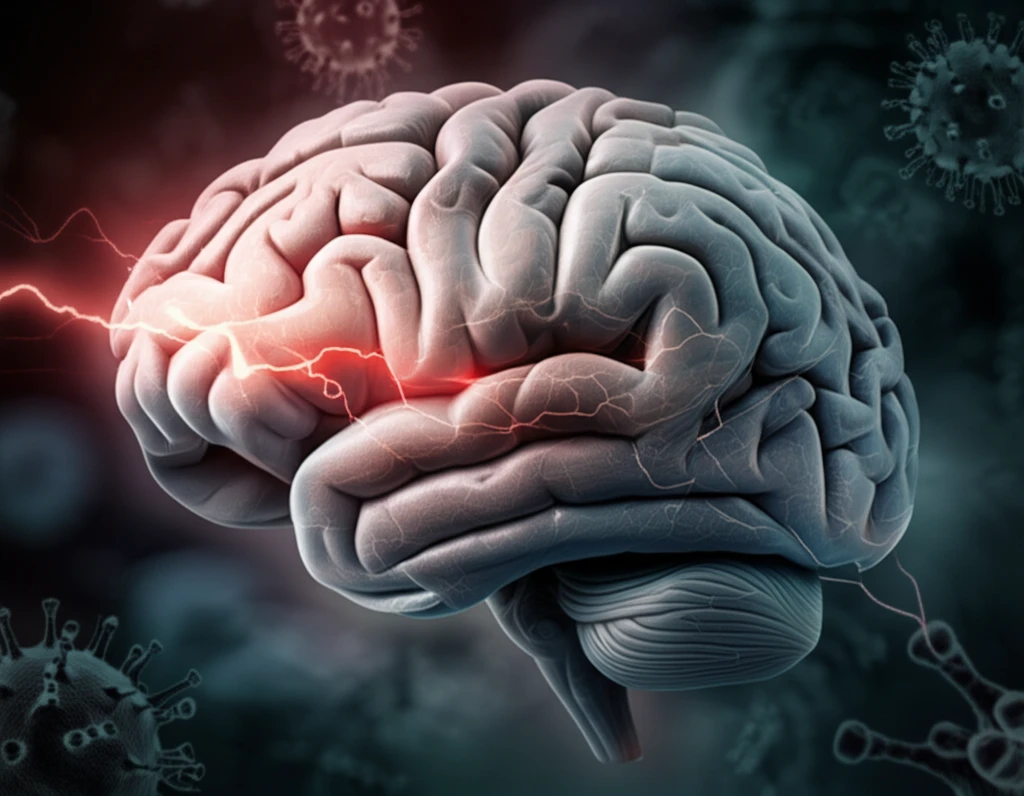
Surreal illustration combining brain imagery with herpes virus and stroke symbols.

HSV-2 Encephalitis: A Rare Stroke Culprit You Need to Know About

"Unmasking the unexpected link between herpes simplex virus-2 and ischemic stroke, and why prompt diagnosis is crucial."


Herpes simplex virus-2 (HSV-2) encephalitis (HSE) is an uncommon condition in adults. Typically, HSV-2 infections of the central nervous system (CNS) have been linked to hemorrhagic or ischemic strokes, or just ischemic strokes, but these occurrences are rare.

Here, we report a unique case: HSV-2 encephalitis presenting as an ischemic stroke initially, followed by a transient ischemic attack (TIA), all without any bleeding in the brain. This unusual presentation underscores the complexities of diagnosing neurological conditions.

The patient, a 68-year-old Hispanic woman with a history of systemic lupus erythematosus on immunosuppressants, hypertension, depression, and migraines, initially complained of a three-week-long mild headache. This was followed by acute left-sided numbness, occurring alongside acute kidney injury and a urinary tract infection. She also experienced brief episodes of visual and auditory hallucinations at night, which doctors initially attributed to metabolic imbalances due to her kidney issues and infection. Importantly, she showed no signs of encephalopathy during her hospital stay and had a non-focal neurological examination upon admission.

The Diagnostic Journey: Uncovering HSV-2's Role in Stroke

Surreal illustration combining brain imagery with herpes virus and stroke symbols.

Initial MRI scans revealed three distinct areas of acute ischemia, affecting the right anterior inferior insula and two regions in the right frontal cortex. Further investigations, including MRA of the head and neck, transesophageal echocardiogram, 24-hour Holter monitoring, and a hypercoagulable panel, did not reveal any vascular abnormalities or other common stroke causes.

The patient was started on aspirin and rosuvastatin for secondary stroke prevention. However, three days later, she experienced transient slurring of speech and right-sided facial weakness that resolved within an hour. A repeat MRI didn't show any new signs of acute stroke. Considering her persistent headache and immunosuppressed state, doctors suspected a possible CNS infection and performed a lumbar puncture.

Cerebrospinal fluid (CSF) analysis revealed:
  • Significantly elevated protein levels (255 mg/dl).
  • Normal glucose levels (45 mg/dl).
  • Elevated white blood cell count (649 mm³ with 100% lymphocytes).
  • Presence of red blood cells (91/mm³).
  • Positive PCR for HSV type 2; negative for HSV type 1.
  • Negative results for EBV, VZV, CMV, VDRL, and TB in CSF.
Based on these findings, the patient was started on intravenous acyclovir for a three-week course. Her headaches improved, and she remained symptom-free and neurologically intact.

Key Takeaways: Why Early Detection Matters

While most ischemic strokes are managed with antiplatelets (or anticoagulants) and vascular risk factor management, this case highlights the critical need to consider less common etiologies that require alternative treatment approaches. A high degree of suspicion is essential.

In this particular case, the lumbar puncture and CSF analysis were pivotal in diagnosing HSV-2-related stroke, prompting the initiation of antiviral treatment. This underscores the importance of performing a lumbar puncture in cases of ischemic stroke with unclear etiology, especially when CNS infection is suspected.

The patient's history of chronic immunosuppression likely predisposed her to an indolent viral infection. While the exact mechanism of ischemic stroke in HSV-2 infection remains unknown, it is hypothesized that, similar to varicella-zoster virus vasculopathy, HSV-2 can cause viral invasion and vessel wall inflammation, potentially leading to vessel occlusion or secondary thrombosis. Further research is needed to confirm this hypothesis.

About this Article -

This article was crafted using a human-AI hybrid and collaborative approach. AI assisted our team with initial drafting, research insights, identifying key questions, and image generation. Our human editors guided topic selection, defined the angle, structured the content, ensured factual accuracy and relevance, refined the tone, and conducted thorough editing to deliver helpful, high-quality information.See our About page for more information.

This article is based on research published under:

DOI-LINK: 10.1007/s10072-017-3100-9, Alternate LINK

Title: Hsv-2 Encephalitis Presenting As Multifocal Ischemic Stroke

Subject: Psychiatry and Mental health

Journal: Neurological Sciences

Publisher: Springer Science and Business Media LLC

Authors: Fanglin Zhang, Ai Sumida, Jason Margolesky, Leticia Tornes, Alberto Ramos, Sebastian Koch

Published: 2017-08-31

Everything You Need To Know

1

What is HSV-2 encephalitis, and how did it present in this particular case?

Herpes simplex virus-2 (HSV-2) encephalitis (HSE) is a rare condition where the HSV-2 virus, typically associated with genital herpes, infects the brain. In this specific instance, it manifested as an ischemic stroke, meaning it disrupted blood flow to the brain, causing damage similar to a typical stroke. This is unlike the more common presentation of HSV-2 in the central nervous system, which usually involves hemorrhagic or other ischemic strokes.

2

What diagnostic steps were crucial in identifying HSV-2 as the cause of the stroke, and why were they important?

The diagnostic process involved several steps. Initially, MRI scans revealed areas of acute ischemia in the brain. However, standard stroke investigations like MRA, echocardiogram, and hypercoagulable panel didn't find the usual causes. The key to diagnosis was a lumbar puncture, which revealed elevated protein and white blood cell levels in the cerebrospinal fluid (CSF), along with a positive PCR test for HSV type 2. Testing for EBV, VZV, CMV, VDRL, and TB in CSF returned negative results, helping to isolate HSV-2 as the cause.

3

How did the patient's medical history, including systemic lupus erythematosus and immunosuppressant use, contribute to the development and diagnosis of HSV-2 encephalitis?

The patient's history of systemic lupus erythematosus and being on immunosuppressants are significant. Immunosuppressants weaken the immune system, making individuals more susceptible to infections like HSV-2 encephalitis. Systemic lupus erythematosus is an autoimmune disease where the immune system attacks its own tissues which can affect the central nervous system. The added stress on the body with the urinary tract infection and acute kidney injury compounded with the other elements made diagnosis especially challenging. This case underscores the importance of considering atypical infections in immunosuppressed patients presenting with stroke-like symptoms.

4

Why is early detection of HSV-2 encephalitis so important, and what specific treatment was used in this case?

Prompt diagnosis is critical because HSV-2 encephalitis requires specific antiviral treatment, in this case, intravenous acyclovir. Standard stroke treatments like antiplatelets and vascular risk factor management wouldn't address the underlying viral infection. Delay in diagnosis and treatment could lead to further brain damage and neurological deficits. In this specific instance, the patient was treated with a three-week course of intravenous acyclovir, leading to the resolution of symptoms and no lasting neurological effects.

5

What are the broader implications of this case for understanding stroke and considering less common causes?

While most ischemic strokes are managed with antiplatelets (or anticoagulants) and vascular risk factor management, this case highlights the critical need to consider less common etiologies that require alternative treatment approaches. This case expands our understanding of stroke etiology by demonstrating that infections, specifically HSV-2, can be a rare but important cause. It emphasizes the need for a high degree of suspicion, especially in patients with risk factors like immunosuppression or unusual presentations. Also, it encourages clinicians to perform thorough investigations, including lumbar punctures, when the cause of a stroke is unclear.

Newsletter Subscribe

Subscribe to get the latest articles and insights directly in your inbox.