
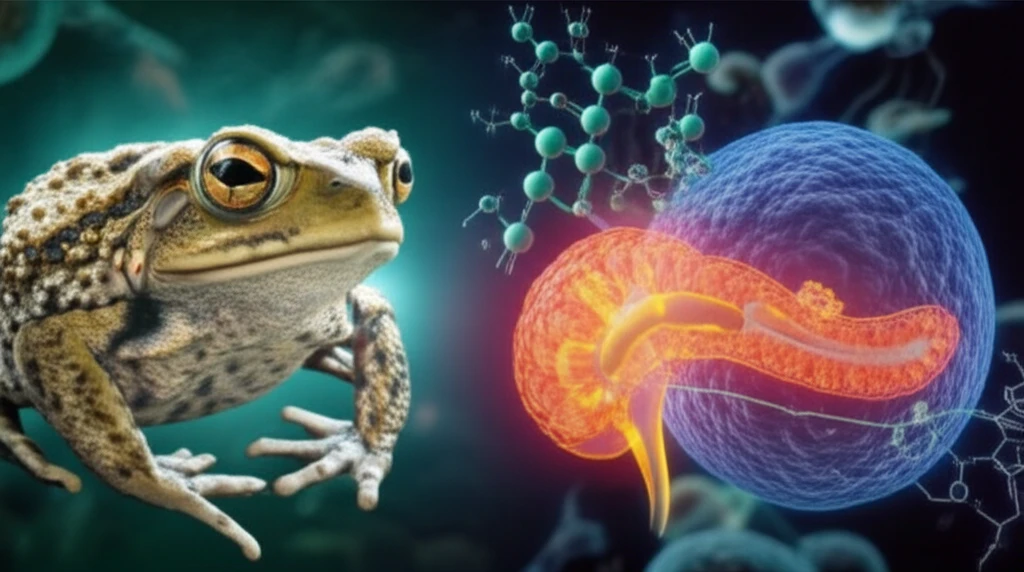
Hope on the Horizon: How a Traditional Chinese Medicine Compound Could Revolutionize Pancreatic Cancer Treatment

"Groundbreaking research reveals that Resibufogenin, a compound derived from traditional Chinese medicine, shows promise in combating pancreatic cancer by targeting key cellular pathways."
Pancreatic cancer, often diagnosed at a late stage, presents a formidable challenge in the medical world. Known for its aggressive nature and limited treatment options, it has a five-year survival rate that hovers around a dismal 10%. The disease's complexity demands innovative approaches, and the scientific community is actively exploring new avenues to combat this devastating illness.
In the realm of traditional Chinese medicine (TCM), the compound Resibufogenin (RB), derived from the skin of the toad, has garnered attention for its potential anticancer properties. Now, emerging research sheds light on RB's mechanisms, suggesting a novel approach to tackling pancreatic cancer. This new research indicates that RB can interfere with the activity of nuclear factor-kappa B (NF-κB), a protein often overactive in cancer cells.
This article delves into the specifics of how Resibufogenin is showing promise in lab studies. We'll explore the detailed cellular processes involved and explain how this compound disrupts the growth and survival of pancreatic cancer cells. Furthermore, we'll discuss the significance of these findings within the broader context of cancer research, offering a message of cautious optimism for those affected by this difficult disease.
Unraveling Resibufogenin: A Deep Dive into Its Anti-Cancer Mechanisms
The recent study, published in the journal Cancer Science, provides a detailed examination of Resibufogenin's effects on pancreatic cancer cells. The researchers found that RB effectively suppressed the growth and promoted programmed cell death (apoptosis) in these cancer cells. These findings indicate that RB can effectively inhibit the cancer cells ability to multiply, by forcing the cancer cells into programmed self destruction.
- NF-κB Inhibition: RB suppresses the activity of NF-κB, a key factor in cancer cell survival.
- TAK1 and GSK-3 Inhibition: RB interferes with the activation of TAK1 and GSK-3 pathways, further disrupting cancer cell function.
- Apoptosis Induction: RB induces apoptosis, or programmed cell death, in pancreatic cancer cells.
- In Vivo Efficacy: In animal studies, RB inhibited the growth of pancreatic tumors.
Looking Ahead: The Future of Resibufogenin in Cancer Therapy
The research on Resibufogenin marks an exciting step forward in the ongoing battle against pancreatic cancer. As scientists continue to explore the potential of this compound, further studies are needed to confirm the safety and efficacy of RB in human clinical trials. The initial findings provide a reason for hope. It encourages researchers and healthcare professionals to explore this potential avenue for treating this challenging disease. With further research, RB could pave the way for new and effective treatment strategies for pancreatic cancer.