
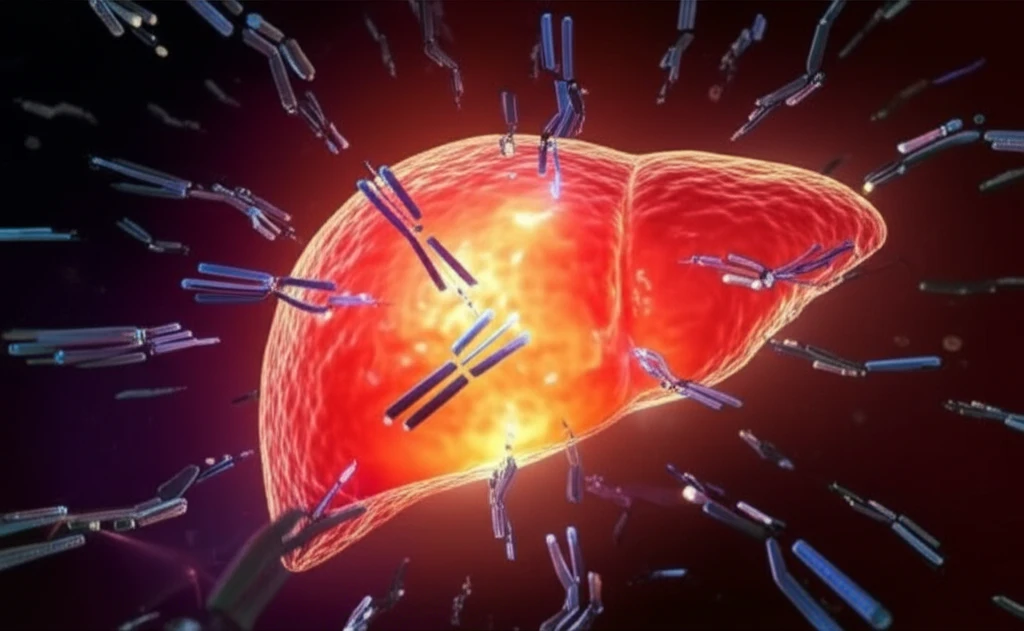
Illustration of immunotherapy targeting liver cancer cells

Hope for Liver Cancer: New Immunotherapy Trial Shows Promise

"A Phase 3 study explores tislelizumab as a potential first-line treatment for advanced hepatocellular carcinoma, offering a new avenue of hope for patients."


Hepatocellular carcinoma (HCC), the most common form of liver cancer, presents a significant global health challenge. Often diagnosed at advanced stages, treatment options have been limited, underscoring the urgent need for innovative therapies. Traditional treatments, such as sorafenib, have provided some benefit, but the quest for more effective and less toxic alternatives continues.

Enter tislelizumab, a novel anti-PD-1 antibody, which is now at the forefront of research. Unlike other antibodies, tislelizumab is engineered to minimize binding to macrophages, potentially reducing unwanted side effects and enhancing its anti-cancer activity. This unique characteristic sets the stage for a promising new approach in HCC treatment.

A recent phase 3 clinical trial has explored the effectiveness and safety of tislelizumab compared to sorafenib as a first-line treatment for advanced HCC. This study, designed as a randomized, open-label, multicenter trial, aims to determine if tislelizumab can offer a superior treatment option for patients facing this challenging disease.

What is Tislelizumab and How Does It Work?

Illustration of immunotherapy targeting liver cancer cells

Tislelizumab, known in scientific circles as BGB-A317, represents a cutting-edge approach to cancer treatment. It's classified as a humanized IgG4 monoclonal antibody, meticulously designed to target the programmed cell death receptor-1 (PD-1). This receptor plays a crucial role in regulating the immune system's response to cancer cells.

Here's how it works: Cancer cells often exploit the PD-1 pathway to evade detection and destruction by the immune system. By binding to PD-1, tislelizumab effectively blocks this pathway, unleashing the immune system to recognize and attack the cancer cells. What sets tislelizumab apart is its unique engineering, which minimizes its interaction with macrophages. Macrophages are immune cells that can sometimes inadvertently clear therapeutic antibodies, reducing their effectiveness. By minimizing this interaction, tislelizumab aims to enhance its therapeutic potential.

  • High Affinity and Specificity: Tislelizumab binds strongly and precisely to PD-1, ensuring a targeted immune response.
  • Engineered for Reduced Side Effects: Minimizing macrophage binding helps reduce potential side effects, making it a potentially safer option.
  • Unleashing the Immune System: By blocking the PD-1 pathway, tislelizumab allows the immune system to target and destroy cancer cells.
Previous studies, including a phase 1A/1B trial (NCT02407990), have shown that tislelizumab is generally well-tolerated and demonstrates anti-tumor activity across various solid tumors, including HCC. These findings paved the way for the current phase 3 trial, solidifying the rationale for its continued investigation as a promising cancer therapy.

Looking Ahead: What the Trial Hopes to Achieve

The ongoing phase 3 trial (NCT03412773) is a pivotal study designed to definitively evaluate tislelizumab's role in treating advanced HCC. With approximately 640 patients participating across 100 international centers, the trial compares tislelizumab to sorafenib, a standard treatment, to determine if tislelizumab offers superior outcomes. The primary goal is to assess overall survival (OS), a critical measure of treatment effectiveness. Secondary outcomes include objective response rate, progression-free survival, duration of response, and patient quality of life. These comprehensive assessments will provide a detailed understanding of tislelizumab's benefits and risks.

About this Article -

This article was crafted using a human-AI hybrid and collaborative approach. AI assisted our team with initial drafting, research insights, identifying key questions, and image generation. Our human editors guided topic selection, defined the angle, structured the content, ensured factual accuracy and relevance, refined the tone, and conducted thorough editing to deliver helpful, high-quality information.See our About page for more information.

Everything You Need To Know

1

What is Hepatocellular Carcinoma (HCC), and why is it a major health concern?

Hepatocellular carcinoma (HCC) is the most common form of liver cancer, representing a significant global health challenge. Its severity stems from the fact that it's often diagnosed at advanced stages, which limits treatment options and reduces patient survival rates. The urgent need for innovative therapies highlights the critical nature of this disease and the importance of ongoing research, such as the phase 3 trial evaluating tislelizumab.

2

How does tislelizumab work as a treatment for advanced HCC, and what is its mechanism of action?

Tislelizumab, also known as BGB-A317, is a humanized IgG4 monoclonal antibody. It functions by targeting the programmed cell death receptor-1 (PD-1). Cancer cells utilize the PD-1 pathway to avoid immune detection. Tislelizumab binds to PD-1, effectively blocking this pathway and allowing the immune system to recognize and attack the cancer cells. A key advantage of tislelizumab is its engineering, which minimizes binding to macrophages, potentially reducing side effects and enhancing its anti-cancer activity. This targeted action and reduced side effects make it a promising treatment option.

3

What are the key differences between tislelizumab and other anti-PD-1 antibodies?

A key difference between tislelizumab and other anti-PD-1 antibodies lies in its design to minimize binding to macrophages. Macrophages can sometimes clear therapeutic antibodies, thereby reducing their effectiveness. By reducing this interaction, tislelizumab aims to enhance its anti-cancer activity and potentially reduce unwanted side effects. This unique characteristic contributes to tislelizumab's promise as a potentially safer and more effective treatment option.

4

What is the purpose of the phase 3 clinical trial (NCT03412773) evaluating tislelizumab for advanced HCC?

The phase 3 clinical trial (NCT03412773) aims to definitively evaluate the role of tislelizumab in treating advanced HCC. The study compares tislelizumab to sorafenib, a standard treatment, to determine if tislelizumab offers superior outcomes. The primary goal is to assess overall survival (OS), which is a key measure of treatment effectiveness. Secondary outcomes include objective response rate, progression-free survival, duration of response, and patient quality of life. The trial involves approximately 640 patients across 100 international centers and provides a comprehensive assessment of tislelizumab's benefits and risks, potentially paving the way for a new standard of care.

5

What are the potential benefits of tislelizumab compared to traditional treatments like sorafenib for HCC, and what outcomes are being measured in the clinical trial?

The potential benefits of tislelizumab compared to sorafenib include superior treatment outcomes and potentially fewer side effects. The phase 3 clinical trial is measuring several key outcomes to assess tislelizumab's effectiveness. The primary goal is to assess overall survival (OS). Secondary outcomes include objective response rate, progression-free survival, duration of response, and patient quality of life. By evaluating these measures, researchers can gain a detailed understanding of tislelizumab's ability to extend life, reduce tumor growth, and improve the overall well-being of patients with advanced HCC, offering a potential advancement over current treatment options.

Newsletter Subscribe

Subscribe to get the latest articles and insights directly in your inbox.