
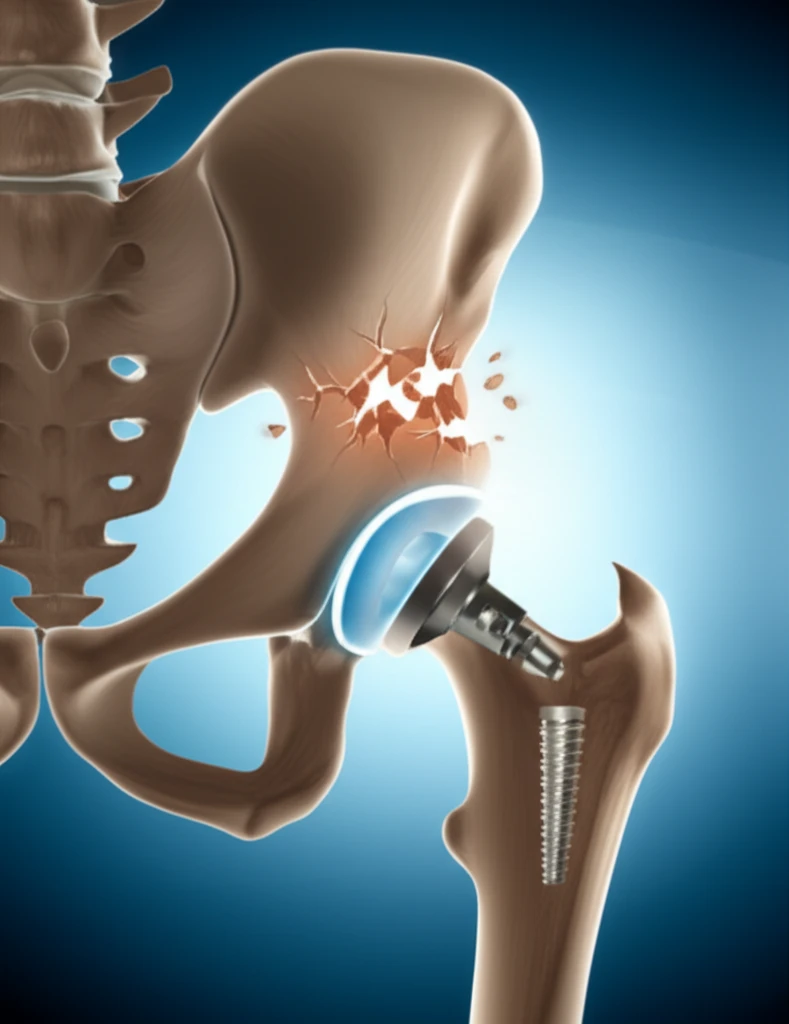
Surreal illustration of a fractured hip implant.

Hip Replacement Alert: Are Taper-Slip Stems Increasing Fracture Risks?

"New research reveals a potential downside to taper-slip stems in cemented hemiarthroplasty, urging a closer look at hip fracture treatment strategies."


Hip fractures are a major health concern, especially for older adults. When a hip breaks, it often requires surgery, and one common procedure is a hemiarthroplasty. This involves replacing part of the hip joint with an artificial implant. These implants come in various designs, each aiming to provide stability and restore mobility. But what if certain designs carried hidden risks?

A recent study from the Norwegian Hip Fracture Register is making waves in the orthopedic community. It suggests that the type of stem used in cemented hemiarthroplasty—specifically, polished taper-slip stems—might be linked to a higher risk of periprosthetic fractures. This is a fracture that occurs around the implant itself, a complication no patient wants to face.

This article delves into the details of this research, exploring what these findings mean for patients, surgeons, and the future of hip fracture treatment. We'll break down the complexities of stem designs, analyze the study's data, and discuss the potential implications for surgical decision-making. Understanding these insights is crucial for anyone seeking the best possible outcome after a hip fracture.

Taper-Slip vs. Straight Stems: Understanding the Design Debate

Surreal illustration of a fractured hip implant.

The core of this discussion revolves around two main types of femoral stems used in hemiarthroplasty: polished taper-slip (TS) stems and straight stems. Taper-slip stems, like the Exeter and CPT models, are designed to subside slightly within the cement mantle that secures them to the femur. This subsidence is intended to create even load-bearing and reduce stress on the bone.

Straight stems, on the other hand, such as the Charnley, Charnley Modular, and Spectron EF, rely on a composite-beam (CB) principle. They're designed to be rigidly fixed within the cement, distributing the load along the entire stem. Anatomic stems, like the Lubinus SP2, also use the CB principle but are shaped to better match the natural anatomy of the femur.

  • Polished Taper-Slip (TS) Stems: Designed for subsidence within the cement mantle, aiming for even load distribution. Examples include Exeter and CPT stems.
  • Straight Stems (CB Principle): Designed for rigid fixation within the cement, distributing load along the stem. Examples include Charnley, Charnley Modular, and Spectron EF stems.
  • Anatomical Stems (CB Principle): Shaped to match the natural femur anatomy while maintaining rigid cement fixation. Example: Lubinus SP2 stem.
The Norwegian study aimed to compare the mid-term survival rates of these different stem designs, focusing on the risk of reoperation due to various complications, with a particular emphasis on periprosthetic fractures. By analyzing data from over 20,000 patients, the researchers hoped to shed light on whether one design truly outperformed the others.

Making Informed Decisions for Better Outcomes

The Norwegian Hip Fracture Register study provides valuable insights into the potential risks associated with different stem designs in cemented hemiarthroplasty. While implant survival rates remain high, the increased risk of periprosthetic fracture with polished taper-slip stems warrants careful consideration. By understanding these factors, surgeons and patients can collaborate to make informed decisions, ultimately striving for the best possible outcomes and improved quality of life after a hip fracture. Further research and long-term follow-up studies will continue to refine our understanding and optimize hip replacement techniques.

About this Article -

This article was crafted using a human-AI hybrid and collaborative approach. AI assisted our team with initial drafting, research insights, identifying key questions, and image generation. Our human editors guided topic selection, defined the angle, structured the content, ensured factual accuracy and relevance, refined the tone, and conducted thorough editing to deliver helpful, high-quality information.See our About page for more information.

This article is based on research published under:

DOI-LINK: 10.1302/0301-620x.100b12.bjj-2018-0262.r1, Alternate LINK

Title: More Reoperations For Periprosthetic Fracture After Cemented Hemiarthroplasty With Polished Taper-Slip Stems Than After Anatomical And Straight Stems In The Treatment Of Hip Fractures

Subject: Orthopedics and Sports Medicine

Journal: The Bone & Joint Journal

Publisher: British Editorial Society of Bone & Joint Surgery

Authors: T. B. Kristensen, E. Dybvik, O. Furnes, L. B. Engesæter, J-E. Gjertsen

Published: 2018-12-01

Everything You Need To Know

1

What is a hemiarthroplasty and why is it performed?

A hemiarthroplasty is a surgical procedure used to address hip fractures, especially in older adults. It involves replacing part of the hip joint with an artificial implant, aiming to restore mobility and stability. Different stem designs are available, including polished taper-slip stems and straight stems, each with unique load-bearing characteristics. The choice of stem design can impact the risk of complications such as periprosthetic fractures.

2

What are polished taper-slip stems and what are the implications of using them?

Polished taper-slip stems, such as the Exeter and CPT models, are designed to subside slightly within the cement mantle that secures them to the femur. This subsidence aims to create even load-bearing and reduce stress on the bone. However, a recent study suggests that these stems might be associated with a higher risk of periprosthetic fractures compared to other stem designs. This is significant because periprosthetic fractures are a major complication following hip replacement, requiring further surgery and potentially affecting patient outcomes. The use of polished taper-slip stems requires careful consideration of the potential risks and benefits.

3

How do straight stems differ from taper-slip stems in hip replacements?

Straight stems, like the Charnley, Charnley Modular, and Spectron EF, operate on a composite-beam principle. They are designed to be rigidly fixed within the cement, distributing the load along the entire stem. Anatomic stems, like the Lubinus SP2, also use the composite-beam principle but are shaped to better match the natural anatomy of the femur. The choice between taper-slip stems and straight stems is crucial because the Norwegian Hip Fracture Register study indicates a potential link between taper-slip stems and increased fracture risk. Surgeons need to consider these design differences and their potential impact on patient outcomes.

4

What is a periprosthetic fracture and why is it a concern in hip replacements?

A periprosthetic fracture is a fracture that occurs around a hip implant. The Norwegian Hip Fracture Register study suggests that polished taper-slip stems might be associated with a higher risk of these types of fractures. This is a significant concern because periprosthetic fractures often require additional surgery, can lead to prolonged recovery times, and can negatively impact a patient's quality of life. Understanding the factors that contribute to periprosthetic fractures is essential for improving hip replacement outcomes.

5

What is the Norwegian Hip Fracture Register study and why is it important?

The Norwegian Hip Fracture Register study is a large-scale study analyzing data from over 20,000 patients to compare the mid-term survival rates of different stem designs used in hemiarthroplasty. It focuses on the risk of reoperation due to complications, particularly periprosthetic fractures. This study is significant because it provides valuable insights into the potential risks associated with different stem designs, helping surgeons and patients make informed decisions about hip fracture treatment. The findings highlight the importance of considering stem design when planning a hemiarthroplasty to minimize the risk of complications.

Newsletter Subscribe

Subscribe to get the latest articles and insights directly in your inbox.