
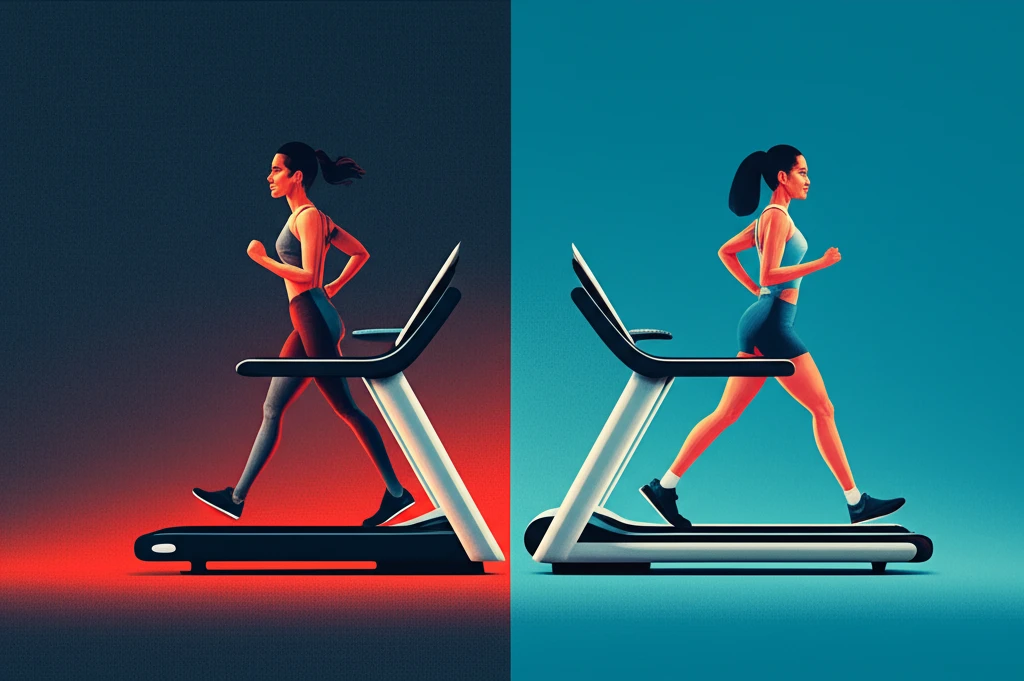
HIIT versus Moderate-Intensity Exercise: Visual representation of different exercise intensities and their mental perceptions.

HIIT vs. Moderate Exercise: Which Workout is Best for Overweight Men?

"A new study reveals how different exercise intensities impact psychological responses, muscle damage, and more in overweight men."


High-intensity interval exercise (HIIE) has gained popularity as a time-efficient way to improve cardiorespiratory fitness and cardiometabolic health. Often compared to moderate-intensity continuous exercise (MICE), the debate continues regarding which approach is more effective and enjoyable, especially for individuals who are inactive or overweight.

From a psychological perspective, exercise isn't just about physical exertion; it's also about how it makes you feel. Recent research has explored the affective responses (feelings of pleasure or displeasure) associated with different exercise intensities, contributing to the ongoing discussion about the best exercise recommendations for the general population.

A recent study published in Physiology & Behavior delves into the psychological and physiological responses of overweight men to HIIE and MICE. The research compares in-task affect, perceived exertion, self-efficacy, enjoyment, and future intention to exercise, alongside assessments of muscle damage, soreness, and inflammation. This article explores the study's findings to help you understand which exercise approach might be the most suitable for you.

Decoding the HIIT vs. MICE Experiment: What the Study Revealed

HIIT versus Moderate-Intensity Exercise: Visual representation of different exercise intensities and their mental perceptions.

Researchers Luiz Fernando Farias-Junior, Rodrigo Alberto Vieira Browne, and colleagues conducted a study involving 15 overweight men (average age 28.9 years, BMI 29.2 kg/m²). Participants completed two exercise sessions: HIIE, consisting of 10 one-minute intervals at 100% maximal velocity with one-minute recovery periods, and MICE, a 20-minute session at 55-59% VO2reserve. Throughout the sessions, researchers assessed affect, alertness, rating of perceived exertion (RPE), and self-efficacy. Enjoyment and future intention were evaluated post-exercise. Blood samples were collected to measure creatine kinase, lactate dehydrogenase, interleukin-6 and -10, tumor necrosis factor alpha, and muscle soreness.

The study yielded several key findings:

  • In-Task Affect: Participants experienced significantly more negative affect during HIIE compared to MICE.
  • Self-Efficacy: Self-efficacy was lower during HIIE compared to MICE.
  • Perceived Exertion: RPE and alertness were higher in HIIE.
  • Correlations: Negative affect correlated with higher RPE in both HIIE and MICE and with time spent above the respiratory compensation point in HIIE. Positive affect correlated with self-efficacy in MICE.
  • Post-Exercise Measures: Enjoyment, future intention, muscle damage, soreness, and inflammation were similar between HIIE and MICE.
In essence, while HIIE was perceived as more unpleasant during the workout, the psychological and physiological responses afterward were comparable to MICE in this group of overweight, inactive men.

The Takeaway: Tailoring Exercise to Your Preferences

This study highlights the importance of considering individual preferences when choosing an exercise regimen. While HIIE offers a quick and effective workout, the negative affect experienced during the session may be a barrier to adherence for some individuals. MICE, on the other hand, provides a more pleasant experience, which could improve long-term consistency.

The researchers suggest alternative HIIE approaches to mitigate negative affect, such as lowering the intensity (85-90% VO2max), reducing interval duration (less than 1 minute), or increasing recovery time (more than 1 minute). These modifications may make HIIE more palatable for overweight, inactive individuals.

Ultimately, the best exercise is one that you enjoy and can stick with. Experiment with different intensities and modalities to find what works best for you. If you find HIIE too unpleasant, don't be afraid to opt for MICE or other forms of physical activity that you find more enjoyable.

About this Article -

This article was crafted using a human-AI hybrid and collaborative approach. AI assisted our team with initial drafting, research insights, identifying key questions, and image generation. Our human editors guided topic selection, defined the angle, structured the content, ensured factual accuracy and relevance, refined the tone, and conducted thorough editing to deliver helpful, high-quality information.See our About page for more information.

This article is based on research published under:

DOI-LINK: 10.1016/j.physbeh.2018.11.028, Alternate LINK

Title: Psychological Responses, Muscle Damage, Inflammation, And Delayed Onset Muscle Soreness To High-Intensity Interval And Moderate-Intensity Continuous Exercise In Overweight Men

Subject: Behavioral Neuroscience

Journal: Physiology & Behavior

Publisher: Elsevier BV

Authors: Luiz Fernando Farias-Junior, Rodrigo Alberto Vieira Browne, Yuri Alberto Freire, Filipe Fernandes Oliveira-Dantas, Telma Maria Araújo Moura Lemos, Nicole Leite Galvão-Coelho, Sarah J. Hardcastle, Alexandre Hideki Okano, Marcelo Saldanha Aoki, Eduardo Caldas Costa

Published: 2019-02-01

Everything You Need To Know

1

What's the fundamental difference between high-intensity interval exercise (HIIE) and moderate-intensity continuous exercise (MICE)?

High-intensity interval exercise (HIIE) involves short bursts of intense activity followed by brief recovery periods. Moderate-intensity continuous exercise (MICE) involves sustained activity at a moderate level. The key difference lies in the intensity and duration of the exercise. HIIE aims for maximal exertion in short intervals, while MICE focuses on maintaining a consistent, moderate effort over a longer period.

2

According to the study, how did overweight men psychologically and physiologically respond to HIIE versus MICE?

The study revealed that during exercise, individuals experienced more negative feelings during HIIE compared to MICE. Self-efficacy, or the belief in one's ability to succeed, was also lower during HIIE. Participants reported higher perceived exertion (RPE) and alertness during HIIE. However, post-exercise, enjoyment and future intention to exercise were similar between HIIE and MICE. Muscle damage, soreness, and inflammation were also comparable.

3

What do these findings imply about choosing between HIIE and MICE for overweight men, and how does individual preference factor in?

The results suggest that while HIIE can be effective, the negative feelings experienced during the workout could be a barrier to sticking with it long-term. MICE offers a more pleasant experience, potentially improving consistency. Choosing between HIIE and MICE depends on personal preferences and tolerance for intense exercise. If someone dislikes intense exertion, MICE might be a better option. For those seeking a quick, effective workout and can tolerate the discomfort, HIIE could be suitable.

4

What are creatine kinase, lactate dehydrogenase, interleukin-6 and -10 and tumor necrosis factor alpha, and what role did they play in the study?

Creatine kinase and lactate dehydrogenase are enzymes that indicate muscle damage. Interleukin-6 and -10, and tumor necrosis factor alpha, are markers of inflammation. By measuring these substances, the study assessed the physiological impact of HIIE and MICE on the participants' bodies. The research found that these markers were similar between the two exercise types, suggesting that both HIIE and MICE had comparable effects on muscle damage, soreness, and inflammation in this specific population.

5

On whom can the results of this study be applied? Are there any limitations to consider when interpreting these findings?

The study focused on overweight men with an average age of 28.9 years and a BMI of 29.2 kg/m². The findings may not be directly applicable to other populations, such as women, older adults, or individuals with different fitness levels or health conditions. Further research is needed to determine how HIIE and MICE affect diverse groups of people. Additionally, the study assessed only a limited range of psychological and physiological responses. Future studies could explore other factors, such as the impact on sleep, appetite, or cognitive function.

Newsletter Subscribe

Subscribe to get the latest articles and insights directly in your inbox.