
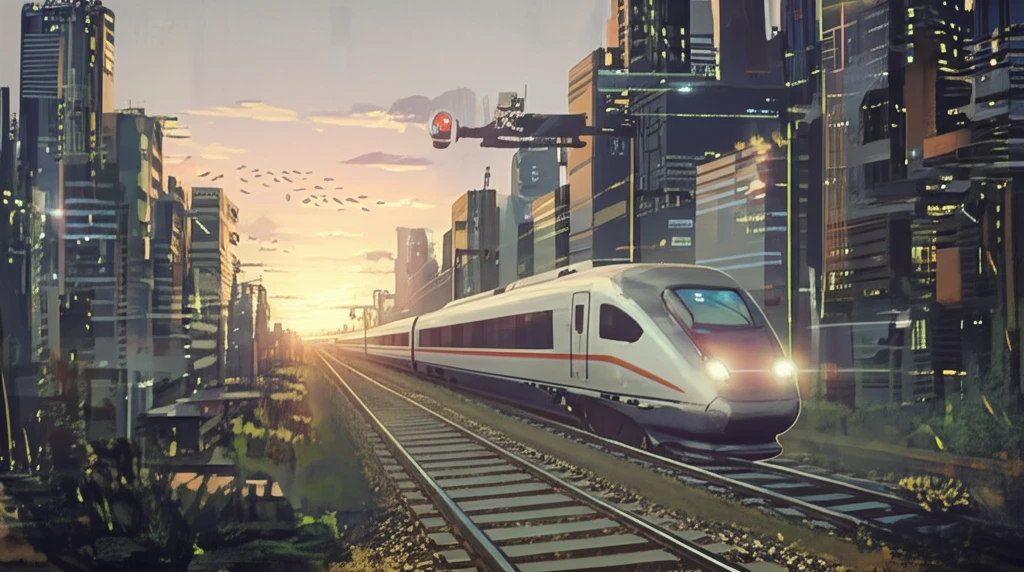
High-Speed Rail: Connecting Cities, Transforming Regions

"Uncover the impact of city-cluster high-speed rail on regional growth and integration. Is it the key to cohesion or does it widen the gap?"
High-speed rail (HSR) has long been a topic of discussion for researchers and policymakers, particularly when it comes to how transportation investments influence regional integration and territorial equality. HSR's role extends to shaping urban development by enhancing connectivity and linking cities, with inter-city connections playing a vital role in socio-economic progress across developed nations.
China's rapid expansion of its HSR network has sparked intense interest, and the state is set to expand HSR lines further. HSR, along with other transportation investments, serves as a means to achieve this goal. While HSR is promising, its actual effects depend on many social, spatial, and economic factors.
This article explores the cohesion effect, focusing on the City-Cluster HSR (C-HSR) and its impact on spatial and economic dynamics, specifically along the Shanghai-Nanjing corridor in the Yangtze River Delta. By examining passenger flows and travel behavior, the study determines C-HSR's role in fostering spatial transformation and regional integration within the Yangtze River Delta.
A Network Built on Scale and Numbers
China operates the world's longest high-speed rail system, with more than 40,000 kilometers of lines in service. Broad international rail usage figures draw on the International Union of Railways' Railway Statistics 2019 Report, though many of those numbers are acknowledged as incomplete because they exclude metro and rapid-transit services. Passenger traffic data tracking high-speed rail worldwide shows growth in passenger-kilometers traveled between 2010 and 2021, including detailed statistics for China and Japan's Shinkansen operations. The UIC continues to compile and publish reference material such as the Atlas High-Speed Rail 2022 and related congress messaging on the role of high-speed rail.
Engineering Standards and Design Constraints
High-speed rail engineering must account for dynamic loads that become critical as speeds rise. When trains exceed 200 km/h, the excitation frequency of moving loads can approach or coincide with a bridge's natural vibration frequency, a central constraint in design. Comparative analysis of embankment and substructure design across China, France, Germany, Japan, Russia, Spain, and Sweden reveals that different countries adopt different design parameters for different track types, including limitations at transitions, at design speeds up to 300 km/h. In the U.S., the High Speed Rail Association has proposed a 17,000-mile, four-phase national network, while France's TGV remains a widely cited benchmark for route design, scheduling, and onboard amenities.
From First Railways to Global High-Speed Networks
Modern high-speed rail emerged after rail won key early transport battles, with dedicated systems appearing first in France and then spreading across Germany, Italy, and Spain. Around 25 countries beyond that core, from Morocco and Turkey to Taiwan and Uzbekistan, now have high-speed rail systems or are developing them. China's trajectory is marked by clear milestones, including the Beijing-Tianjin line in 2008, the Shanghai high-speed launch in 2011, and the introduction of Fuxing trains in 2017. In the U.S., the California High-Speed Rail Authority was established in 1996 after decades of advocacy, and foundational urban rail history reaches back to the world's first underground railway, which opened in 1863.
Understanding the Dynamics of City-Cluster HSR
To fully understand C-HSR and its effects, a detailed analysis of passenger flows is essential. This involves determining which areas and types of travel benefit most from C-HSR and how it shapes the relationships between major regional cities and other districts. By examining these dynamics, transportation policies and infrastructural investments can be better informed.
- Cohesion and Balance: Positive cohesion results from balanced resource distribution; negative cohesion results from polarization.
- Accessibility and Economy: Access to networks and socio-economic developments are key variables in analyzing cohesion.
- Mixed Outcomes: HSR construction can lead to either concentrated or dispersed city hierarchies.
- Case Context: Success varies due to network characteristics and regional contexts.
Performance, Economics, and Competition in Current Research
Recent technical research investigates the dynamic airtightness thresholds for high-speed maglev systems, work that cites an earlier 2022 study in Economic Research-Ekonomska Istrazivanja assessing the role of transportation improvement in the urban economy. On the demand side, research from SilverRail suggests that increased competition on key high-speed rail routes across Europe could help curb demand for air travel, encouraging greener travel choices. Coverage of the fastest trains worldwide emphasizes that modern high-speed networks reduce travel times, promote economic growth, and offer a sustainable option for commuters and governments alike.
Slow Builds, Ballooning Budgets, and Legal Battles
Critics of high-speed rail point to exceptionally long delivery timelines. According to the European Court of Auditors, construction on audited high-speed projects averaged 16 years, and 26 years from initial proposal to operation when planning time is included. California's San Francisco-Los Angeles line, projected to cost $68 billion with completion slated for 2022, began construction while still drawing heavy criticism. The rail authority's re-certification of its environmental impact report in the Peninsula did not stop a wave of litigation, and high-profile political criticism has echoed the objections local critics have raised for years.
Cost, Definition, and Strategy Across Systems
High-speed rail is defined as a rail transport network using trains that run significantly faster than traditional rail, built on an integrated system of specialized rolling stock and dedicated tracks. Comparisons between China's buildout and U.S. efforts highlight dramatic cost gaps, with claims of roughly $20 million per mile in China versus about $70 million in the U.S. HSR America argues its model could be carbon-negative, using solar panel canopies to power its transit network and generate excess energy for the surrounding grid. Strategic assessment frameworks in EU member states also shape how high-speed rail proposals are compared and whether they influence decision-making.
Implications for Future Planning
The findings underscore the significance of C-HSR in fostering regional cohesion and highlight the importance of tailored planning policies. C-HSR helps in the growth of intermediate regions and reshapes city networks to be horizontal and polycentric. To maximize regional cohesion, C-HSRs should be strategically designed in high-density mega-regions, focusing on inter-urban connectivity and industry collaboration to enhance regional integration.
Expert Views on Speed, Definition, and Delivery
From the Shinkansen to the TGV, the world's fastest high-speed trains continue to be developed, underscoring sustained industry momentum. Industry experts argue there is a huge drive to maximize high-speed rail in order to rebalance economic growth, with procurement contracts carrying strict clauses around fair payment, skills development, and UK-based investment. The engineering community conventionally defines high-speed rail as requiring a minimum speed of 250 km/h on tracks built for HSR and 200 km/h on upgraded classic tracks. Commentators caution that political milestones remain uncertain, noting that the High Speed Rail (London-West Midlands) Bill still faced a final Commons vote in which it could theoretically be blocked.
Congress Agendas, Cross-Border Lines, and Renewed U.S. Hopes
The 12th UIC World Congress on High-Speed Rail, held in Beijing from July 8-11, 2025, convened under the theme "High-Speed Rail Innovation and Development for a Better Life," with organizers describing it as an event that would shape the future of high-speed rail. New cross-border projects such as the Belgrade-Budapest line illustrate emerging trends in international high-speed networking. In the U.S., the technology has been slow to arrive but could still come; Robert Yaro's engagement dates to 2004, when he led a Penn studio examining long-term development trends and infrastructure needs.
Engineering Rigor, Financing Gaps, and Governance Strain
Systemic challenges to high-speed rail cut across engineering, financing, and governance. In high-speed railway bridge design, the allowable stress method is applied consistently throughout the standard system, alongside core principles of safety, rigidity, stability, and dynamic response capacity. California's project has repeatedly encountered lawsuits, engineering problems, geological obstacles, bureaucracy, swelling costs, and delays, with its budget ballooning from $33 billion to $77 billion and no secure financing plan in place. While France has launched an even better TGV, the U.S. has yet to field one, though other lines are in the works, including a Dallas-Houston connection and projects in Nevada and Arizona.
Travel-Time Savings, Employment, and Regional Change
High-speed rail changes daily life through dramatic travel-time reductions, such as the roughly 40-minute journey identified between Sydney and Newcastle in corridor research that also examines impacts on employment rates in the periphery of HSR-connected cities. China, which had no high-speed rail at the start of the 21st century, now boasts the world's largest network, while Spain built more than 2,400 miles of high-speed rail in about 20 years. Research on route planning establishes a causal relationship between rail share and reduced travel times as speeds increase. These impacts are scale-specific: at the micro scale, extended metropolitan regions reveal a specialization of rail traffic, along with a transfer of certain commodities from rail to road and water networks.