
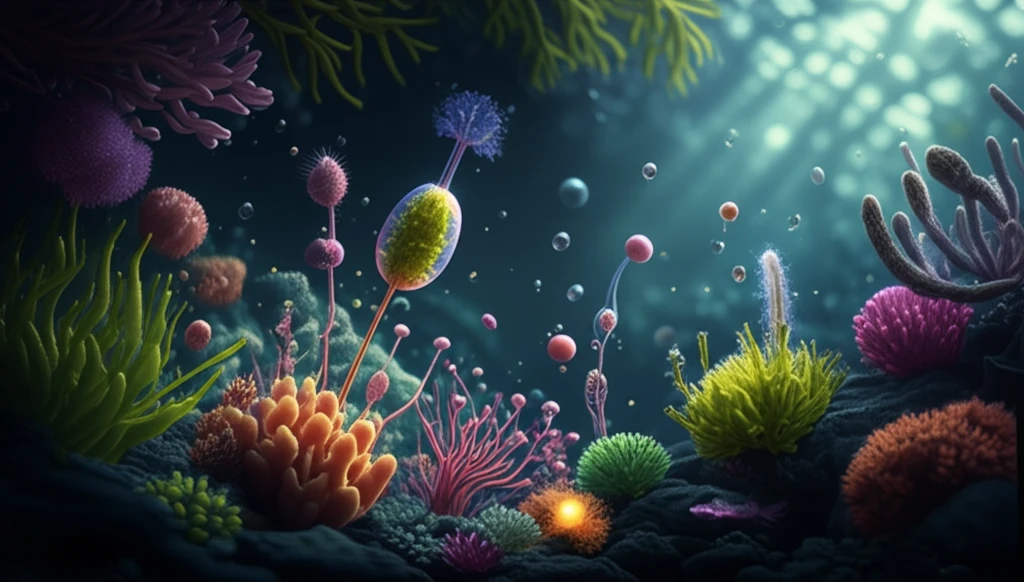
Hidden Wonders: Unveiling the Secrets of Microalgae in Our Ecosystems

"Tiny but mighty, microalgae play a crucial role in aquatic environments. Explore their diversity, ecological functions, and why they matter to our planet's health."
Microalgae are the foundation of many aquatic ecosystems, particularly in shallow lakes. Unlike larger aquatic plants, microalgae can quickly shift their dominance based on water conditions. These tiny organisms, both in the water column and on the sediment, are essential for linking inorganic compounds to the food web, providing vital nutrients to higher trophic levels.
In shallow estuaries, a fascinating phenomenon often occurs: high benthic microalgal biomass exists alongside low primary production and phytoplankton biomass, while pelagic areas boast high rates of primary production. This contrast highlights the complex interactions within these ecosystems, influenced by factors like light availability, grazing pressure from zooplankton, and the settling of phytoplankton cells onto the sediment.
The opening and closing phases of estuaries significantly impact microalgae populations. For example, during closed phases, diatoms may dominate phytoplankton communities, while open phases see an increase in dinoflagellates and cryptophytes. Nutrient availability and light penetration play critical roles in these shifts, underscoring the dynamic nature of these environments.
A Market on the Rise, Figures in Flux
Microalgae have grown into a multi-billion-dollar industry, though published estimates of its size vary considerably depending on the report. One 2026 research compilation places the market at roughly $6.8 billion with growth projected to reach $17 billion by 2030, while another report cites 3.4 million tons of microalgae produced in 2022 and forecasts a $9.2 billion market by 2030. A separate forecast, citing Data Bridge Market Research, arrives at a far smaller valuation of about $1.39 billion with a 6.4% CAGR from 2022 to 2030, illustrating how divergent these projections can be. On the environmental side, one report credits microalgae-based bioremediation in wastewater treatment with removing 5 million tons of nitrogen and 3 million tons of phosphorus in 2023. Across these sources, the industry is consistently described as large and growing, fueled by a combination of environmental and nutritional applications.
Established Cultivation Methods and Where They Fall Short
Standard approaches to microalgae production span functional food and nutraceutical development, biofuel generation, bioremediation, and CO2 capture, yet each method carries distinct trade-offs. In the biofuel space, researchers report that every production technique offers benefits and drawbacks, with ongoing work focused on improving efficiency and sustainability and reducing production costs. In air-quality applications, a review of microalgae-mediated removal of indoor volatile compounds notes that current evidence primarily supports the systems' promise but warns that future studies must report standardized performance indicators and verify mineralization through mass-balance or isotope-based approaches. Regulatory hurdles also loom, with the functional-food literature highlighting challenges around the safe consumption of microalgal bioactives. Recent innovations aim to address these limitations, such as a two-stage cultivation method developed at the Indian Institute of Technology Guwahati that reportedly improves CO2 capture, biomass production, self-harvesting efficiency, and bioenergy generation.
From 1890 Discovery to a Biodiverse Research Field
The scientific study of microalgae traces back more than a century, with one account crediting the first discovery of the cyanobacterium Chlorella vulgaris to Dr. Beijerinck in Germany in 1890. Its use as a model for studying plant physiology was then advanced by Warburg in the early 1900s. Microalgae themselves comprise a biodiverse group of photosynthetic organisms that live in water sources and sediments, according to a Frontiers in Plant Science overview. Today the field has expanded well beyond physiology labs, with modern work ranging from genetic tools for transgene expression to nutritional applications such as the University of Hohenheim's tasting studies, where volunteers sampled microalgae-based foods described as reminiscent of fish and nutritionally versatile.
Diversity and Ecological Significance of Microalgae
The diversity of microalgae in ecosystems like Lake St. Lucia is remarkable, reflecting the variety of habitats and environmental changes. While long-term quantitative studies are limited, the existing research reveals a complex community structure, especially among cyanobacteria and diatoms. These microorganisms form prominent benthic mats, particularly under hypersaline conditions, showcasing their resilience to extreme environments.
- Light Availability
- Nutrient Levels
- Salinity Fluctuations
- Grazing Pressure
Biotechnology Advances Across Sectors
Recent reviews frame microalgae biotechnology as spanning biofuels, environmental protection, aquaculture, and nutraceuticals, with molecular biology studies flagged as especially important to the latest developments. In the energy space, a review positions microalgae as a promising biofuel feedstock thanks to their rich energy content, rapid growth rate, inexpensive culture approaches, notable CO2 fixation capacity, and oxygen addition to the environment. Environmental applications are also advancing, as shown by a comprehensive review of microalgae-based removal of the antibiotic oxytetracycline that examines removal mechanisms, efficiency factors, and ecological implications. Taken together, the current literature presents microalgae as a flexible platform that is simultaneously being pushed forward on multiple applied fronts.
Technical Setbacks and Unresolved Limitations
For all the enthusiasm around microalgae, the record also includes notable failures and stubborn limitations. Microalgae-based bioregenerative life support systems were proposed decades ago for space missions but faced a variety of technical problems that hindered their application, even though recent research effort has produced significant progress. In medicine, therapeutic applications are constrained by immune clearance, and researchers argue that microalgae must be processed through various strategies to augment efficacy and mitigate that limitation. Even where promise is strong, such as in heavy metal remediation, the case rests on practical advantages like inexpensive growth requirements of solar light and CO2 and the ability to be used for multiple purposes simultaneously. These counterpoints are a reminder that scale, stability, and cost remain open questions rather than settled outcomes.
Microalgae vs. Fish, Supplements, and Markets
Comparative studies are increasingly measuring microalgae against the products they aim to displace. A comparative life cycle assessment of microalgae and fish species focused on nutritional profiles, particularly n-3 PUFAs and protein, as a way to evaluate microalgae's merits as a human food component. Other work compares microalgae-derived alternatives with established products such as fish oil supplements and conventional proteins, with recent empirical studies in Europe pointing to positive effects of certain labels and credentials. The regulatory landscape also differs sharply by region, with EU novel food regulations and US GRAS status both requiring investment in safety data and application dossiers. Sourcing comparisons between China, India, and the US, meanwhile, show distinct advantages in cost, technology, and regulation depending on a buyer's priorities.
Why Microalgae Matter
Understanding microalgae is crucial for maintaining healthy aquatic ecosystems. These tiny organisms play a significant role in primary production, nutrient cycling, and supporting complex food webs. By studying their diversity, ecological functions, and responses to environmental changes, we can better manage and conserve these vital components of our planet's ecosystems. Continuous monitoring and research are essential to uncovering further secrets of microalgae and harnessing their potential benefits.
What European Experts See Ahead
Synthesizing expert opinion, one study conducted a two-round Delphi analysis of European microalgae researchers', experts', and stakeholders' opinions and recommendations to help improve both microalgae research and marketing across the region. A related bibliometric analysis echoes the view that Europe holds high potential for microalgae research, innovation, and industrial development, bringing together a critical mass of expert researchers, companies, and technological platforms. Practical innovations are already emerging, such as the 'liquid tree' developed by UGM experts, a microalgae-based device whose producers report that microalgae can absorb up to 25 times more CO2 than other plants in the same area. Industry voices like biologist David Suárez highlight the concrete commercial track, with microalgae already being cultivated to produce Omega-3 for dietary supplements outside their natural marine habitat.
Projected Growth in Feed, Food, and Fuel
Forward-looking assessments describe the microalgae market as poised for significant growth, driven by rising demand across the food, feed, and biofuel industries. One industry report estimates the market will reach $5.20 billion with a 14.43% CAGR from 2025 to 2035, fueled by demand for natural pigments, proteins, and biofuels. Aquaculture stands out as a strategic driver, with reviews noting that microalgae are an irreplaceable food for aquatic animals such as mollusks, shrimps, and fish, especially in their early life stages. The outlook for the microalgae animal-feed segment specifically is described as promising, in line with growing consumer demand for natural and organic products.
Scale, Standardization, and Systemic Hurdles
Placing microalgae in a broader systemic context reveals that the sector's biggest obstacles are less about biology than about engineering and governance. A recent study on microalgae-mediated removal of indoor volatile organic compounds situates its findings within the wider microalgae-based wastewater treatment literature, which catalogs the mechanisms, challenges, recent advances, and future prospects of the field. That literature points to persistent challenges around performance validation, including the need for standardized indicators and verified mineralization in remediation claims. The systemic challenge, in other words, is translating lab-scale demonstrations into reliable, documented, and economically viable processes at real-world scale.
From Lab to Everyday Applications
Microalgae are increasingly moving from the laboratory into applications people actually encounter. With microalgae emerging as prime candidates for efficient and scalable biological CO2 capture, research is quantifying the real-world potential of large-scale cultivation systems, including case studies on the role of forests and algae in national CO2 balances. In marine settings, commercial use-cases align with global efforts to cut carbon emissions and transition to renewable energy sources. Marine microalgae also produce bioactive compounds with anti-inflammatory, antioxidant, and skin-healing properties that feed into pharmaceutical and cosmeceutical products. Meanwhile, processing research, such as work on separating lipids and proteins from microalgae lysates for microfiltration, underpins the industrial feasibility of turning biomass into marketable products.