
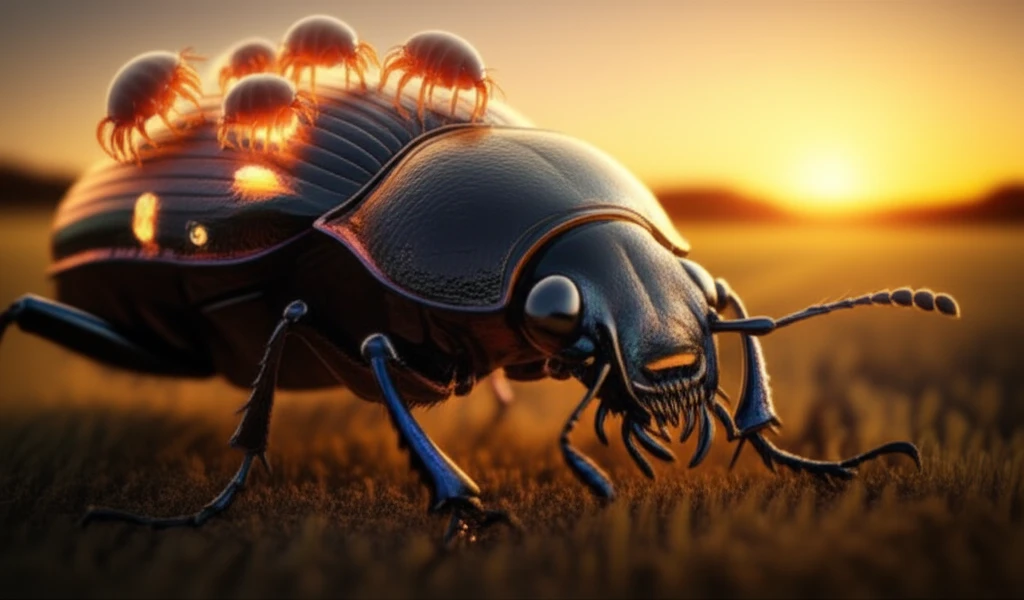
Hidden Hitchhikers: Unmasking the Mite World on Beetles

"A new study reveals the secret lives of mites parasitizing carabid beetles, including the first-ever description of the male Eutarsopolipus elongatus."
The world is full of hidden relationships, and some of the most fascinating occur on a scale too small for the naked eye. Podapolipidae mites, tiny creatures in the order Heterostigmata, live as permanent parasites on insects, particularly beetles. Among these, the genus Eutarsopolipus, boasts a diverse range of species, each uniquely adapted to its beetle host. Unlocking these relationships can tell us a lot about ecology and species evolution.
Carabid beetles, also known as ground beetles, are common in agricultural landscapes, where they play a role in pest control. These beetles can host mites from the Eutarsopolipus genus. Recent research has focused on Eutarsopolipus elongatus, a mite species previously known only from female specimens found in Europe. Now, a new study unveils its presence in Asia and describes the previously unknown male.
This article explores the world of Eutarsopolipus elongatus, detailing its discovery in northwestern Iran, the methods used to study it, and the implications of these findings. Get ready to zoom in on a miniature drama playing out on the backs of beetles.
Unveiling Eutarsopolipus elongatus: A Closer Look
Researchers collected carabid beetles (Amara aenea) from agricultural fields in Iran and carefully examined them for mites. These mites were then meticulously prepared and mounted on slides to be studied under a microscope. Detailed observations and measurements were taken to describe the physical characteristics of the mites, following established scientific terminology.
- Detailed descriptions: Meticulous documentation of the physical characteristics of adult females, larval females and males.
- Microscopic measurements: Precise measurements of body parts, setae (bristle-like structures), and other features.
- Illustrations: Detailed drawings to visually represent the mites' anatomy.
Why Mite-y Discoveries Matter
This research expands our understanding of mite biodiversity and the complex relationships between mites and their insect hosts. By describing the male Eutarsopolipus elongatus for the first time, the study fills a gap in our knowledge of this species.
Understanding these mite-beetle relationships can have implications for agriculture. Carabid beetles are important predators of crop pests, and the presence of mites could potentially affect their effectiveness. Further research is needed to explore the ecological consequences of these parasitic relationships.
The discovery of Eutarsopolipus elongatus in Asia highlights the importance of continued biodiversity research. There are likely many more undiscovered mite species and ecological interactions waiting to be unveiled. Each new discovery enhances our appreciation for the intricate web of life on Earth.