
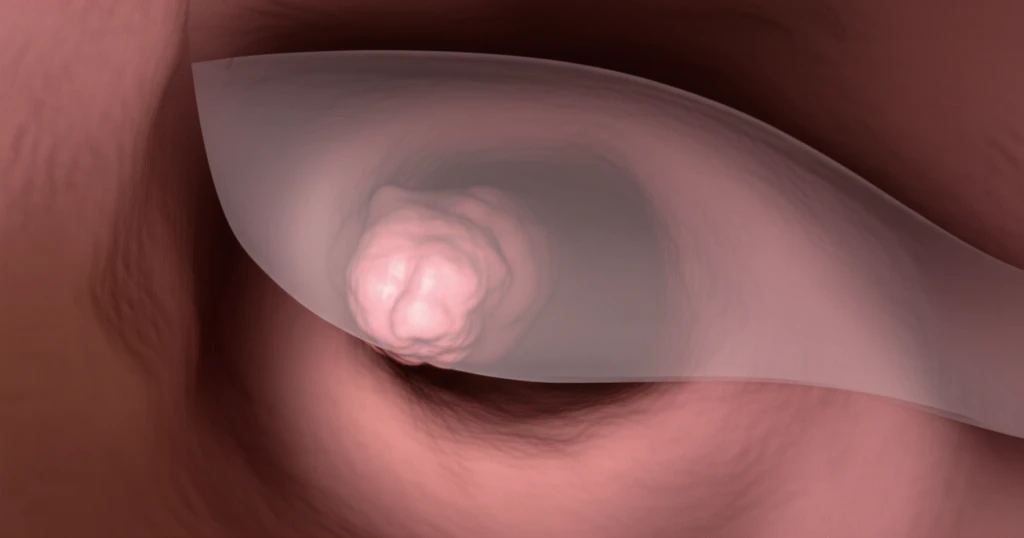
Hidden tumor revealed during a colonoscopy, underscoring the importance of vigilant screening.

Hidden Danger: When a Colonoscopy Reveals More Than Expected

"A routine colonoscopy can uncover unexpected findings, like a submucosal tumor, that require immediate attention. Understanding the implications can save lives."


Colonoscopies are a crucial screening tool for detecting abnormalities in the colon, including polyps and tumors. Often, these procedures provide reassurance and early detection, leading to timely treatment and better outcomes. However, sometimes, a colonoscopy can reveal unexpected findings that require immediate attention and further investigation.

One such instance involves the discovery of a submucosal tumor (SMT), a growth located beneath the inner lining of the colon. While many SMTs are benign, some can harbor malignancy. A recent case study highlights a scenario where a routine colonoscopy uncovered an adenocarcinoma presenting as a submucosal tumor, underscoring the importance of vigilant screening and comprehensive diagnostic approaches.

This article delves into the specifics of this case, exploring the diagnostic process, treatment strategies, and the broader implications for colon cancer screening. By understanding the nuances of such cases, both patients and healthcare providers can be better prepared to navigate unexpected findings and ensure optimal care.

The Unexpected Discovery: A Submucosal Tumor's True Nature

Hidden tumor revealed during a colonoscopy, underscoring the importance of vigilant screening.

A 64-year-old woman underwent a colonoscopy due to abdominal discomfort. The procedure revealed a small, protruded lesion measuring approximately 10 mm in the descending colon. Initially, the tumor appeared to be covered by normal-appearing mucosa, leading to a preliminary diagnosis of a submucosal tumor (SMT). Adjacent to the SMT, a small adenomatous polyp was also observed.

To accurately assess the nature of the SMT and address the coexisting polyp, the medical team performed an endoscopic submucosal dissection (ESD) to completely remove both lesions. Pathological examination of the resected tissue yielded a surprising result: the SMT was identified as a moderately differentiated tubular adenocarcinoma confined to the submucosal layer.

  • Initial Assessment: The tumor appeared benign during the colonoscopy.
  • Unexpected Diagnosis: Pathological examination revealed adenocarcinoma.
  • Coexisting Polyp: A small adenomatous polyp was present nearby.
  • Complete Resection: Endoscopic submucosal dissection (ESD) was performed.
Further analysis revealed that the adenocarcinoma was completely covered by non-neoplastic mucosa, and the coexisting polyp was a tubular adenoma. Histologically, there was no continuity between the adenocarcinoma and the adenoma, emphasizing their distinct origins. Genetic testing identified a rare frameshift mutation in both lesions, suggesting a shared precursor lesion despite their separate development.

Key Takeaways and the Importance of Vigilance

This case underscores the critical importance of thorough endoscopic examinations and pathological assessments, even when initial observations suggest a benign condition. The unexpected discovery of adenocarcinoma within a submucosal tumor highlights the potential for malignancy to be masked by normal-appearing mucosa. Regular colonoscopies, coupled with advanced diagnostic techniques, play a vital role in early detection and improved outcomes for colon cancer.

About this Article -

This article was crafted using a human-AI hybrid and collaborative approach. AI assisted our team with initial drafting, research insights, identifying key questions, and image generation. Our human editors guided topic selection, defined the angle, structured the content, ensured factual accuracy and relevance, refined the tone, and conducted thorough editing to deliver helpful, high-quality information.See our About page for more information.

Everything You Need To Know

1

What is a submucosal tumor (SMT) and why is it significant in the context of colonoscopies?

A submucosal tumor (SMT) is a growth located beneath the inner lining of the colon. While many SMTs are benign, some can harbor malignancy, making their identification and assessment crucial during a colonoscopy. The significance lies in the potential for these tumors to be cancerous, even when they appear benign upon initial examination. This underlines the importance of thorough diagnostic procedures and follow-up care to identify and treat any underlying malignancy, such as adenocarcinoma.

2

How can a seemingly benign submucosal tumor turn out to be cancerous, and what are the implications of this unexpected diagnosis?

A submucosal tumor (SMT) can appear benign during a colonoscopy because it may be covered by normal-appearing mucosa. However, as seen in the case study, pathological examination can reveal that the SMT is, in fact, adenocarcinoma, a type of cancer. The implications of this unexpected diagnosis are significant, as it necessitates immediate attention and further investigation to prevent the cancer from spreading. This can include endoscopic submucosal dissection (ESD) for complete removal and subsequent treatment based on the stage and characteristics of the cancer. Early detection and treatment are critical for improved outcomes.

3

What is the role of Endoscopic Submucosal Dissection (ESD) in the management of submucosal tumors (SMTs)?

Endoscopic Submucosal Dissection (ESD) is a technique used to completely remove lesions, such as submucosal tumors (SMTs) and polyps, from the colon. In the case study, ESD was performed to remove the SMT and an adjacent adenomatous polyp. The goal of ESD is to obtain a complete resection of the lesion, allowing for a thorough pathological examination to determine its nature. This helps to accurately diagnose the condition, such as confirming the presence of adenocarcinoma, and guide subsequent treatment strategies, such as further surgery or adjuvant therapy.

4

In the case study, what specific findings were crucial in understanding the nature of the discovered lesions?

Several findings were crucial in understanding the nature of the lesions in the case study. The initial observation during colonoscopy was a submucosal tumor (SMT) appearing benign. However, the subsequent pathological examination of the resected tissue revealed that the SMT was, in fact, a moderately differentiated tubular adenocarcinoma. Further, the presence of a coexisting small adenomatous polyp was noted. Genetic testing identified a rare frameshift mutation in both the adenocarcinoma and the adenoma, suggesting a shared precursor lesion despite their separate development. These findings highlighted the importance of thorough examination, accurate diagnosis, and advanced techniques like ESD.

5

Why are regular colonoscopies and advanced diagnostic techniques essential, especially when dealing with submucosal tumors?

Regular colonoscopies, coupled with advanced diagnostic techniques, are essential for several reasons. Firstly, they are a crucial screening tool for detecting abnormalities in the colon, including polyps and tumors, which often provide reassurance and early detection, leading to timely treatment and better outcomes. Secondly, when a submucosal tumor (SMT) is discovered, it's vital to use advanced techniques like endoscopic submucosal dissection (ESD) for complete removal and a thorough pathological assessment. These techniques allow for a precise diagnosis, identifying even small areas of malignancy, such as adenocarcinoma, that might be missed with less thorough approaches. Early detection and precise diagnosis are key for effective treatment and improved survival rates for colon cancer.

Newsletter Subscribe

Subscribe to get the latest articles and insights directly in your inbox.