
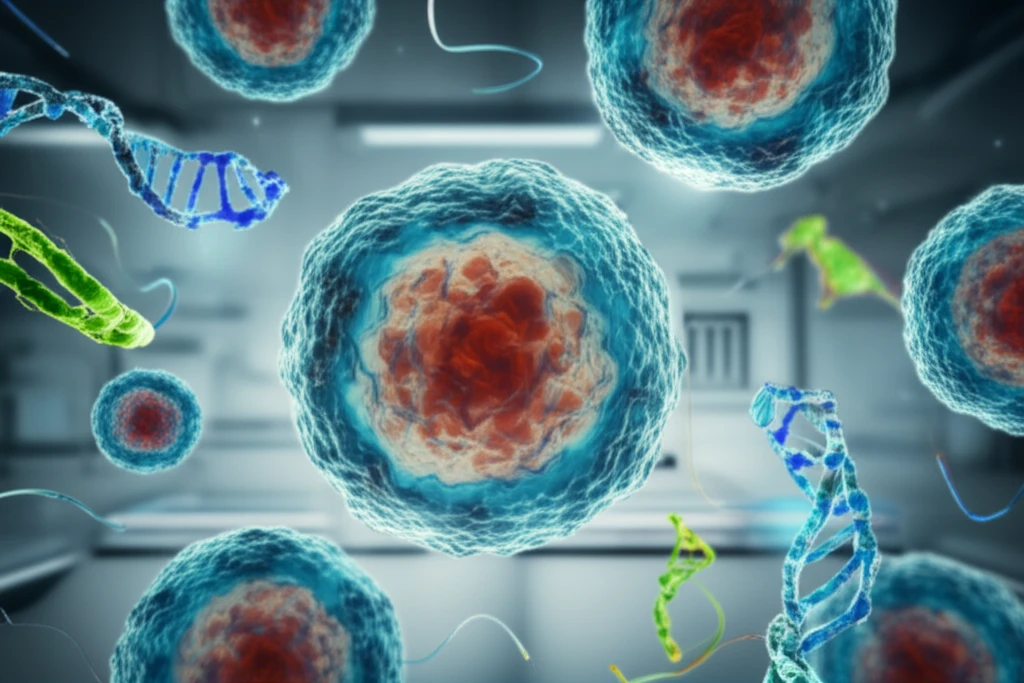
HepG2 Cells: Are 3D Spheroids the Future of Liver Toxicity Testing?

"Exploring how 3D cell cultures could revolutionize drug safety assessment."
For decades, the pharmaceutical industry has grappled with the challenge of accurately predicting drug-induced liver injury (DILI) during preclinical development. Traditional methods often fall short, leading to costly clinical failures and potential risks to patients. This has spurred a search for more reliable in vitro models that better mimic the complexities of the human liver.
One promising avenue of research involves the use of three-dimensional (3D) cell cultures, specifically spheroids, which are aggregates of cells that more closely resemble the structure and function of real tissues than traditional two-dimensional (2D) monolayers. Among the cell types used in these 3D cultures, HepG2 cells, a well-established human liver cell line, are frequently employed.
A recent study published in Toxicology Letters investigates the proteomic responses of HepG2 cells grown in both 2D and 3D cultures when exposed to various hepatotoxins. By comparing the protein profiles of these cells, researchers aimed to determine whether 3D spheroids offer a more physiologically relevant model for assessing liver toxicity and predicting drug safety.
2D vs. 3D: Unraveling the Proteomic Puzzle
The study meticulously compared the proteomes of HepG2 cells cultured as conventional monolayers and as 3D spheroids. Proteomics, the large-scale study of proteins, provides a comprehensive snapshot of cellular activity and function. The researchers used sophisticated techniques to identify and quantify thousands of proteins in both culture types, revealing significant differences in their protein expression patterns.
- Increased abundance of liver-specific proteins: 3D spheroids exhibited higher levels of alpha-fetoprotein, alpha-2-HS-glycoprotein, and serum albumin, all of which are indicative of a more mature hepatic phenotype.
- Altered cytoskeletal arrangement: Proteins involved in cell structure and organization, such as keratins and tubulins, were also more abundant in 3D spheroids, reflecting the distinct morphology and cell-cell interactions within these cultures.
- Inconsistent proteomic transitions: Despite the overall differences, the researchers noted variability in the proteomic changes across different replicates of the 3D spheroid cultures. This suggests that the process of spheroid formation and maturation can be somewhat inconsistent, leading to diverse cellular phenotypes.
The Future of Liver Toxicity Testing: A 3D Perspective
The study underscores the potential of 3D HepG2 cell cultures as a valuable tool for liver toxicity testing. By more closely mimicking the in vivo environment, these spheroids offer a more nuanced and physiologically relevant model for studying drug-induced liver injury.
However, the research also highlights the challenges associated with 3D cultures, particularly the variability in proteomic transitions during spheroid formation. To overcome this limitation, the authors suggest that optimizing the duration of spheroid culture may be essential to achieve reproducible proteomic transitions and establish a stable 3D spheroid phenotype.
As technology advances and our understanding of cellular behavior deepens, 3D cell cultures are poised to play an increasingly important role in preclinical drug development, ultimately leading to safer and more effective therapies.